
PRA Group Strengthens Collections and Capital Discipline Amid Stable Portfolio Supply
Global specialty finance firm PRA Group reports solid Q2 2026 results, underscored by disciplined portfolio purchasing and robust cash collections across diversified geographies.
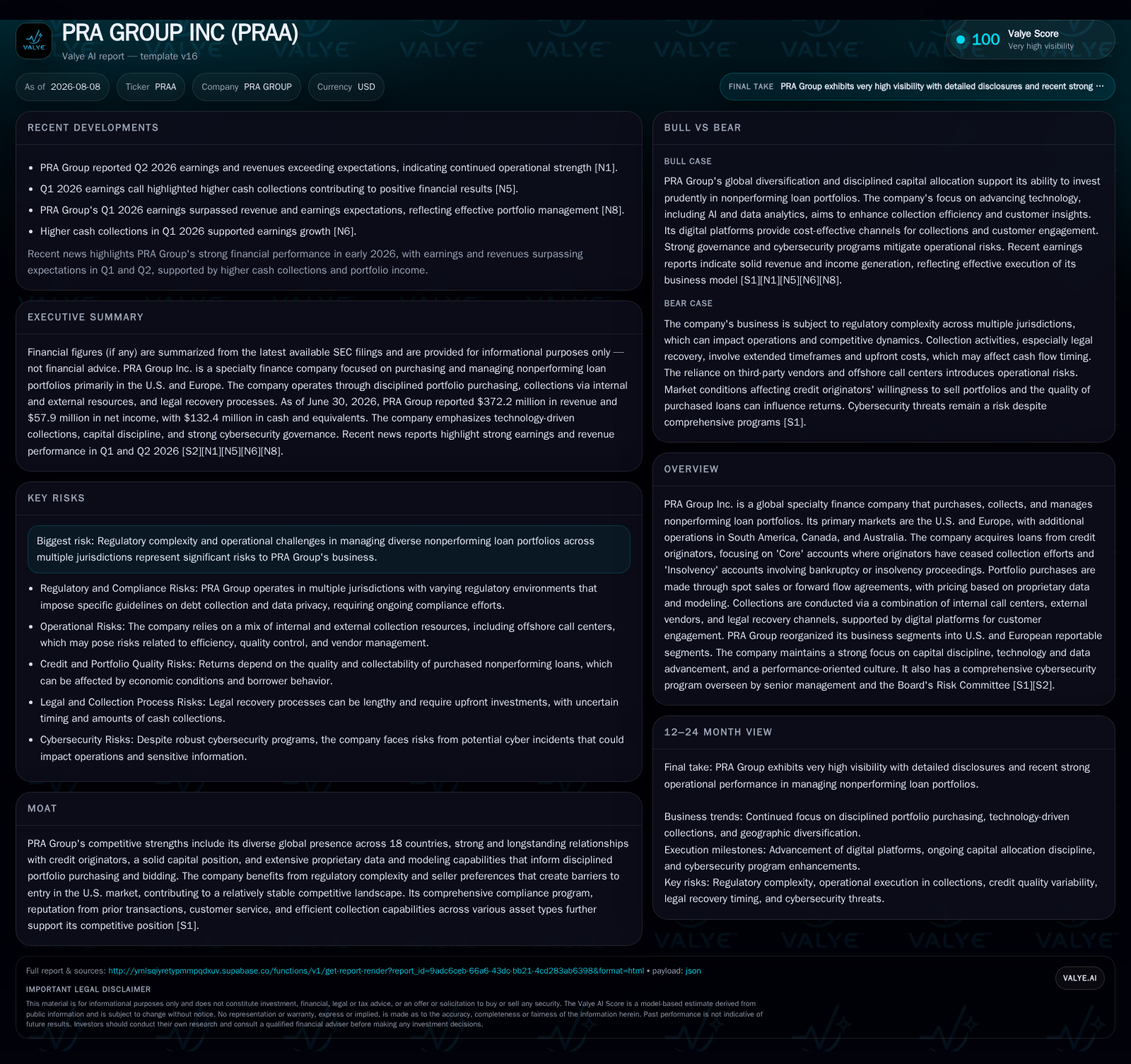
PRA Group continues executing its strategic plan, boosting cash collections and net income in Q2 2026 while maintaining capital discipline and expanding its portfolio purchases. The company’s global operating model, anchored in the U.S. and Europe with smaller footprints in South America, Canada, and Australia, leverages proprietary data modeling to price nonperforming loan portfolios. Despite persistent regulatory and operational risks inherent in managing diverse distressed debt assets, PRA’s geographic diversification and strong seller relationships support steady growth opportunities through forward flow contracts and disciplined collection strategies. Monitoring collection efficiency, portfolio aging, and capital allocation will be key to tracking execution efficacy moving forward.
Recent Operating Update: Q2 2026 Highlights
PRA Group’s second quarter 2026 report reflects ongoing execution against its multi-year PRA 3.0 strategic plan aimed at optimizing portfolio investing and operational efficiency. The firm purchased $296.6 million in nonperforming loan portfolios during the quarter, up from prior quarters but reflecting careful discipline on purchase pricing that factors proprietary data analytics on recoverability and cost to collect [S2]. Cash collections demonstrated growth driven by improved contact rates via internal call centers complemented by external vendor networks and legal recovery channels tailored by geography [S2]. Net income saw an uptick compared to prior periods, illustrating operational leverage despite a challenging regulatory landscape across jurisdictions where PRA operates [N1][S2]. This recent financial picture confirms that portfolio acquisitions remain opportunistic yet disciplined with capital allocation tightly managed through established risk-return thresholds.
Business Model: Nonperforming Loan Acquisition and Collection
PRA Group is a specialty finance company focused primarily on acquiring portfolios of nonperforming loans from credit originators — predominantly banks and finance companies — that have either ceased or failed to fully collect balances (‘Core’ accounts). A smaller portion involves purchasing loans tied to insolvency or bankruptcy proceedings (‘Insolvency’ accounts) where the company actively manages claims under legal insolvency frameworks like IVAs or Trust Deeds mainly in the UK, Canada, Germany, and the U.S. [S1].
Revenue originates largely from the spread between discounted purchase prices of these debt portfolios and subsequent collections realized over extended periods. Portfolio acquisition occurs via spot sales or forward flow agreements—pre-arranged contracts supplying portfolios over six to twelve months at negotiated prices based on account eligibility criteria [S1]. Forward flow contracts provide PRA with recurring supply visibility while allowing repricing if portfolio quality deteriorates.
Collection strategies blend multiple channels optimized per region: internal call centers drive direct customer engagement informed by proprietary credit modeling; third-party vendors supplement outreach efforts; legal recovery teams pursue judicial enforcement when warranted. Technology platforms facilitate payment processing and customer digital interactions to enhance collection yields [S1].
Critical operating KPIs include purchase volume tracked by segment (Core vs Insolvency), collection yield (cash collected relative to portfolio face value), cost-to-collect ratio balancing operational expenditure against recoveries, portfolio aging patterns signaling asset quality shifts, contract terms for forward flows reflecting supply certainty, and recovery rates especially on insolvency accounts that require legal claim management expertise.
Industry Structure and Competitive Position
The market for nonperforming loan acquisition is competitive but characterized by high barriers due to regulatory complexity across countries and seller preferences for experienced buyers with proven compliance programs. PRA benefits from a broad global footprint spanning 18 countries with principal operations in the U.S. and Europe complemented by smaller-scale presence in South America, Canada, and Australia—a geographic diversification that mitigates regional economic or regulatory shocks [S1]. This scale contributes to robust seller relationships enabling access to preferred deals including exclusive spot sales or forward flow arrangements that competitors may not secure.
Competitors encompass other specialty finance firms such as Encore Capital Group specializing in consumer receivables buying/collection; large institutional investors like Blackstone Credit involved in sizable distressed debt investments; plus traditional collection agencies focusing on servicing but without ownership of loan portfolios. PRA positions itself distinctively through its balance of portfolio acquisition expertise paired with efficient omni-channel collection infrastructure supported by advanced analytics.
The company’s capital discipline ensures measured leverage aligned to expected returns from purchased portfolios while preserving financial flexibility—a contrast to peers potentially overextending credit facilities or aggressively expanding purchase volumes without proportional yield enhancement.
Growth Drivers
Several structural forces provide a foundation for sustained demand for PRA’s core services:
- Stable volume of charge-offs: While macroeconomic conditions fluctuate, charged-off consumer credit card debt, auto loans, overdrafts, and small business loans continue flowing into secondary markets where originators divest nonperforming assets.
- Forward flow agreements: These contracts establish predictable sourcing pipelines allowing PRA to deploy capital efficiently while managing exposure through quality-based repricing clauses.
- Data analytics enhancements: Ongoing improvements in proprietary modeling refine bid pricing accuracy for portfolio acquisitions capturing nuanced asset characteristics which can improve net returns.
- Regulatory landscape: Complex compliance requirements create entry barriers protecting incumbent operators; supportive environments favor originating institutions’ willingness to sell off distressed assets rather than manage costly collections internally.
- Technology adoption: Deploying digital communication tools alongside traditional call center methods increases contact rates improving collection yields gradually while controlling cost structures.
- Ancillary fee-based services: Expansion into class action claims recoveries introduces supplementary revenues supporting diversification.
Risks / Watchpoints / Growth Constraints
PRA operates within a regulated domain subject to evolving laws impacting permissible collection methods across disparate jurisdictions requiring constant compliance vigilance [S1]. Legal challenges remain an ongoing concern given frequent litigation initiated by consumers or regulators alleging unlawful collection practices potentially resulting in fines or reputational damage. Reaction time within legal risk management will be critical.
Macroeconomic risks also influence borrower repayment capacities—rising inflation or geopolitical instability (e.g., Middle East conflicts elevating energy prices) may impair debtor cash flows thus diminishing recovery rates threatening overall portfolio yield stability highlighted as a watchpoint [S7][S12]
Capital availability dictates growth pace given portfolio purchases require upfront outlays funded via revolving credit facilities or senior notes; maintaining optimal leverage ratios is vital amid fluctuating financing conditions [F1].
This leverage position supports prudent capital management consistent with the company's targeted operating thresholds under global credit facility covenants.
Net income improvements during Q2 coupled with increased cash collections reflect favorable operating leverage despite elevated regulatory compliance expenses characteristic of the industry. No investment advice is provided herein.
Disclaimer: This is research-only, informational analysis and not investment advice. It may include AI-generated interpretation and general industry context. Always verify important details using primary sources.

Comments