
Aspen Aerogels Advances Thermal Barrier Leadership Amid Customer Concentration and Capital Needs
Aspen Aerogels maintains growth momentum in electric vehicle and energy industrial insulation markets despite operational setbacks and concentrated revenue exposure.
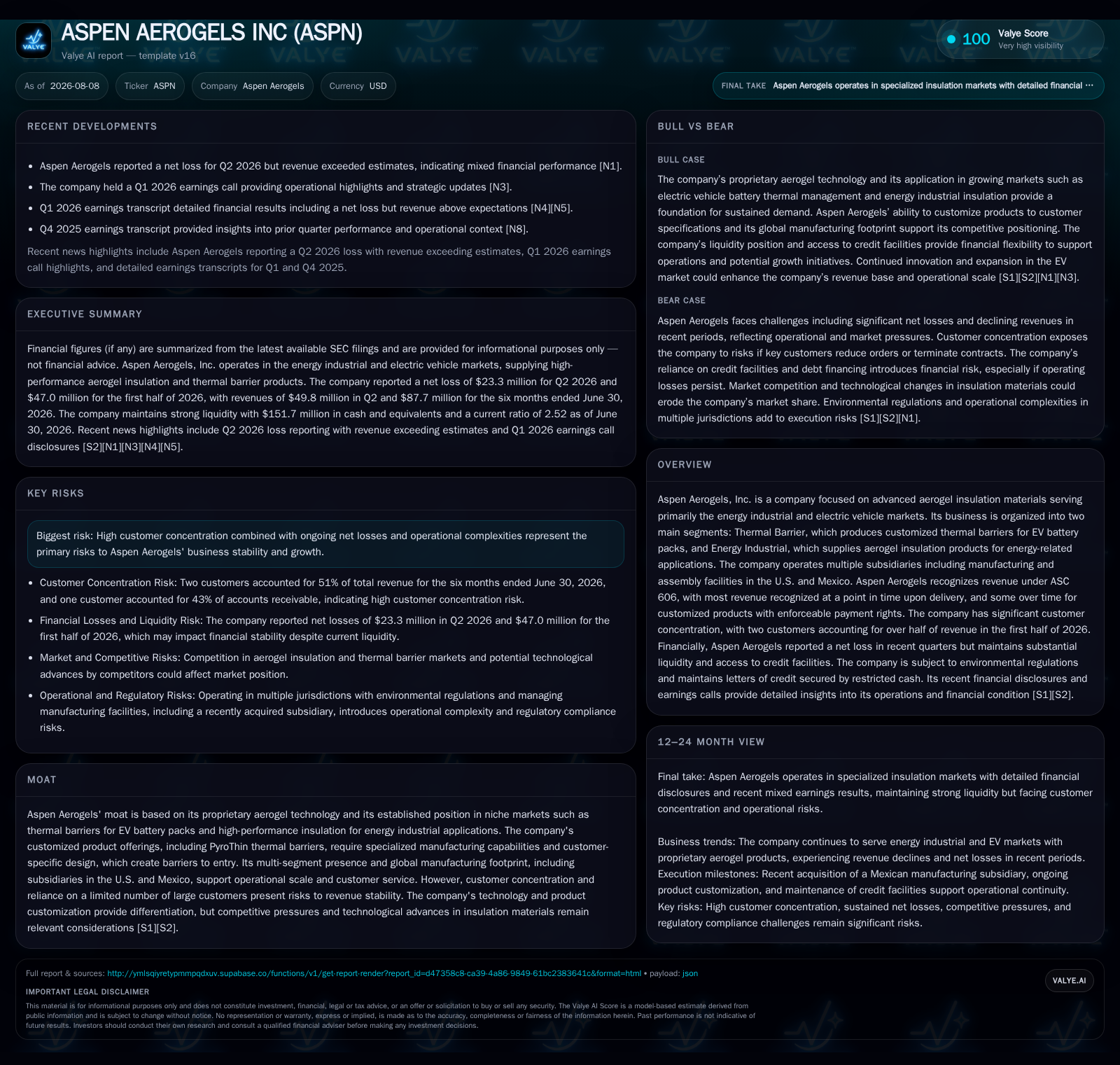
Aspen Aerogels, a specialist in aerogel-based thermal barriers for electric vehicle battery packs and energy industrial insulation, reported solid revenue performance in its second quarter of 2026 while continuing to operate at a net loss. The company’s proprietary technology and customized product designs underpin its competitive moat, but a high concentration of revenue from two customers introduces notable risks. Its manufacturing footprint across the U.S. and Mexico supports operational scale, though an April 2026 manufacturing incident caused temporary disruptions. Financially, Aspen holds a healthy cash position but expects to require additional funding sources to support long-term growth investments.
Recent Operating Update Highlights
Aspen Aerogels’ latest quarterly filing (10-Q dated August 7, 2026) reveals the company continues navigating a complex operating landscape marked by robust demand mixed with operational disruptions. Despite an April 2026 explosion at its East Providence manufacturing facility that led to partial cessation of production and damage to equipment, production resumed with expected insurance recoveries mitigating the financial impact [S2]. The event underscores operational risk inherent in complex aerogel manufacturing but also highlights Aspen's resilience.
Financially, Aspen reported consistent revenues supported largely by thermal barriers for electric vehicle (EV) battery packs and insulation materials for the energy industrial segment. Notably, the Company disclosed that two customers accounted for more than half of the revenue in H1 2026 [S2], emphasizing persistent customer concentration which raises credit risk considerations despite ongoing evaluation practices.
Management signaled confidence that current cash reserves of approximately $152 million will support operational requirements and capital expenditures related to sustaining their existing markets across EVs and energy industrial sectors for at least the next twelve months [S2]. However, to fuel long-term growth ambitions—including potential capacity expansions and R&D investments—Aspen anticipates supplementing these funds via operating cash flows complemented by equity or debt financing alternatives alongside sale-leaseback arrangements or governmental support programs
A simultaneous Regulation FD disclosure accompanying an August 6 press release reiterated this financial outlook without updating explicit guidance but confirmed continuity of strategy stressing innovation-led market penetration plus proactive capital structure management [S3][N1]
Business Model Insights
Aspen Aerogels operates predominantly in two key segments: Thermal Barrier solutions focused on highly-engineered PyroThin® aerogel products designed specifically for EV battery packs; and Energy Industrial segment supplying varied aerogel insulation products adaptable to oil & gas pipelines, refineries, power plants, and sustainable construction applications. These product lines rely heavily on proprietary nanotechnology that creates ultralightweight yet thermally efficient materials offering superior performance compared to conventional insulation alternatives [S1].
Revenue generation follows ASC 606 standards wherein most sales conclude at point-of-delivery recognizing immediate revenue; however, bespoke projects—especially those involving customized thermal barrier assemblies—employ over-time recognition aligned with enforceable payment rights [S1][S2]. This reflects typical project-based monetization structures common in advanced materials sectors serving OEMs or large infrastructure contractors with infrequent repeat transactions but sizable order volumes per contract
The company channels sales chiefly through insulation distributors, fabricators specializing in technical material integration, insulation contractors servicing energy-industrial clients, as well as direct relationships with select automotive OEMs. This network architecture demands stringent customer service capabilities combined with technical customization expertise driving switching costs favorable to Aspen yet creating operational complexity given bespoke order specifications and scale-up challenges.
Manufacturing activities span dedicated U.S. facilities supplemented by operations in Mexico enabling cost efficiencies and supply chain flexibility. Despite this footprint advantage providing some geographic diversification benefits within North America’s core markets, capacity constraints amplified temporarily by the recent factory incident indicate monitoring utilization rates will be crucial going forward.
Industry Structure and Competitive Position
Aspen aerogels competes within the advanced materials domain focusing narrowly on high-performance insulation leveraging aerogel technology—a segment characterized by significant barriers related to R&D intensity, proprietary formulations, complex manufacturing processes requiring cleanroom conditions or specialized handling techniques.
Peers range across industrial insulation suppliers transitioning into advanced materials (e.g., Owens Corning’s specialty products), electric vehicle component manufacturers incorporating thermal management systems (like BorgWarner), providers of energy infrastructure materials (such as Rockwool), as well as niche aerogel developers producing competing formulations. However, Aspen's differentiation lies in its vertically-integrated design-to-manufacturing capabilities enabling highly customized PyroThin® solutions tightly integrated into EV battery packs—an increasingly strategic component as automakers seek weight-saving thermal management balancing safety and range extension.
In addition to IP protection via patents covering unique chemical formulations and assembly techniques of their aerogels and barrier products, Aspen benefits from established relationships with major industry players creating switching costs combined with technically demanding fitment requirements. This dynamic generates a defensible moat but amplifies risk if these key customers consolidate supply bases or develop internal alternatives occurring especially amid accelerating EV innovation.
Growth Drivers
The global push toward electrification represents a structural growth driver compelling heightened adoption of advanced thermal barriers due to stringent safety standards regulating battery temperature control under diverse conditions. Aspen's PyroThin® technology addresses these demands by offering thin-profile yet effective thermal insulation reducing overall pack weight improving vehicle efficiency while safeguarding against thermal runaway events.
Concurrently, tightening energy efficiency regulations across industries propel upgrades in industrial insulation systems reducing heat loss from pipelines or process vessels where Aspen's aerogel blankets deliver performance advantages over traditional mineral wool or foam insulations.
Technological progress favoring lightweight construction across automotive and industrial sectors fuels solvent demand which Aspen strives to capture via continued product innovation pipeline supported by R&D investment increasing relative spending highlighted semiannually [S1]. Moreover government incentives aligned with clean energy transitions potentially enhance funding availability – a facet management referenced as potential supplementary capital source contributing toward moderate balance-sheet flexibility.
Risks and Watchpoints
Despite technological strengths underpinning its moat, Aspen faces considerable risks primarily stemming from pronounced customer concentration—two customers constituting over half total revenues pointing toward substantial dependency risk that could disrupt revenue stability if contractual terms shift unfavorably or demand fluctuates unexpectedly.
Moreover, the company has reported continuing net losses reflecting elevated fixed costs intrinsic to advanced-materials scale-up including manufacturing overheads compounded recently by the East Providence incident disrupting throughput. Sustained losses necessitate careful capital allocation management whilst scaling operations sustainably without undermining liquidity runway. Market competitiveness remains intense with evolving substitute materials challenging price positioning while rapid innovation cycles could erode product distinctiveness absent agile R&D advancement.
Operationally scaling production capacity without repeat incidents is critical; post-incident recovery trajectory including restoration of production space utilization will be a key milestone influencing near-term delivery promises crucial under project-based contracts.
What To Watch Next
Investor attention should focus closely on quarterly updates disclosing:
- Production ramp status post-April 2026 facility incident including capacity utilization improvements,
- Trends in order backlog for customized EV battery pack thermal barriers signaling tangible demand momentum,
- Revenue composition shifts especially concentrations across top customers or new client acquisitions,
- Gross margin trajectory reflecting raw material cost fluctuations or pricing pressure,
- Cash flow from operations indicating progress toward positive free cash flow alongside announced capital raising progress,
- R&D expenditure pacing relative to sales transformation hinting at future product innovation pipeline vitality,
- Potential government grant or financing arrangements securing non-dilutive capital supporting scale-up.
No explicit quantitative guidance was provided recently; thus close scrutiny of these KPIs within subsequent filings will be instrumental to measuring execution efficacy against strategic growth plans.
Financial Profile Discussion
Aspen Aerogels’ financial position reflects typical characteristics of growth-stage advanced materials firms investing heavily in technology commercialization amid nascent market adoption phases. Ending Q2 2026 with approximately $152 million in cash equivalents affords comfortable short-term liquidity with a strong current ratio of approximately 2.52, indicating good working capital health relative to current liabilities near $98.6 million [F1][S2]
Management acknowledges the need for supplemental equity or debt issuances alongside alternative financing mechanisms such as sale-leasebacks demonstrating prudent financial policy aiming at balanced growth funding structures [S2]. Tracking operating cash flow progression will be critical to assessing pathway toward self-sufficient financing reducing external dependence.
Overall financial profile reinforces a conditionally stable foundation coupled with clear capital needs tied directly to ambitious growth objectives within expanding EV and energy industrial end-markets requiring substantial up-front investment before economies of scale significantly improve margins.
This analysis is based solely on publicly available SEC filings dated through August 7, 2026 including Aspen Aerogels’ Form 10-Q and related disclosures along with contextual industry knowledge. It does not constitute investment advice or research views.
Disclaimer: This is research-only, informational analysis and not investment advice. It may include AI-generated interpretation and general industry context. Always verify important details using primary sources.

Comments