
American Healthcare REIT Leverages RIDEA Structure for Operational Growth amid Sector Challenges
American Healthcare REIT’s Q2 2026 report highlights stable occupancy and operational income via its RIDEA model, while risks around tenant credit and geographic concentration remain.
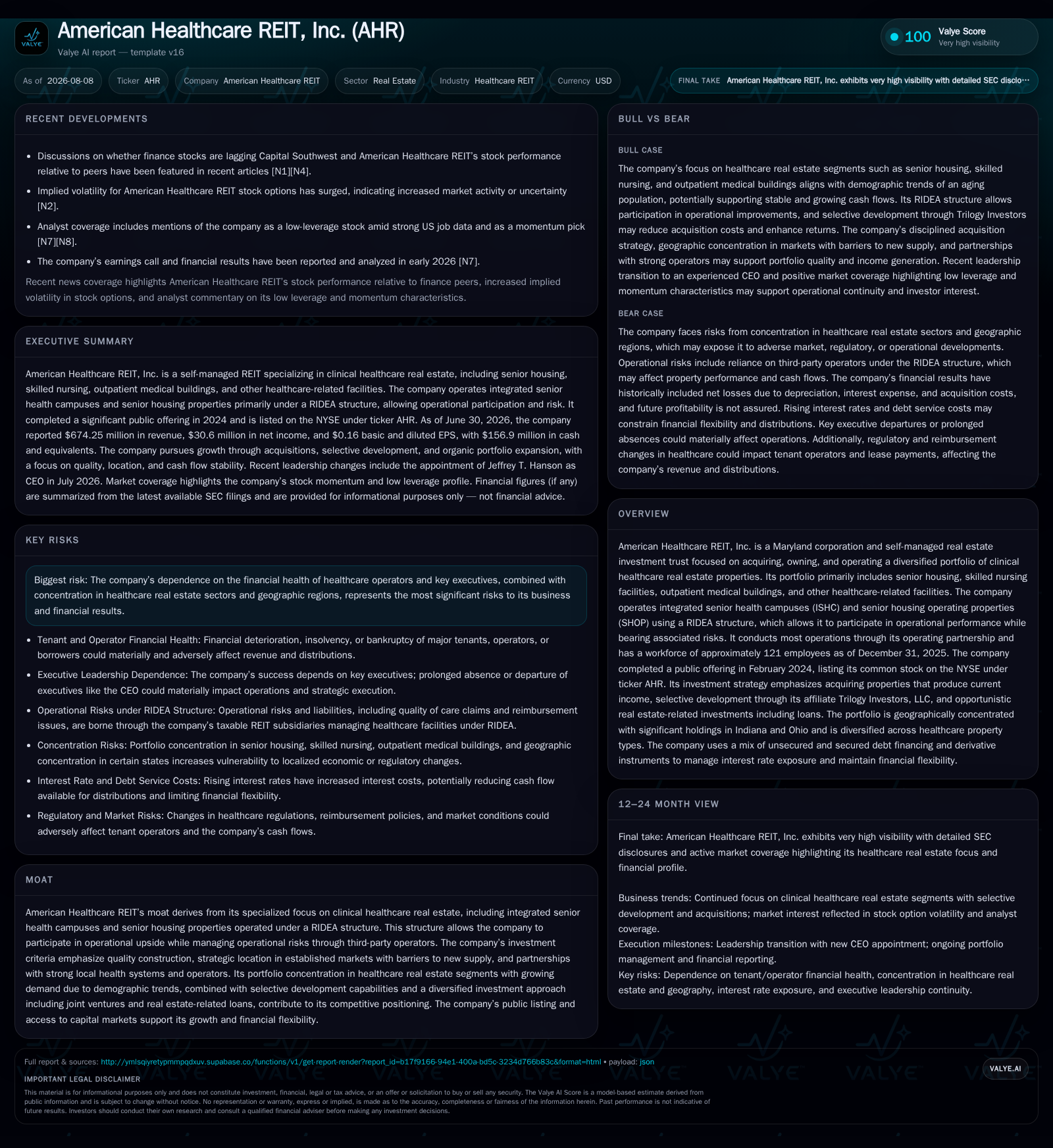
In its latest quarterly filing, American Healthcare REIT (AHR) demonstrates continued operational stability driven by its participation in operational performance through the RIDEA structure, anchored by Integrated Senior Health Campuses (ISHC) and Senior Housing Operating Properties (SHOP). The company’s unique dual revenue model—from rental income and operational cash flows—provides differentiated exposure compared to peers relying solely on triple-net leasing. However, AHR faces persistent risks from operator financial health vulnerabilities and geographic concentration, necessitating close monitoring of tenant credit quality and regulatory developments. Its balance sheet remains well-positioned with moderate leverage and liquidity to support growth initiatives.
Q2 2026 Performance Spotlight: Navigating Operational Income within RIDEA Structures
American Healthcare REIT’s most recent quarterly filing (Q2 2026) underscores the importance of its dual revenue streams—rental income augmented by operating income participation through the RIDEA structure ([S2], [S3]). The company reported stable occupancy trends across its Integrated Senior Health Campuses (ISHC) and Senior Housing Operating Properties (SHOP), which form the backbone of its portfolio mix. These properties do not operate under traditional triple-net leases but rather under RIDEA agreements that enable AHR to share in operating cash flow generated by tenants while assuming some operational risk.
This participation positively impacts revenue diversification but requires continuous oversight of operator performance. The reported operational income contribution confirms that while the company benefits from upside when facilities perform well, it also bears some risk case if operators face challenges—a distinct dynamic compared to peers primarily focused on triple-net lease structures where landlords receive fixed rent irrespective of operator outcomes. Stability in occupancy coupled with resilient operating income signals that operator financial health remains sufficient currently but emphasizes the need for vigilant credit risk management during sector pressures.
Strategic Portfolio Composition: Concentration in ISHC and Senior Housing as a Competitive Moat
American Healthcare REIT’s competitive moat is closely linked to its focused portfolio predominantly composed of ISHCs and senior housing properties operated via RIDEA ([S1], valye_report_excerpt). This specialization offers barriers related to property quality criteria—emphasizing established market locations, quality construction, and partnerships with reputable health systems—which create entry barriers for competitors.
The integrated campus model allows AHR to capture synergies between physical assets and service delivery operations, potentially enhancing long-term value appreciation beyond pure real estate plays. However, concentration in these segments introduces sensitivity to demographic shifts favoring aging populations alongside regulatory risks specific to senior care licensing and reimbursement regimes. Geographic concentration within select U.S. markets compounds risk exposure; adverse developments in any key region could disproportionately affect cash flows. Thus, the portfolio's strategic composition confers differentiated growth potential tempered by identifiable concentration risks.
Industry Context: Healthcare Real Estate Dynamics Shaping AHR’s Competitive Positioning
Within the broader healthcare REIT landscape occupied by players like Welltower and Ventas, American Healthcare REIT distinguishes itself through active operational engagement via the RIDEA structure rather than dependence solely on fixed triple-net leases (, [S1]). This provides potential for superior returns through participation in facility-level profitability but introduces complexities including greater sensitivity to operator creditworthiness and compliance with healthcare regulations.
Healthcare real estate demand is heavily influenced by regulatory factors such as Medicare/Medicaid reimbursement policies and state certificate-of-need (CON) laws affecting supply. These requirements can restrict new facility development maintaining favorable supply-demand dynamics aligned with aging-driven demand growth. Nonetheless, they also heighten uncertainty around tenant viability since changes in reimbursement or licensure can impair operators’ ability to generate sufficient cash flows. AHR’s positioning between capital provision and healthcare operations requires balancing this risk-return tradeoff carefully.
Growth Catalysts: Development Pipeline and Capital Market Access Supporting Expansion Opportunities
Growth strategy centers on opportunistic development complemented by acquisitions funded through capital markets access ([S1], valye_report_excerpt). Through Trilogy Investors LLC, AHR selectively develops healthcare properties—especially within its ISHC portfolio—to capitalize on favorable supply constraints in senior living sectors. Public equity raised during the February 2024 offering provides a timely liquidity platform enabling disciplined expansion without overreliance on debt financing.
This approach targets incremental earnings accretion through property improvements or new developments that meet stringent quality benchmarks. The limited new supply environment due to regulatory barriers supports rent growth potential over time. Consequently, the development pipeline represents a meaningful lever for future funds from operations (FFO) improvement if executed effectively.
Risks Highlighted: Tenant Credit Health, Geographic Concentration, and Regulatory Volatility
As flagged repeatedly in filings ([S1], [S2], valye_report_excerpt), tenant insolvency risk constitutes a principal threat given AHR’s partial operational risk exposure under RIDEA agreements. Lease defaults or terminations would directly reduce distributions capacity.
Additionally, geographic concentration magnifies vulnerability: adverse regional economic or regulatory shifts could impact multiple properties simultaneously. State CON laws can alter market dynamics rapidly by changing development feasibility or tenant licensing status. Moreover, ongoing industry litigation risks tied to resident care quality pose financial liability concerns potentially affecting operators’ sustainability.
Inflationary pressure on capital expenditures may compress margins if operators cannot offset cost increases via higher rents or operational efficiencies. Management must continue close monitoring of these multi-dimensional risks.
"Indicator Watch": Key Metrics to Monitor in Upcoming Quarters for Confirmation or Challenge of Outlook
The near-term outlook depends critically on several measurable KPIs ([S2], [F1]): occupancy rates remain a frontline gauge of asset utilization; sustained or rising levels support stable rental revenue bases.
Monitoring lease renewal rates provides early insight into tenant satisfaction and future cash flow visibility. Critical too is tracking tenant creditworthiness through updated financial reviews given operational revenue linkage via RIDEA.
FFO trends will confirm whether expanded operational participation delivers accretive earnings as intended. Balanced leverage ratios relative to equity underpin financial flexibility; deteriorating interest coverage would indicate pricing pressures or weakening income quality.
Close attention will be paid to any shifts in these metrics signaling emerging headwinds or validating management’s execution path.
Financial Profile Discussion: Leverage Management and Cash Position Enhancing Flexibility Amid Rising Interest Rates
American Healthcare REIT posted approximately $890 million in total debt against nearly $157 million in cash equivalents as of June 30, 2026 ([F1]), yielding a net debt position near $733 million. This moderate leverage level aligns with industry norms for healthcare-focused REITs balancing yield generation against financing risk amid macroeconomic volatility.
Capital structure policies include use of both secured mortgage loans and unsecured lines of credit ([S4], [S5]), combined with derivative instruments for interest rate hedging to dampen expense volatility. Readers should interpret forward-looking assessments cautiously given inherent sector regulatory complexity and operator interdependence unique to RIDEA-based models.
Disclaimer: This is research-only, informational analysis and not investment advice. It may include AI-generated interpretation and general industry context. Always verify important details using primary sources.

Comments