
FedEx Freight's Scale and Technology Position It as North America’s Leading LTL Carrier Post-Spin-Off
Following its June 2026 spin-off, FedEx Freight leverages its expansive network and digital platform to pursue margin growth amid industry cyclicality and high leverage.
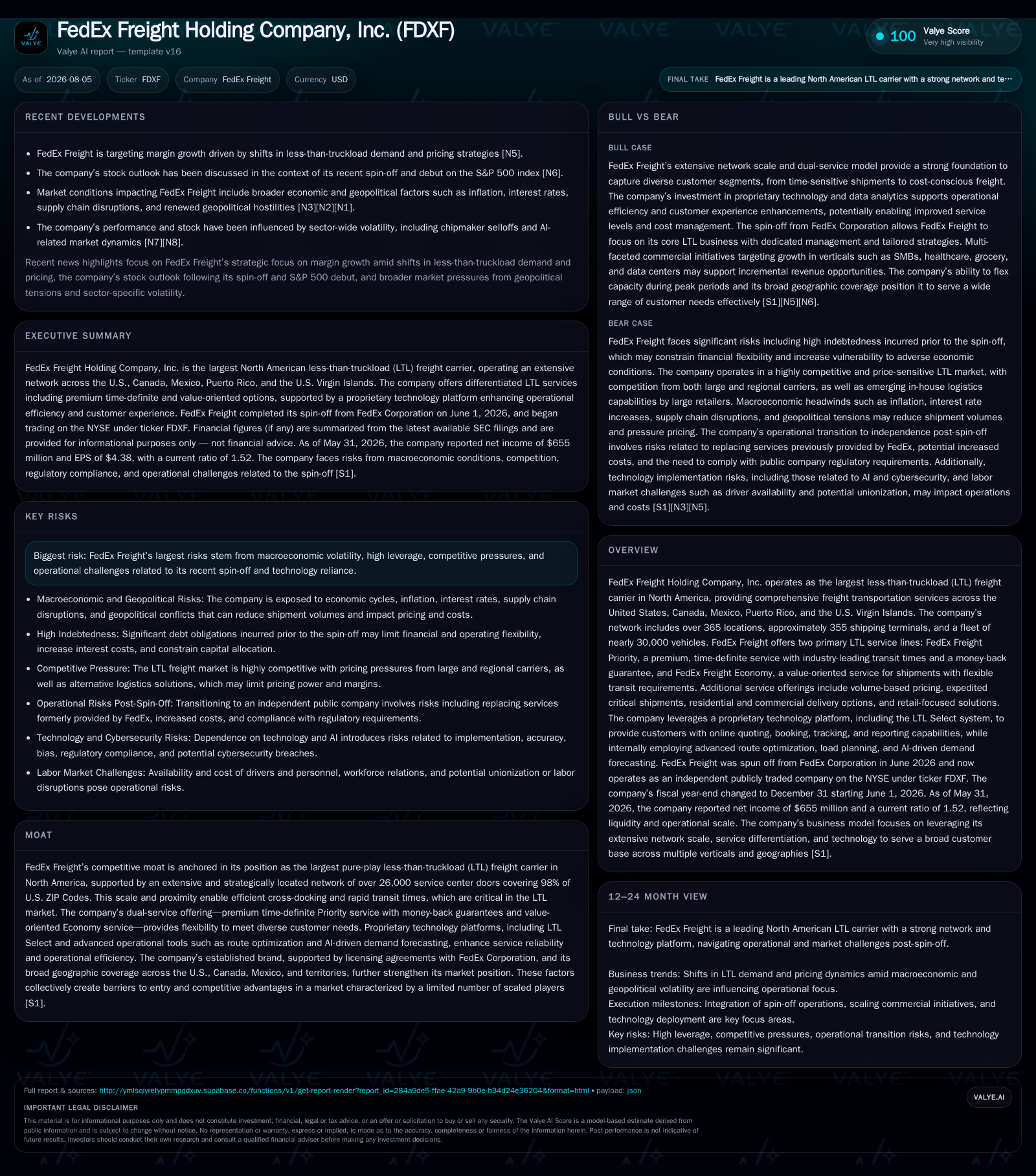
FedEx Freight Holding Company, Inc. emerged as an independent publicly traded entity in June 2026, becoming the largest less-than-truckload (LTL) freight carrier across North America with a vast network of terminals and nearly 30,000 vehicles. Its business model balances premium, time-definite services with cost-effective economy options, supported by a proprietary digital platform enhancing customer experience and operational efficiency. While positioned strongly due to scale, service differentiation, and technology, FedEx Freight faces risks from macroeconomic volatility, competitive pricing pressures, operational integration post-spin-off, and significant leverage incurred during separation.
Recent Operating Update
FedEx Freight Holding Company completed its spin-off from FedEx Corporation on June 1, 2026, transitioning into an independent publicly traded company under ticker FDXF [S3]. This reorganization included adopting a December 31 fiscal year-end starting FY2027 instead of May 31. Accompanying the spin-off was a substantial capital restructuring: the company assumed approximately $4.3 billion of new debt primarily in senior notes ($3.7 billion) and a $600 million term loan facility used to pay a cash dividend of about $4.1 billion back to FedEx Corporation prior to separation [S4][F1]. This resulted in significant leverage that may restrict future financial flexibility.
Simultaneously with operational independence, FedEx Freight revised its income statement presentation aggregating certain cost categories into “Operating supplies and expenses” without changing reported profitability metrics—a sign of efforts to simplify expense tracking as a standalone entity [S8]. It also announced unaudited recast historical standalone financials for full-year periods ending December 31 of previous years based on prior consolidated reporting [S8].
Business Model Overview
FedEx Freight is the largest less-than-truckload (LTL) freight carrier in North America by scale. It specializes in transporting shipments that do not require full truckloads but are too large or heavy for parcel carriers [S1]. The company’s revenue derives primarily from charging customers based on shipment weight, dimensions (freight class), distance traveled, and chosen service level—Priority or Economy. Priority offers premium time-definite delivery backed by money-back guarantees including next- or second-business-day service over specified distances; Economy is a value-oriented lower-cost option without formal guarantees but consistent transit times across broader geographies including Puerto Rico and the U.S. Virgin Islands through alliances
The operational complexity of LTL relies heavily on a dense terminal network where shipments are cross-docked—unloaded from inbound trucks onto outbound ones—to consolidate freight efficiently en route to final destinations. FedEx Freight operates over 355 shipping terminals (320+ in the U.S.) plus some linehaul relay sites with nearly 30,000 motorized vehicles including tractors [S1], providing intensive geographic coverage that enables rapid transit times critical in the LTL sector. Its network covers more than 98% of U.S. ZIP Codes via over 26,000 service center doors—a competitive moat limiting new entrants who face immense capital investment hurdles for comparable coverage.
To enhance customer experience and operational productivity, FedEx Freight deploys proprietary technology platforms such as LTL Select—a cloud-based transportation management system facilitating instant online quotes based on shipment specifics (weight/dimensions), digital booking and scheduling pickups, real-time shipment tracking with full visibility across borders between the U.S., Canada, and Mexico [S1]. The integration of AI-driven route optimization tools further supports operational efficiency through improved load factors (truck utilization) and linehaul cost control.
Supporting solutions like expedited critical shipments (FedEx Custom Critical) complement core LTL offerings for customers with urgent or specialized freight needs requiring white glove or surface expedite services available round-the-clock year-round.
Industry Structure and Competitive Position
The less-than-truckload industry is characterized by asset-intensive operations requiring large fleets and extensive terminal networks optimized through scheduled linehaul routes interconnecting hubs for freight consolidation. Unlike truckload (full trailer) carriers that operate point-to-point routes typically at fixed prices regardless of shipment size, LTL carriers price flexibly by weight brackets (hundredweight), distance bands, freight class reflecting complexity/handling requirements, fuel surcharges tied to volatile fuel costs—and often contractual volume pricing arrangements.
Competition among leading players such as Old Dominion Freight Line and Saia centers around minimizing transit times while maintaining cost-efficient operations across an expansive footprint. Differentiators include transit speed reliability—reinforced by service-level guarantees like FedEx’s money-back policy—technology-enabled customer portals for simplified shipment management, expansive geographic coverage especially cross-border capabilities within NAFTA/USMCA regions, and broad product suite addressing both time-critical priority shipments and value-conscious economy customers.
FedEx Freight leverages its legacy brand association via trademark license agreements with FedEx Corporation post-spin [S5], which supports customer trust during transition amidst industry fragmentation tendencies.
Growth Drivers
FedEx Freight's growth drivers tie directly to fundamental industry dynamics: economic expansion boosts manufacturing output increasing demand for intermediate goods movement; e-commerce proliferation accelerates smaller parcel shipments funneling into less-than-truckload channels; globalization intensifies cross-border shipments necessitating reliable NAFTA-wide enterprise logistics solutions.
Moreover, shippers increasingly optimize inventory deployment favoring frequent replenishment cycles using flexible LTL capacities rather than holding costly inventories locally—supporting structural demand rise.
Technological investments underpin scalable growth by lowering customer friction points (instant quoting/booking) while enhancing operational margins via route planning algorithms reducing empty miles or underutilization (higher load factor).
Expansion or densification of terminal networks can unlock access to underserved markets or improve transit times supporting margin uplift via better asset utilization schedules. Fleet modernization initiatives targeting fuel-efficient vehicles also reduce linehaul cost per mile sustainably amid fluctuating fuel prices.
Risks and Constraints
Material risks stem first from macroeconomic cyclicality: industrial activity downturns reduce freight volumes disproportionately hurting fixed-cost-heavy LTL operators reliant on high terminal utilization rates; conversely inflation elevates operating costs especially labor wages given prevailing driver shortages posing recruitment/retention challenges influencing human capital expenses materially [S27]
FedEx Freight’s material indebtedness ($4.3 billion total debt post-spin-offs) constrains liquidity reserves limiting agility for opportunistic capital expenditures or cushioning unexpected disruptions like supply chain bottlenecks or regulatory compliance costs such as environmental mandates impacting fuel use or emissions controls currently evolving federally/statewide across transport sectors [F1][S4][S27]
Competitive pressure remains intense with peers actively vying for contract renewals pushing pricing toward underlying cost floors; failure to maintain service reliability may erode premium Priority segment pricing power thereby compressing overall margins [S1]
The company recently spun off from a larger organization meaning transitional risks remain regarding IT systems separation completeness ensuring no disruption in shipment booking or tracking functionalities; contracting relationships need autonomous scaling away from legacy infrastructure/agreements managed previously by FedEx Corporation [S3][S22]. Cybersecurity risks accompanying newly independent technology infrastructure present additional potential volatility factors.
Finally regulatory compliance surrounding driver hours-of-service rules enforced by the FMCSA alongside evolving electronic logging device mandates demands continuous process improvement investments potentially pressuring operating expense ratios further.
What to Watch Next
Key operational markers include monitoring quarterly revenue per hundredweight trends indicating mix shifts between Priority versus Economy services—serving as proxy signals for margin trajectory given differential pricing structures [N1]. Terminal utilization rates should be watched closely as capacity constraints can cap growth upside or necessitate incremental capital deployment ahead of demand inflections.
Further progress integrating advanced AI-driven route planning could indicate sustained operating income growth via improved truck load factors reducing linehaul costs per mile beyond current levels [N1]. Regulatory developments imposing stricter environmental constraints remain critical externalities shaping fleet composition plans.
Debt servicing metrics like interest coverage ratios alongside free cash flow generation will reveal financial health trajectory influencing strategic flexibility amid the moderately elevated leverage environment post-spin-off balance sheet restructuring [F1][S4]. Finally investor communications will likely update margin targets reflecting evolving freight demand/pricing dynamics observed during ongoing macroeconomic fluctuations [N1].
Financial Profile Discussion
As of May 31, 2026—reflecting the period before spin-off but adjusted for standalone reporting—FedEx Freight reported operating income of approximately $540 million and net income around $655 million [F1]. The reported current ratio stood at a healthy 1.52 evidencing short-term liquidity adequacy supported by $1.5 billion in current assets against near $993 million in current liabilities at that date [F1].
However, total outstanding debt rests at around $4.3 billion—all net debt given cash levels are subordinate—inclusive of $3.7 billion senior notes plus supplemental term loans raised explicitly to finance the distribution to FedEx Corporation shareholders related to spin-off transactions [F1][S4]. Such leverage accentuates exposure to credit market fluctuations making consistent free cash flow generation imperative for sustainable deleveraging.
Interest expense absorbs a significant portion of operating cash flow potentially constraining reinvestment capacity in fleet renewal programs or incremental technological enhancements key for competitive positioning going forward.
In summary, while foundationally profitable with established market leadership bolstered by differentiated product offerings and technology adoption, the company's capital structure after becoming independent presents challenges that will necessitate disciplined cash flow management alongside targeted operating improvements to meet medium-term financial performance goals reliably.
This analysis compiles information available from SEC filings dated August 2026 alongside relevant Nasdaq news coverage without providing investment advice or price guidance. The perspectives reflect an effort to contextualize FedEx Freight's recent corporate actions within less-than-truckload industry dynamics emphasizing operating model intricacies, competitive positioning nuances, and capital structure implications inherent in its new status as an independent public company.
Disclaimer: This is research-only, informational analysis and not investment advice. It may include AI-generated interpretation and general industry context. Always verify important details using primary sources.

Comments