
Solventum Corp Advances Strategic Review and Operational Independence After Spin-Off
Solventum's latest quarterly filings highlight critical strategic reviews in healthcare IT and ongoing operational shifts post-spin-off from 3M, shaping near-term growth and risk outlook.
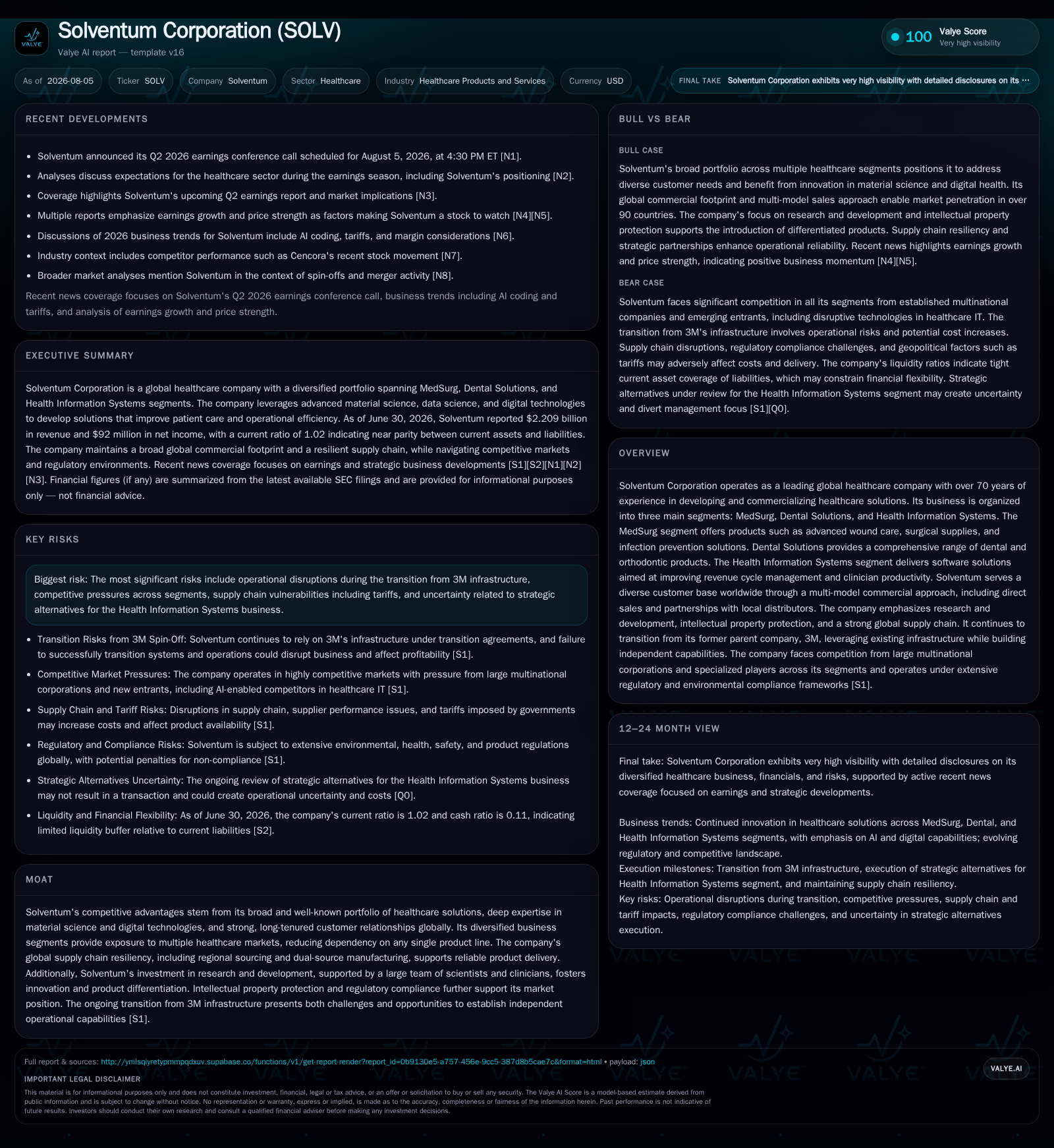
In its Q2 2026 disclosures, Solventum Corporation detailed the ongoing evaluation of strategic alternatives for its Health Information Systems segment alongside progress in establishing independent operations following its spin-off from 3M. The company’s diversified portfolio across MedSurg, Dental Solutions, and Health IT leverages strong R&D capabilities and a global commercial footprint. While supply chain adaptations and innovation efforts provide avenues for growth, elevated debt levels and transition-related operational risks remain key watchpoints. Upcoming milestones include completion of the health IT strategic review and advancing product pipelines supported by regulatory clearances.
Latest Quarterly Operating Update: Strategic Focus on Health IT Review & Infrastructure Transition
Solventum’s Q2 2026 Form 10-Q filing confirmed that the company is actively evaluating strategic alternatives for its Health Information Systems segment. This review underscores management’s intent to optimize business portfolio alignment but introduces uncertainty related to timing, potential execution challenges, and cost implications whether or not a transaction transpires. The process diverts some management focus from operations while posing risks such as customer or employee uncertainty that could impact retention or performance metrics. These dynamics add volatility over the near term until clarity emerges on whether a divestiture, partnership, or internal repositioning is pursued [S2], [S3].
Concurrently, Solventum continues decoupling its operations from legacy 3M infrastructure. Historically reliant on significant integrated support from 3M—including shared services like IT systems, supply chain networks, purchasing scale, and R&D collaboration—the company faces transitional costs and operational challenges as it establishes standalone processes. This de-integration affects cost structures and may cause temporary inefficiencies pending full capability ramp-up. Monitoring order fulfillment lead times and margin stabilization will be key markers for successful operational independence [S2], [S3].
Expanding Innovation Across MedSurg, Dental, and Digital Segments
Solventum’s business comprises three main segments that collectively shape its revenue base and margin profile: MedSurg accounted for 57.9% of total sales in 2025; Dental Solutions contributed 16.2%; Health Information Systems represented roughly 16.3% [S1]. The MedSurg segment includes advanced wound care products such as negative pressure therapies, synthetic tissue matrices, surgical supplies focused on infection prevention (e.g., sterilization assurance devices), intravenous site management tools, skin care products, OEM-manufactured medical electrodes, and other consumables designed to improve patient outcomes while reducing care costs.
Dental Solutions offers a comprehensive suite spanning orthodontic brackets and aligners to restorative cements and bonding agents—products critical through the life cycle of dental health from preventative maintenance to complex restorations. This segment’s reliance on both consumable sales volume and orthodontic device adoption links performance closely to procedural trends at dental clinics globally.
Health Information Systems delivers healthcare IT software including clinical documentation tools utilizing computer-assisted physician documentation, direct-to-bill automation that reduces administrative burden for clinicians by improving coding accuracy, classification methodologies for claims processing efficiency, speech recognition technologies incorporating AI enhancements, and data visualization platforms aimed at optimizing revenue cycle management across hospitals [25].
Investment in research & development is notable with approximately 2,000 employees in technical roles ranging from material science researchers to software engineers fueling cross-segment innovation initiatives. This R&D intensity underpins product differentiation—a necessity amid stringent regulatory requirements that govern safety and efficacy—and supports incremental new product introductions which act as important growth levers [S1].
Supply Chain Resiliency Amid Global Disruptions: Dual Sourcing & Regionalization
Given ongoing geopolitical trade tensions and tariff risks coupled with pandemic-era supply constraints impacting medical manufacturing broadly, Solventum employs deliberate supply chain strategies emphasizing dual-source manufacturing capabilities across multiple geographies. This approach mitigates single points of failure or regional disruption effects by enabling flexible production shifts between facilities depending on raw material availability or transportation challenges.
Regional sourcing priorities help reduce lead times while controlling costs; this also addresses increasingly complex regulatory compliance relating to import/export controls especially relevant for high-tech materials in MedSurg products or software service delivery in Health IT. Maintaining stable inventory levels across hubs aligns with delivering consistent product availability—especially critical for consumables used routinely in hospitals where shortages can cause clinical workflow disruptions.
These efforts reflect typical sector KPIs such as supply chain lead times reduction targets and gross margin preservation against inflationary pressures seen by peers like Stryker Corporation in surgical device manufacturing [S1;S2].
Competitive Positioning: Differentiated Portfolio Versus Healthcare Peers
Solventum competes within diversified healthcare equipment sectors alongside firms such as 3M Healthcare (for MedSurg products), Align Technology (dental orthodontics), and Cerner Corporation (healthcare IT solutions). The company benefits from exposure across multiple markets rather than concentration in one vertical—an advantage mitigating cyclicality tied to any single therapy area or reimbursement model [S1].
Its combination of deep material sciences expertise enables development of cutting-edge wound care materials differentiating it versus commoditized surgical supplies providers. Coupled with proprietary healthcare IT platforms enhancing clinical workflows and revenue integrity efforts builds a technological moat challenging to replicate quickly.
Intellectual property protections facilitate competitive positioning though patent expirations remain a general industry risk requiring continuous R&D refreshment [S1;S18].
Long-standing customer relationships with hospitals and clinics increase switching costs enhancing retention rates—a KPI aligned with sustained top-line stability across all segments.
Growth Opportunities: Leveraging Demographic Trends & Value-Based Care Adoption
Several secular trends underpin Solventum's growth prospects:
- Global aging populations drive increased usage of advanced wound care products addressing chronic ulcers or postoperative healing complications prevalent among older patients.
- Rising chronic disease incidence expands demand for specialized surgical supplies enabling minimally invasive procedures with faster recovery.
- Healthcare systems worldwide are adopting value-based care models emphasizing efficiency gains where Solventum's Health IT solutions reduce revenue cycle waste thus appealing to hospitals incentivized on cost control.
- Expansion into emerging markets where healthcare infrastructure investments are underway provides geographic penetration upside.
- Regulatory approvals allowing launch of novel devices or enhanced software versions stimulate incremental sales gains. These factors collectively suggest structural tailwinds beyond cyclical fluctuations commonly observed in consumable-driven medical device sectors.
Risks to Watch: Spin-Off Legacy Challenges, Regulatory Pressure, & Strategic Execution
Despite strengths several risks warrant diligence:
- The ongoing transition away from legacy 3M support exposes Solventum to potential disruptions in procurement efficiency or IP access that may impair margins temporarily or longer term if not smoothly managed [S1], [S2].
- Elevated leverage reflected by net debt approximating $4.68 billion against cash reserves near $400 million creates balance sheet pressures that could restrict investment flexibility or increase refinancing risk should market conditions tighten [F1].
- Regulatory compliance complexity spans product approvals delays risks for new launches plus adherence monitoring across more than ninety countries sold complicating expansion cadence [S11], [S19].
- Competitive intensity especially in health IT—where new AI-driven entrants emerge—poses risks to pricing power if differentiation falters or technology adoption lags compared to leaders like Cerner Corporation.
- The execution risk surrounding the Health Information Systems strategic alternatives process adds uncertainty about capital allocation outcomes impacting future revenue composition.
Key Milestones Ahead: Health IT Strategic Decision Timeline & Product Innovation Pipeline
Market watchers should monitor for announcements concluding the strategic review of the health IT business expected later in fiscal year 2026 based on recent management disclosures. The outcome will clarify whether divestiture proceeds or an internal reinvestment thesis emerges guiding cash flow expectations downstream.[S2],[S3]
Simultaneously advancing R&D programs aligned with regulatory clearance cycles remain pivotal evidence points that will validate innovation-led growth ambitions—particularly launches within advanced wound care technologies or upgraded clinical documentation software packages expanding adoption rates among hospital systems.
Successful navigation through these milestones will serve as leading indicators confirming robustness of growth strategy amid transition-related challenges.
Financial Profile Discussion: Robust Revenue Base Offset by Leverage and Transition Costs Under Scrutiny
As of June-end Q2 2026 financials indicate Solventum held $403 million in cash & equivalents against total debt near $5.08 billion yielding a net debt position around $4.68 billion; current assets ($3.74 billion) marginally exceeded liabilities ($3.66 billion) producing a current ratio around 1.02 -- signaling tight but positive near-term liquidity coverage [F1]
Capital allocation decisions leaning toward deleveraging balanced against continued R&D spending will be critical metrics going forward given cyclical uncertainties alongside enhancement imperatives within all three business segments.
Disclaimer: This analysis is prepared solely for informational purposes based on publicly available SEC filings as of August 5, 2026. It does not constitute investment advice or research views regarding securities of Solventum Corporation.
Disclaimer: This is research-only, informational analysis and not investment advice. It may include AI-generated interpretation and general industry context. Always verify important details using primary sources.

Comments