
Upstart Expands Lending Marketplace with AI-Driven Automation and Capital Diversity in Q2 2026
Upstart Holdings reports Q2 2026 revenue growth driven by AI-powered credit risk models and diversified loan funding sources.
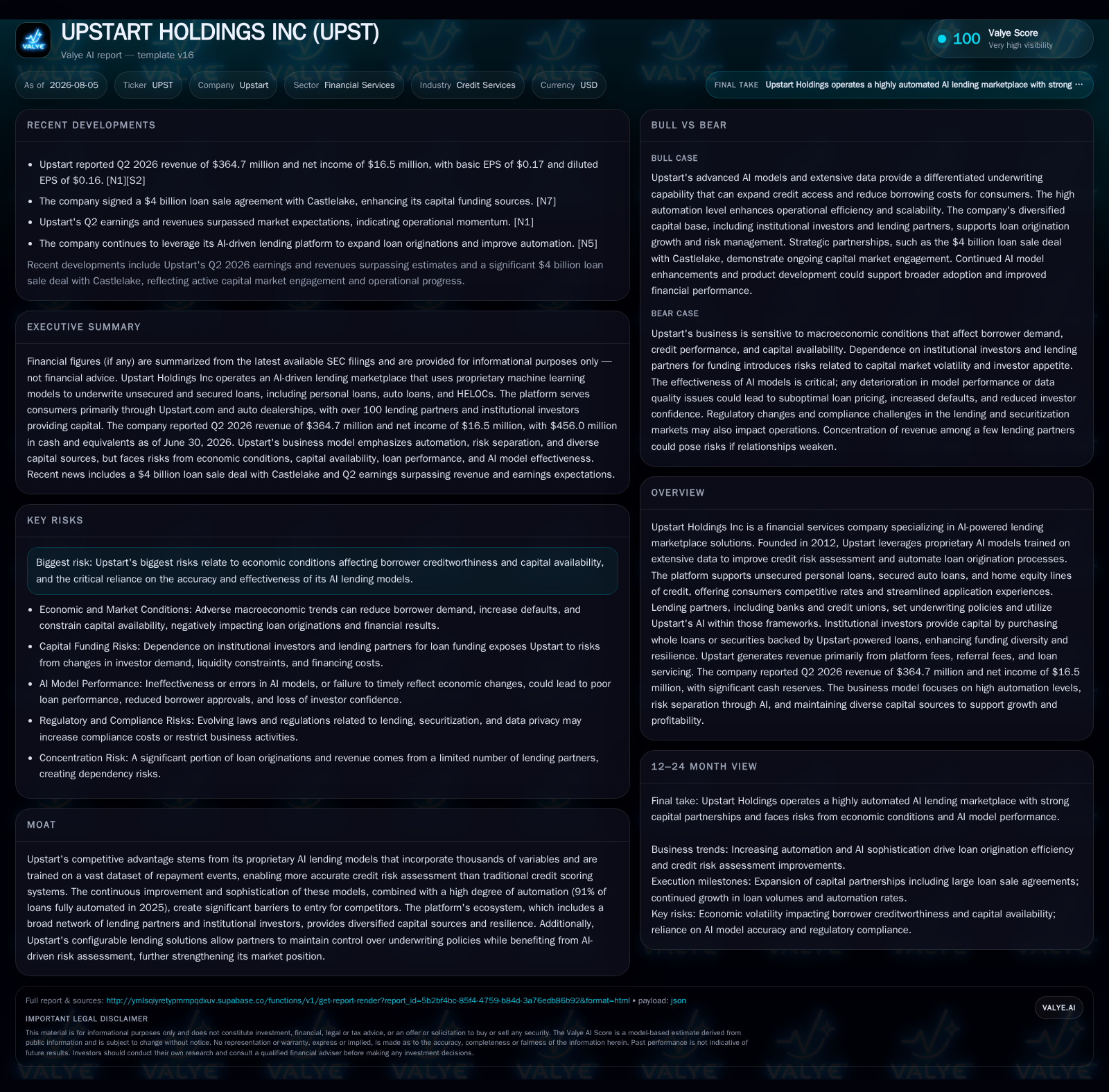
Upstart Holdings demonstrated resilience in its Q2 2026 performance, leveraging its proprietary AI models to enhance credit underwriting accuracy and automating 91% of loans. The company continues to expand its marketplace by deepening relationships with lending partners and institutional investors, supported by a robust capital deployment strategy including whole loan sales and securitizations. Despite challenges from economic volatility and reliance on AI model effectiveness, Upstart’s investment in automation and marketplace diversification positions it well within the AI-powered lending sector. Monitoring onboarding rates for new lending partners, institutional investor participation, and the mix of secured versus unsecured loans will be crucial to assessing Upstart’s ongoing growth trajectory.
Recent Operating Update
Upstart Holdings reported second quarter fiscal 2026 results on August 4, 2026, revealing continued strength in its AI-powered lending marketplace. Revenue for the quarter surpassed estimates at $364.7 million with net income maintaining profitability trends observed in prior periods [S2][N1]. This reflects solid execution in scaling loan origination volume alongside enhanced automation of underwriting processes. Notably, Upstart emphasized the pivotal role of its proprietary AI models in improving credit risk assessment accuracy — a cornerstone for approving more borrowers at better rates than traditional FICO-based systems allow [S2][S1].
The company disclosed that nearly all loans processed through its platform benefit from high degrees of automation (91% fully automated as of 2025), substantially reducing manual intervention costs and accelerating throughput speed. This level of automation covers not only credit decisions but also income verification, fraud detection, identity checks, and servicing interventions throughout the loan lifecycle utilizing advanced agentic AI capabilities [S1][S2]. These operational efficiencies underscore Upstart’s competitive positioning within the digital lending ecosystem.
In terms of capital sourcing, Upstart reported an active marketplace that connects borrowers with lending partners — predominantly banks and credit unions who set underwriting policies — along with institutional investors who provide majority capital either through whole loan purchases or asset-backed securitization programs. This dual-faceted funding approach bolstered by a recent $4 billion loan sale agreement with Castlelake demonstrates effective diversification of capital supply critical for scaling originations under varying market conditions [N11][S1][S3]
Business Model Overview
Upstart operates as an intermediary technology platform employing advanced machine-learning-driven AI underwriting models designed to provide risk separation superior to legacy credit scoring systems. By ingesting thousands of variables beyond traditional scores and continuously training on extensive repayment data sets accumulated over ten years, Upstart achieves finer granularity in borrower risk assessment [S1]. This allows higher approval rates without compromising portfolio quality, enabling lending partners to offer more competitive rates while managing expected losses effectively.
The revenue model consists primarily of platform fees charged to lending partners for access to Upstart’s marketplace technology and referral fees that accrue based on loans originated through the platform [S1][S2]. Additionally, Upstart derives income from servicing fees on loans it services using proprietary technology while holding some loans on its balance sheet — though most are purchased immediately post-origination by institutional investors or retained by partner lenders.
This marketplace design mitigates balance-sheet risk exposure while leveraging a scalable technology stack. The model hinges heavily on maintaining a broad network of active lending partners who configure underwriting parameters but benefit from Upstart’s AI-driven risk insights.
Automation complements this model by accelerating loan processing times while cutting operational costs; more than nine out of ten loans flow through without human intervention as of the latest disclosures. High automation levels also improve customer experience through rapid approvals on digital channels such as Upstart.com or via integrated automotive retail software [S1].
Industry Structure and Competitive Position
Within the broader AI-powered credit lending marketplace sector, Upstart competes alongside firms like SoFi Technologies, LendingClub, Avant, Affirm, Upgrade, and Pagaya — all fintech entities leveraging data-driven underwriting enhancements or alternative financing channels. Unlike traditional lenders reliant mostly on FICO-based rules or manual review processes, this industry segment emphasizes AI underwriting models trained on expansive behavioral data to enhance credit risk separation.
Upstart’s key differentiators in this space include:
- Decade-long data accumulation supporting proprietary AI model sophistication,
- High automation percentage enabling cost-efficient scale,
- Flexible marketplace mechanisms accommodating both banks’ underwriting control needs and diverse institutional investor capital preferences,
- Product breadth extending beyond unsecured personal loans into automotive finance software integration and HELOC offerings.
These factors create barriers for peers attempting rapid replication due to data scale requirements, regulatory compliance burdens tied to automated credit decisions using alternative data points, and operational complexity managing multiple capital-provider relationships. Upstart’s rising adoption among lenders evidences market confidence in its model.
Growth Drivers
Several structural tailwinds underpin potential growth for Upstart:
- AI Adoption Acceleration: Increasing lender acceptance of machine learning-based underwriting over legacy methods drives demand for platforms offering improved risk evaluation.
- Product Diversification: Expansion into secured auto loans through dealership software channels alongside HELOC offerings broadens addressable markets beyond core personal unsecured loans.
- Capital Market Appetite: Rising institutional interest in private credit assets fuels marketplace liquidity enabling higher origination volumes without concentration constraints.
- Consumer Digital Experience Demand: Preferences shifting toward instant digital credit approval align with Upstart’s automated end-to-end process reducing friction.
- Macroeconomic Dynamics: Refinance cycles driven by shifting interest rates present growth opportunities particularly when coupled with agile macroeconomic calibration in underwriting models.
- Partnership Scaling: Maintaining strong relationships with existing bank/credit union lenders while adding new participants expands platform reach.
- Continuous Model Improvement: Ongoing AI refinement improves selection efficiency sustaining higher approval rates while controlling default risks.
These drivers collectively enhance KPIs such as loan origination volume growth, increased average loan sizes via cross-selling secured products, elevated approval rates without commensurate loss-rates increase, higher capital deployment rates through investor deals like the recent Castlelake agreement [N11], and improved servicing efficiency via agentic AI technology.
Risks and Constraints
Material risks remain inherent given the sensitive nature of financial services exposed directly to consumer creditworthiness fluctuations:
- Economic Volatility: Downturns can degrade borrower repayment capacity affecting default rates which are core portfolio quality metrics impacting investor returns.
- AI Model Risk: Model effectiveness depends critically on timely economic condition reflection; failure or delays reduce predictive accuracy harming reputation and business sustainability [S2].
- Capital Provider Dependency: A small number of lending partners contribute disproportionate originations; loss or withdrawal could materially disrupt volumes.
- Regulatory Compliance: Evolving scrutiny around automated decision-making algorithms exposes potential legal/regulatory risks necessitating continuous adaptation.
- Competitive Pressures: Both legacy incumbents starting digital initiatives and fintech startups pose threats requiring ongoing innovation investments.
- Loan Portfolio Risk Management: Retaining some inventory exposes balance sheet risk requiring prudent provisioning processes.
- Technology Failures/Security: Platform downtime or breaches could impair operations or customer confidence.
- Product Mix Uncertainties: Shifts between unsecured vs secured products impact margin profiles needing careful management.
Ongoing monitoring should focus on indicators such as rising delinquency rates beyond modeled expectations signaling macro stress or model shortfalls; changes in lending partner count or concentration; shifts in investor demand for securitized instruments; evolving regulatory guidelines impacting AI use cases; and IT operational stability metrics.
What to Watch Next
Upcoming milestones critical to assessing execution include:
- Quarterly updates detailing loan origination volumes segmented by product line,
- Reported changes in average loan size reflecting deeper cross-sell penetration,
- Loan automation percentage trends confirming scalability gains,
- Default/delinquency statistics validating model sophistication amid economic cycles,
- Lending partner additions or attrition signaling market acceptance,
- Institutional investor participation rate changes especially revolving around asset-backed securitizations,
- Capital deployment velocity highlighting funding resilience,
- Regulatory developments affecting automated credit decision frameworks,
- Any reported enhancements or expansions in servicing capabilities using AI technologies.
These markers collectively will illuminate whether Upstart can sustain favorable unit economics while expanding its footprint within an increasingly competitive digital lending landscape.
Financial Profile Discussion
Upstart entered Q2 2026 with approximately $456 million in cash and cash equivalents as of June 30, providing ample liquidity to support ongoing investment in technology enhancement and capital structure flexibility [F1]. Recent quarters have demonstrated positive net income trajectories, though the company remains subject to earnings volatility tied primarily to fluctuating origination volumes influenced by macroeconomic variables [S2].
Revenue generation is highly correlated with platform throughput: fees earned from lending partners scale with funded loans while referral fees track with origination volumes sold to institutional investors [S1][N11]. Given the significant use of asset-backed securitization programs to offload loans post-origination to investors—such as the highlighted multi-billion-dollar deal closed recently—the capital efficiency benefits accrue indirectly through reinvestment capacity rather than direct interest income capture.
Margins are structurally supported by high automation levels which reduce operating expenses linked to manual underwriting labor costs. However, provisioning for potential loan losses remains a necessary buffer against credit risk tied to economic cycles. The balance-sheet light marketplace approach aids overall leverage management but requires maintaining broad investor appetite for securitized assets alongside stable lender partnerships.
In sum, Upstart's financial discipline centers on maintaining cash reserves adequate for technological innovation cycles while balancing growth investments aligned with evolving customer demands across secured/unsecured consumer finance sectors.
Disclaimer: This is research-only, informational analysis and not investment advice. It may include AI-generated interpretation and general industry context. Always verify important details using primary sources.

Comments