
Exzeo Group Accelerates Insurtech Adoption with Data-Driven Underwriting Expansion
Exzeo's Q2 2026 results demonstrate solid managed premium growth and expanding SaaS scale amid ongoing competitive and regulatory challenges.
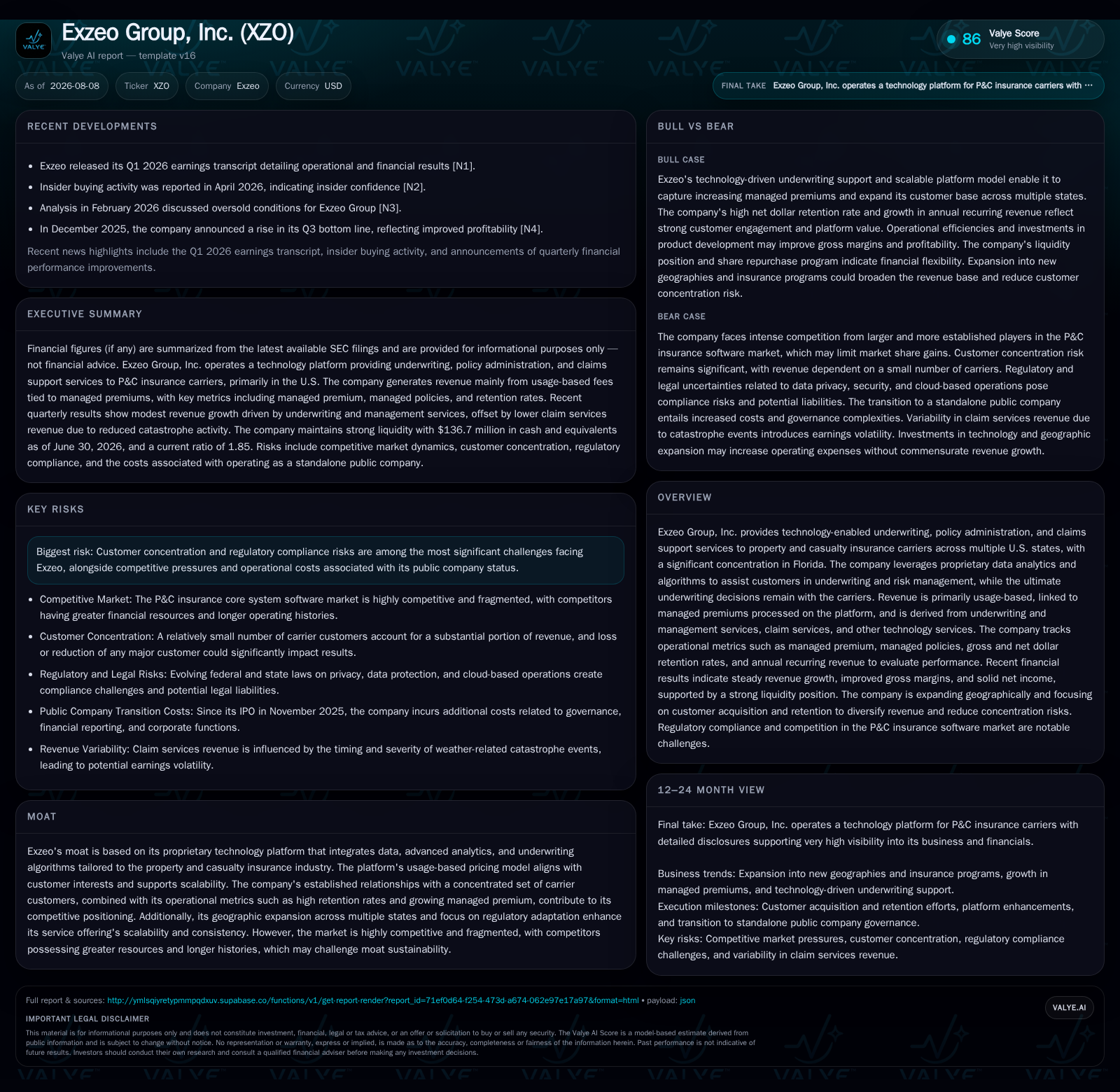
Exzeo Group, Inc. reported continued growth in its technology-enabled underwriting platform in Q2 2026, driven by increased managed premiums and geographic expansion across multiple U.S. states. Its usage-based pricing model aligns revenue directly with carrier premium volumes processed, reinforcing scalability supported by proprietary data analytics. While operational efficiency improvements lifted gross margins, the company remains exposed to customer concentration and a fragmented competitive landscape dominated by larger peers. Key near-term markers include broadening carrier partnerships beyond core affiliates and advancing platform AI capabilities.
Q2 2026 Operating Update: Rising Managed Premiums Fuel Momentum
Exzeo Group's Q2 2026 10-Q reveals a continuation of growth dynamics anchored in its technology-enabled underwriting platform servicing property and casualty (P&C) insurers across an expanding footprint of U.S. states including Florida, Connecticut, Georgia, Massachusetts, Montana, Nevada, New Jersey, New Mexico, and North Carolina [S1], [S2]. The company reports increases in managed premium volumes processed through its platform alongside growing policy counts. This reflects broader customer adoption beyond its historical core markets. Notably, net dollar retention rates improved quarter-over-quarter, underscoring effective customer success efforts that secure recurring revenue streams from existing carriers while supporting upsell potential into additional insured lines or products [S2], [S3].
This quarterly strength is crucial because Exzeo’s revenue is directly tied to the amount of premium it supports through its usage-based fee model rather than fixed subscriptions. Hence, rising premium volumes inherently drive revenue growth and annual recurring revenue (ARR), key performance metrics that validate the attractiveness and scalability of its underwriting support platform. These evolving top-line indicators mark operational scale benefits aligning with SaaS business economics common within the insurance technology sector.
Platform Architecture and Revenue Model: Usage-Based SaaS Enhancements Drive Scalability
Exzeo monetizes through a proprietary underwriting platform that leverages advanced data analytics and real-time algorithms to assist P&C insurance carriers in their risk selection and pricing decisions without itself assuming underwriting risk. The company integrates external dynamic data sources—such as weather patterns or economic indicators—and applies sophisticated statistical techniques to inform carrier processes around underwriting guidelines, policy administration, and claims management support services [S1], [S2].
This setup allows carriers to delegate parts of the administrative workflow while maintaining final underwriting judgments internally. Exzeo’s usage-based fees scale proportionally with managed premiums processed on the platform, enabling high variable leverage; revenue expands commensurate with carrier portfolio growth or intensity of policy management while fixed costs related to cloud hosting, R&D on analytics enhancements, and compliance systems experience dilution at scale. This contrasts against traditional fixed-fee subscription models seen among some peers where contract sizes are more rigid.
As Exzeo deepens its analytics capabilities—including planned AI-driven tools slated for phased launch—it raises switching costs and embedding effects that could enhance customer retention rates and profit margins over time.
Competitive Dynamics: Fragmented Market Meets Proprietary Analytics Advantage
The market for P&C insurance software platforms remains highly fragmented but dominated by larger incumbents such as Guidewire Software or Duck Creek Technologies that offer comprehensive core systems encompassing underwriting, policy administration, billing, and claims management modules. These competitors benefit from brand recognition, extensive resource pools for product development, regulatory adaptation across jurisdictions, and large installed bases providing networking effects (Sector context).
Exzeo competes effectively by focusing on integration ease, domain-specific underwriting analytics tailored for its niche customer base (initially concentrated in Florida), and usage-aligned pricing which transfers some demand volatility risk back to service consumption rather than fixed fees. Furthermore, its agile product development cycle enables quicker incorporation of emerging third-party data sources aiding differentiated risk modeling accuracy versus legacy vendor solutions.
Customer retention metrics reported—including gross dollar retention exceeding industry benchmarks—serve as proxy indicators for brand trustworthiness despite smaller scale compared to larger rivals [S1], [S2]. Nonetheless, sustaining this moat depends heavily on continuous technological innovation combined with measured geographic diversification.
Growth Drivers: Geographic Expansion and Data Innovation as Growth Catalysts
Expanding beyond its foundational Florida market into multiple other U.S. states is a strategic imperative for Exzeo’s long-term value creation. Operating in diverse regulatory environments presents both complexity costs—demanding investments in compliance processes—and opportunity to access larger inventory of insured policies that feed premium-linked revenues. Such geographic diversification improves resilience against local underwriting cycle fluctuations or weather-related loss events affecting premium flow volume [S1], [S2].
Additionally, broadening product scope beyond underwriting support towards claims management services under the same technology ecosystem could unlock incremental wallet share from existing customers while attracting new carriers seeking integrated SaaS platforms over piecemeal legacy tools.
Underpinning these expansions is purposeful ramp-up in AI-powered analytical enhancements designed to refine risk assessment granularity—potentially lowering loss frequency indirectly by better targeting risks during underwriting decisions—which would enhance value proposition credibility.
The rising industry embrace of cloud-based insurance technology catalyzes cost efficiencies through shared infrastructure while reducing barriers for mid-sized carriers seeking digital transformation partners.
Risks and Watchpoints: Customer Concentration, Regulatory Complexity, and Margin Pressure
A pronounced challenge is Exzeo’s current reliance on a relatively small number of P&C carriers for substantial portions of revenue; this customer concentration creates vulnerability should one or more major clients reduce service usage or terminate agreements unexpectedly [S1]. Management explicitly acknowledges this risk while endeavoring to diversify via acquisition of non-affiliate carrier relationships outside their historic HCI affiliate network
Simultaneously, operating across multiple state jurisdictions entails navigating varied insurance regulations impacting product rollout timelines and compliance costs—regulatory complexity that can stall rapid geographic scaling or increase overhead ratios.
Competition from entrenched incumbents with deeper financial resources may exert margin pressure particularly if aggressive price competition emerges or if investments necessary to keep pace technologically escalate faster than organic revenue growth permits.
Operating expenses rose notably in recent quarters due to expanded R&D spending plus sales/marketing hiring reflecting public company cost structures; balancing these investments against achieving sustainable adjusted EBITDA margins is critical for confidence in operating leverage realization over time.
What To Monitor Next: Key Execution Milestones for Customer Acquisition and Tech Investment Alignment
Upcoming catalysts include monitoring successful onboarding of new carrier customers beyond core affiliated entities—a key diversification metric for revenue stability—as well as tracking acceleration in managed premium velocity across newer states reflecting effectiveness of geographic push [S2], [S3].
Additionally, quarterly updates on annual recurring revenue expansion alongside continual improvement in net dollar retention will indicate strengthening platform stickiness essential for long-term value creation.
Technology rollout milestones related to AI-enriched underwriting models could serve as leading indicators of future competitive differentiation benefits driving both new business wins and deeper penetration within current accounts.
Investors should also observe guidance cues around operating expense trends especially research investment pacing relative to realized efficiency gains capturing operating leverage upside typical of scalable SaaS firms.
Financial Profile Discussion: Liquidity Status, Cash Flow Generation, and Capital Allocation
As of June 30, 2026, Exzeo holds $136.7 million in cash and cash equivalents with a current ratio approximating 1.85x based on $169.7 million current assets versus $91.7 million current liabilities indicating healthy near-term liquidity coverage supportive of ongoing operational needs including software development investments and cloud infrastructure costs [F1]
Capital expenditures totaled under $600k over six months emphasizing capital-light nature characteristic of software SaaS providers.
In May 2026 the board authorized a share repurchase program permitting up to $12 million buyback; approximately $10 million has been utilized through Q2 which signals confidence from management balanced with prudent capital deployment amid growth investment demands [S5], [S22].
Overall financial positioning appears solidly supportive of pursuit toward further penetration into multi-state regulatory markets while pursuing incremental enhancements aimed at improving profitability metrics including adjusted EBITDA margin stability targeted near mid-50% range per recent quarters.
Disclaimer: This analysis is for informational purposes only based on publicly available filings as of August 2026 and does not constitute investment advice.
Disclaimer: This is research-only, informational analysis and not investment advice. It may include AI-generated interpretation and general industry context. Always verify important details using primary sources.

Comments