
Wendy’s Faces Margin Pressure and Traffic Challenges While Leaning on Franchise Model and System Optimization
Latest quarterly disclosures reveal operational headwinds, ongoing system optimization efforts, and balanced financial positioning amid industry-wide cost volatility.
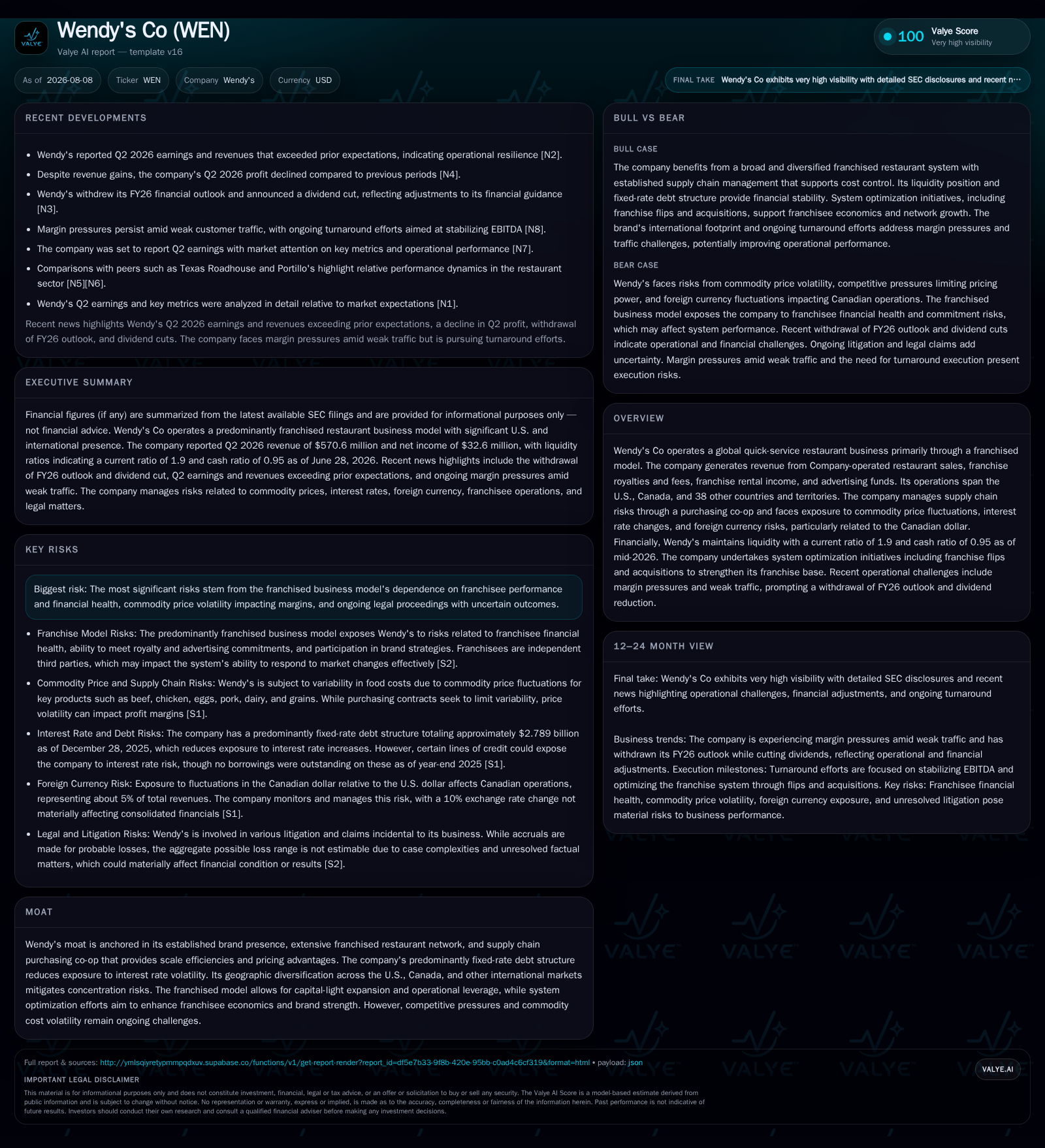
The Wendy’s Company reported mixed operational performance in Q2 2026, marked by margin pressures and weaker customer traffic that led to the withdrawal of its full-year outlook and dividend reduction. Despite these headwinds, Wendy’s continues to leverage its predominantly franchised business model and supply chain purchasing cooperative to manage commodity cost volatility and preserve liquidity. The company’s focus on franchise flips, acquisitions, and digital sales channels aims to enhance franchise economics and offset traffic challenges. However, risks remain from reliance on franchisee health, legal exposures, and competitive intensity within the fast-food industry.
Recent Operating Update
Key metrics such as system-wide sales growth have slowed relative to prior periods, attributable largely to softness in restaurant visits which have not been fully offset by average check size increases or digital order growth [S2][N1]. This aligns with broader Quick Service Restaurant (QSR) trends where traffic volatility remains a significant challenge amid intense competition from peers like McDonald’s, Burger King, and fast-casual chains.
Business Model Overview
Wendy’s operates primarily through a franchised quick-service restaurant format across the United States, Canada, and approximately 38 other countries [S1]. The company's revenue streams comprise company-operated restaurant sales, franchise royalties and fees calculated as a percentage of franchisee sales, franchise rental income from properties leased or subleased to franchisees, and advertising fund contributions collected from franchisees [S1][S13].
This capital-light franchisor approach enables Wendy’s to expand with limited direct capital expenditure while benefiting from operational leverage as royalty streams ramp with franchisee unit growth. Franchisees bear operating costs and run day-to-day operations independently which introduces variability tied to their financial health and capability to execute brand standards [S2][S17]. Nonetheless, this model permits focused corporate resources toward brand management, marketing coordination through advertising funds, supply chain negotiation via purchasing cooperatives (QSCC), and system optimization initiatives like franchise flips or reimaging existing units [S1][S13].
Margins vary between company-operated outlets—which tend to carry higher operating costs but greater direct control—and franchised restaurants where revenue derives mainly from royalties with lower incremental costs for the company [S13]. Therefore, same-store sales performance among franchisees directly influences royalty revenues while system-wide sales indicate overall network health.
Industry Structure & Competitive Position
Operating within the fiercely competitive QSR sector entails managing pressures on pricing power amid evolving consumer preferences around speed, menu innovation, convenience channels such as digital ordering/delivery platforms, and value perception. Wendy’s competes primarily against large scale peers — McDonald’s leads globally in units and digital penetration; Burger King appeals similarly on brand recognition; fast casual players like Chipotle encroach segments by emphasizing fresh quality.
Wendy's supply chain purchasing cooperative (QSCC) delivers scale economies on core inputs—beef, chicken, eggs—mitigating some commodity price volatility risks typical for food service companies [S1]. Nevertheless, price pass-through possibilities are sometimes curtailed by competitive market constraints limiting margin resilience. The fixed-rate debt structure reduces vulnerability to rising interest rates relative to peers who might have variable exposures [S1][S7].
Brand strength is supported via coordinated advertising funded by franchise contributions; however, balancing marketing spend effectiveness against operating margin pressures is critical amidst intensifying competition [S13]. Geographic diversification into Canada exposes Wendy's to foreign currency translation risks primarily via the Canadian dollar versus USD fluctuations but represents only ~5% of revenues limiting disproportionate exposure [S1][S9].
Growth Drivers
Expansion initiatives focus on increasing franchise footprint through new openings plus 'franchise flips' whereby company-operated restaurants transfer ownership to qualified franchisees—unlocking capital light growth with improved returns [S1][N10]. Such system optimization efforts aim both at expanding unit count and enhancing profitability by improving franchisee economics.
Menu innovation continues as a lever for driving ticket size improvements by introducing new product offerings while catering to shifting consumer tastes toward healthier or indulgent options. Digital sales channels—mobile app orders, third-party delivery integration—have experienced accelerated adoption post-COVID-19 and represent an increasing share of total sales helping mitigate foot traffic declines [N13]
Also important are marketing campaigns funded through advertising contributions intended to bolster brand relevance and customer visits; their effectiveness can influence same-store traffic trends alongside customer loyalty programs.
Risks & Watchpoints
The most salient risk remains the high dependence on franchisee performance given their operational independence; financial weakness or lack of participation in strategic initiatives could hamper royalty revenues or brand consistency [S2][S17]. Commodity price swings continue exerting margin pressure despite cooperative purchasing contracts lacking firm purchase commitments—sharp price spikes may not be fully recoverable through menu pricing due to competitive constraints [S1].
Legal exposures represent uncertain downside risks as several lawsuits persist related to labor practices or other incidental business matters with contingent liabilities accrued but outcomes unpredictable [S6][S17]. Regulatory changes in food safety or labor laws could also increase operating complexity.
Competitive dynamics may lead to pricing pressure eroding margins if market share gains require disproportionate discounting or promotional activity. Weakening consumer traffic trends are a cautionary signal that recovery depends on successful execution of digital enhancements or store experience improvements.
What To Watch Next
Key near-term milestones include monitoring same-store sales progression including comparable store traffic versus average ticket size gains as a barometer for demand stabilization. Effectiveness of system optimization activities can be tracked via franchise unit growth metrics and reimaging success rates.
Wendy’s management commentary around margin trend remediation plans post dividend cut will shed light on cost control measures’ sufficiency amid inflationary inputs. Expansion of digital sales penetration could offset some dine-in traffic erosion — thus targeting growth in omnichannel revenue will be insightful.
Any updates related to litigation outcomes or changes in franchisee engagement including new agreements impacting royalties would materially affect risk assessments. Finally, external macroeconomic factors influencing commodity prices or consumer discretionary spending warrant continuous evaluation.
Financial Profile Discussion
As of quarter-end June 28, 2026, Wendy's maintained a solid liquidity position highlighted by cash and cash equivalents totaling approximately $341 million against current liabilities near $357 million yielding a current ratio around 1.9 — indicative of sufficient short-term asset coverage [F1][S2]. Total debt stood near $2.79 billion as of December 28, 2025 with predominantly fixed interest rates mitigating exposure to interest rate hikes [F1][S1].
Net debt after subtracting cash approximates $2.45 billion reflecting moderate leverage levels aligned with typical franchisor profiles combining stable royalty-based cash flows with secured notes collateralized by revenue-generating assets including intellectual property rights under structured securitization entities [F1][S14]. Interest expense remained steady over recent years (~$110 million annually) supported by ongoing amortization of issuance costs but constrained borrowing needs given the capital-light model [S19].
Capital expenditures remain focused largely on supporting company-operated locations plus investments supporting system-wide technology platforms especially related to digital ordering infrastructure rather than broad real estate expansion owning fewer locations outright [S8][F1]. Advertising fund collections contribute significantly toward marketing spend though these expenses necessitate balancing amid narrowing margin headroom [S13]. Share repurchase activity persists within authorized programs but recently tempered alongside dividend cuts reflecting cautious capital allocation prioritizing liquidity preservation under challenging conditions [S22].
This analysis synthesizes SEC filings through August 7, 2026 complemented by industry-standard framing without offering investment advice. Observations are grounded exclusively in documented disclosures respecting risk definitions and accounting data shared publicly by Wendy’s Co.
Disclaimer: This is research-only, informational analysis and not investment advice. It may include AI-generated interpretation and general industry context. Always verify important details using primary sources.

Comments