
Universal Health Realty Income Trust Balances Tenant Concentration with Development in Healthcare Real Estate
UHT’s latest quarter underscores its reliance on a dominant tenant amid active development of medical office buildings.
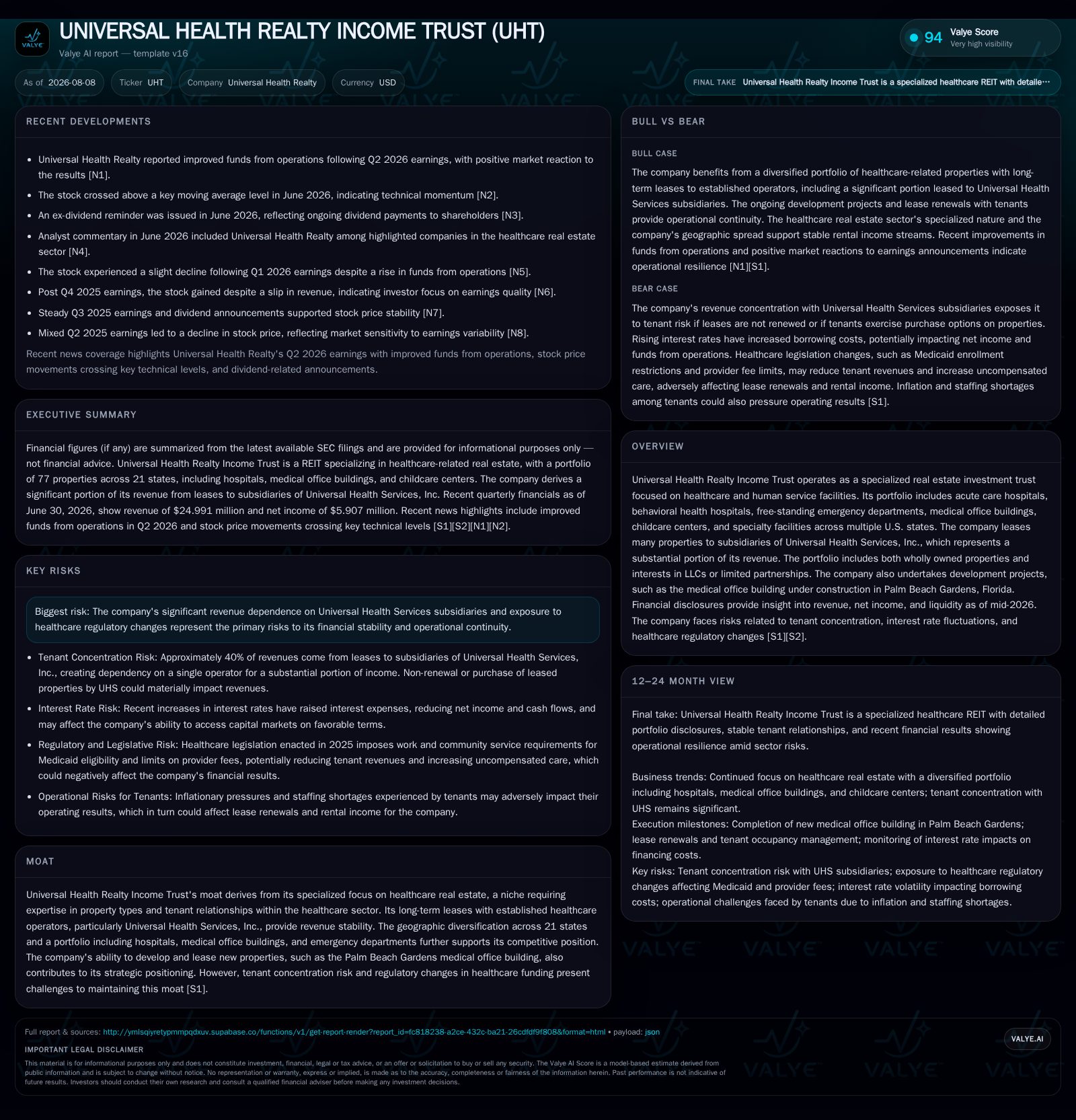
Universal Health Realty Income Trust (UHT) operates a specialized healthcare real estate portfolio, heavily leasing to subsidiaries of Universal Health Services, Inc. (UHS), which accounted for about 40% of consolidated revenues as of 2025 year-end. The company reported stable operations in its latest 10-Q with no material changes in risk factors, maintaining progress on its development pipeline including an 80,000 square foot medical office building in Palm Beach Gardens, Florida. UHT’s significant tenant concentration and exposure to healthcare regulatory shifts remain principal risks. While elevated interest rates continue to pressure borrowing costs, UHT’s long-term leases and geographic diversification across 21 states buttress revenue stability.
Recent Operating Update
Universal Health Realty Income Trust (UHT) disclosed stable operating conditions in its second quarter 2026 Form 10-Q filed August 7, 2026 [S2]. There were no material changes in risk factors compared to the prior year-end filing. Additionally, a recent earnings press release dated July 27 highlighted an improvement in funds from operations (FFO) [N1][S3]. This suggests steady operational performance amid headwinds from macroeconomic factors.
A key near-term development is continuing progress on the Palm Beach Gardens Medical Plaza I—an 80,000 square foot medical office building (MOB) under construction since February 2026. Estimated at around $34 million in cost, the project benefits from a long-term (10-year) master flex lease signed by a wholly owned UHS subsidiary covering approximately 75% of the rentable space, subject to third-party leasing [S1]. The anticipated completion in Q4 2026 underscores UHT's active development pipeline as a growth vector.
Business Model and Revenue Mechanics
UHT operates as a specialized healthcare REIT focusing exclusively on real estate assets dedicated to healthcare delivery and human services [S1][S24]. Its portfolio comprises acute care hospitals, behavioral health hospitals, free-standing emergency departments (FEDs), medical office buildings (MOBs), childcare centers, and specialty facilities across a diversified U.S. footprint spanning twenty-one states
Revenue generation primarily occurs via leasing arrangements with healthcare service operators—most notably subsidiaries of Universal Health Services, Inc. (UHS). These tenants collectively contributed roughly 40% of UHT's total revenues for recent reporting periods [S1]. Long-term triple-net leases underpin revenue stability; they generally feature contractual rent escalations that protect income against inflationary pressures.
UHT also holds partial ownership via interests in LLCs or limited partnerships for certain assets involving third-party tenants [S1]. This hybrid ownership structure diversifies income streams while maintaining concentrated operational control over core hospital properties.
Capitalizing on tenant preferences to outsource property ownership and management enables UHT to act as a landlord intermediary between capital markets and healthcare operators. As such, it often undertakes new facility developments or major renovations—evidenced by its Palm Beach Gardens MOB project—financed primarily through debt facilities alongside reinvested earnings [S1][S23]
Industry Structure and Competitive Position
Within the Healthcare REIT sector—characterized by asset classes like acute hospitals, behavioral health facilities, FEDs, and MOBs—UHT occupies a niche focused heavily on larger hospital operators but with geographic diversification to mitigate localized market risk. Peers such as Ventas Inc., Medical Properties Trust Inc., and Healthpeak Properties serve overlapping domains but vary in portfolio composition; for instance, Medical Properties Trust is more hospital-centric while Healthpeak leans towards life sciences and MOBs.
UHT's competitive moat derives from deep expertise managing specialized healthcare real estate coupled with longstanding tenant relationships—particularly its close alignment with UHS affiliates [S1]. This integration provides revenue predictability absent in more diversified REIT peers exposed to broader commercial real estate sectors.
However, tenant concentration remains pronounced: losing or renegotiating leases with major tenants like UHS could materially affect income streams. Balanced against this is broad geographic reach across twenty-one states and mixed asset types that provide some resilience against regional economic or regulatory shocks.
Growth Drivers
Growth prospects center on several vectors: continued expansion into outpatient and specialty care facilities fuels demand for MOBs; demographic trends like aging populations increase need for acute care hospitals and behavioral health services; and operator preference to reduce capital intensity fosters outsourcing real estate ownership to REIT landlords.
The Palm Beach Gardens MOB underscores active development as a strategic growth driver alongside acquisitions or joint ventures structured via LLC or LP ownership. Long-term master leases supporting these projects provide incremental rental income while anchoring occupancy rate contributions [S1][N1]. Geographic penetration into high-growth markets is consistent with sector trends favoring urban/suburban regions with expanding healthcare infrastructure needs.
Additionally, stable lease terms with built-in escalations support rental revenue growth over time even amid inflationary challenges. Maintaining high occupancy rates through lease renewals remains essential for sustained net operating income (NOI) expansion.
Risks and Constraints
Primary risks stem from tenant concentration given approximately 40% revenue reliance on UHS subsidiaries [S1], making UHT vulnerable to any financial distress or strategic shifts within this large tenant group. Furthermore, regulatory developments post July 2025—including the “One Big Beautiful Bill Act” introducing work/community service requirements limiting Medicaid enrollment—may reduce operator revenues thus impairing their ability to meet lease obligations [S1]. Reduced Medicaid spending combined with capped provider fees adds unresolved pressure on hospital operators’ cash flows.
Interest rate volatility also exerts downward pressure: past rate hikes have significantly increased interest expenses reducing net income, cash flows from operations, FFO levels, and potentially depressing property valuations due to higher cap rates [S1]. Although recent moderation occurred, future rate normalization remains uncertain.
Construction cost overruns or delays constitute execution risks linked to development projects like Palm Beach Gardens MOB. Inflationary pressures historically challenged tenant operating margins via personnel costs or staffing shortages; while somewhat abated recently these remain recurring concerns impacting tenant profitability [S1]. Lastly, potential lease expiration uncertainty requires careful monitoring given dependency on long-term renewal commitments.
What To Watch Next
Key milestones include completion of Palm Beach Gardens MOB expected by Q4 2026 [S1] along with securing third-party leases to optimize space utilization beyond the anchored UHS portion.
Operational KPIs warrant continuous scrutiny: occupancy rates across hospital facilities and MOBs; lease expiration schedules with renewal outcomes; tenant concentration metrics especially vis-à-vis UHS affiliate leases; funds from operations trends indicating cash-generative strength; net operating income progression reflecting margin resilience; capital expenditures relating to both maintenance and growth investments; and leverage ratios addressing interest coverage sufficiency given prevailing borrowing costs.
Regulatory updates affecting Medicaid/Medicare reimbursements must be closely monitored for downstream impacts on tenant sustainability. Interest rate movements will influence cost of capital dynamics determining future acquisition or development affordability.
Financial Profile Discussion
As of June 30, 2026 quarter-end, UHT held approximately $6.8 million in cash and equivalents against total debt approximating $374.8 million as of December 31, 2025 [F1]. This translates into net debt near $368 million reflecting a leveraged balance sheet typical within healthcare REITs where capital intensity necessitates substantial debt financing.
The company amended its credit agreement in April 2026 enabling an incremental $50 million term loan facility consistent with existing loan terms including variable interest rates indexed to SOFR plus applicable margins tied to leverage ratios [S23]. Despite elevated interest expense pressures noted historically reducing net income and FFO [S1], this financing flexibility supports development activities such as Palm Beach Gardens MOB while preserving liquidity buffers.
Maintaining manageable leverage ratios aligned with interest coverage requirements will be critical given ongoing sensitivity to fluctuating borrowing costs amid an uncertain macro backdrop affecting both market valuation multiples and access to attractive capital sources.
Disclaimer: This analysis is based solely on publicly available information from SEC filings and factual news references up to August 8, 2026. It does not constitute investment advice nor an endorsement of Universal Health Realty Income Trust securities. Readers should conduct their own due diligence before making any financial decisions.
Disclaimer: This is research-only, informational analysis and not investment advice. It may include AI-generated interpretation and general industry context. Always verify important details using primary sources.

Comments