
Biglari Holdings Balances Active Portfolio Management and Restaurant Subsidiary Growth Amid Market Volatility
The latest quarterly filing reveals stable liquidity and accelerated subsidiary sales growth within an actively managed investment portfolio dominated by public securities and restaurant operations.
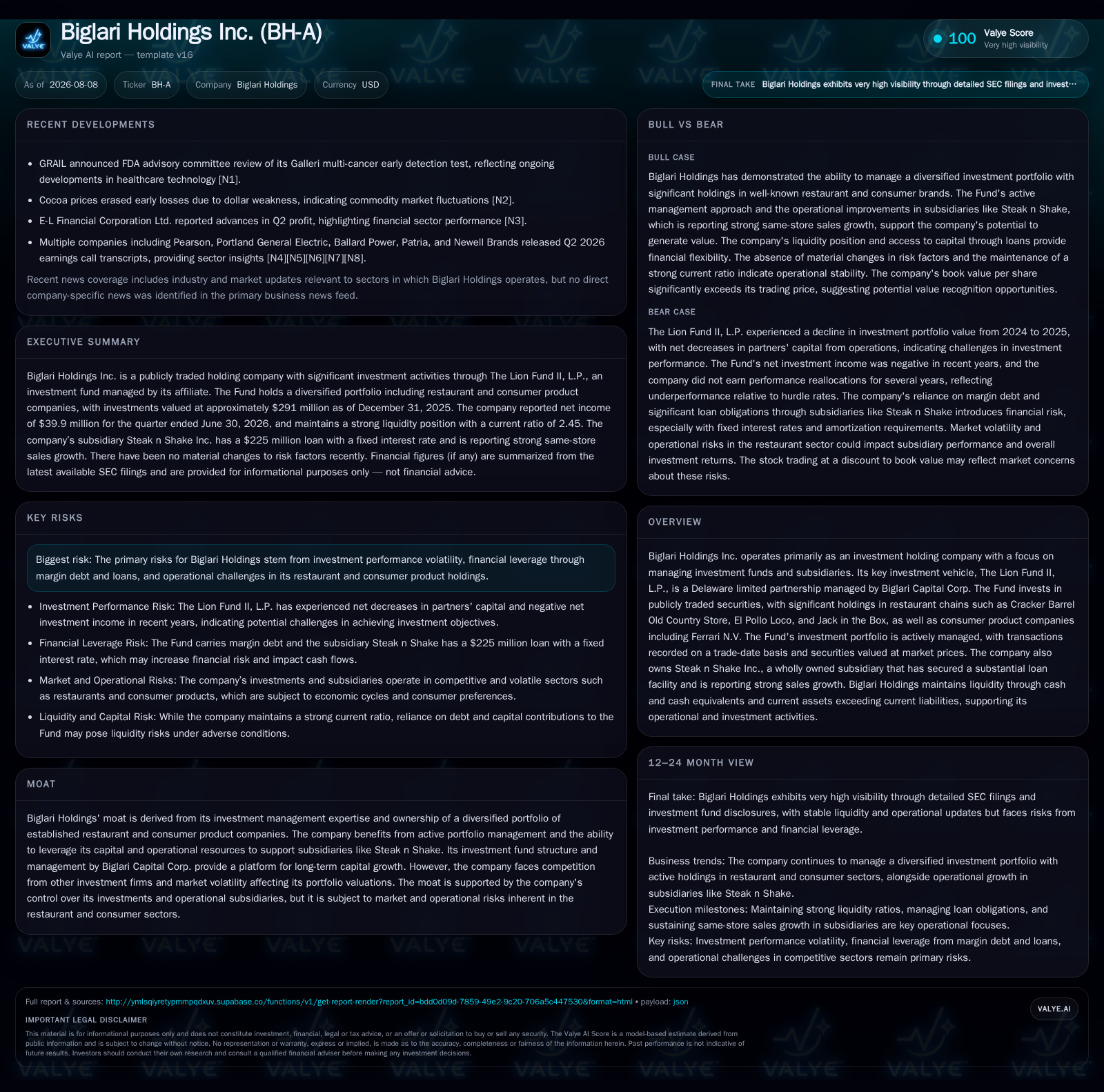
Biglari Holdings Inc. reported its second quarter results highlighting sustained liquidity management and promising sales momentum at Steak n Shake, its wholly owned restaurant subsidiary. The company’s investment portfolio, anchored by The Lion Fund II, L.P., continues to emphasize food-service and consumer product companies with active trade-date accounting and market valuation adjustments. While financial leverage through margin debt remains a watchpoint, the firm’s diversified holdings combine capital appreciation potential with operational upside in its subsidiaries, reflecting a hybrid business model amidst volatile market conditions.
Recent Operating Update
Biglari Holdings Inc.'s latest 10-Q filing dated August 7, 2026, confirms no material change to previously disclosed risk factors but presents key operational insights underscoring its hybrid investment-operating company model [S2][S23]. The company holds a robust liquidity position with current assets of approximately $384 million against current liabilities near $157 million, yielding a healthy current ratio of 2.45 as of June 30, 2026 [F1]. Cash and cash equivalents stood at about $68 million [F1], providing operational flexibility.
On the subsidiary front, Steak n Shake continues to show vigorous sales momentum. As reported earlier around late 2025 filings, Steak n Shake achieved same-store sales growth exceeding 15% across both company-operated locations and franchise partners in the U.S. This acceleration supports an operational turnaround narrative for the restaurant business under Biglari Holdings' control [S22][S26]. Further financial underpinning was secured via a $225 million loan facility obtained by Steak n Shake in September 2025 with an interest rate fixed at 8.8%, amortizing at 3% annually; this replaced a prior line of credit amounting to $75 million [S27]. The debt incurred through this facility is reflected on Steak n Shake's books but indicates Biglari Holdings' strategic use of leverage to fuel subsidiary operations.
Portfolio management remains pivotal. The Lion Fund II, L.P.—the company's Delaware-based limited partnership investment vehicle managed by Biglari Capital Corp.—continues its active management approach involving transaction recording on a trade-date basis with securities carried at market value [S1]. The fund concentrates notably on publicly traded equities in the restaurant sector (Cracker Barrel Old Country Store, El Pollo Loco, Jack in the Box) alongside consumer product firms such as Ferrari N.V., highlighting sector specialization that aligns with subsidiary business segments.
Business Model Specifics
Biglari Holdings operates primarily as an investment holding company with an embedded operating platform through wholly owned subsidiaries like Steak n Shake. Revenue streams thus derive from capital appreciation across public securities held within The Lion Fund II, realized dividend income from these holdings, and operational earnings generated by subsidiaries engaged mainly in food-service retail.
The company leverages active portfolio management strategies that encompass frequent buying/selling decisions influenced by market conditions. This aspect requires rigorous accounting governance given the presence of unrealized gains/losses driven by fluctuating public equity valuations reported monthly [S1].
Simultaneously, Biglari exerts direct operating control over its subsidiaries enabling them to harness economies of scale, refine unit economics through same-store sales growth initiatives (notably at Steak n Shake), and access external capital markets for funding growth via targeted loan facilities [S27][S22]. The loan secured by Steak n Shake reflects such asset-backed leverage intended to support ongoing expansion while maintaining manageable amortization schedules.
Liquidity management is critical given inherent volatility in both market valuations affecting the investment portfolio and operational cash flow required for subsidiaries’ working capital needs [F1]
Industry Structure and Competitive Position
Within the broader landscape of investment holding companies and asset management firms with operating affiliates—comparable peers include Berkshire Hathaway with its vast insurance operations and multiple subsidiaries or Loews Corporation for diversified holdings—Biglari Holdings distinguishes itself through concentrated sector bets predominantly in consumer retail dining brands alongside selective consumer product equities.
This positioning exposes Biglari Holdings to cyclical risks related to discretionary spending patterns impacting restaurants but offers upside from potential operational turnarounds fostering recurring revenue growth at subsidiaries such as Steak n Shake [S22]. Unlike pure equity funds or private equity firms focused solely on passive investment returns or short-to-medium-term flip cycles, Biglari’s combination model demands sophisticated capital deployment balancing portfolio rebalancing versus internal operating investments.
Market valuation sensitivity within publicly traded securities held in The Lion Fund II contributes marked volatility risk. For instance, margin debt utilized to finance portions of the fund introduces leverage risk where adverse price movements could amplify unrealized losses requiring either margin calls or forced liquidations under stressed conditions [S1]. Preservation of healthy liquidity ratios partly mitigates this vulnerability.
Growth Drivers
Multiple vectors underpin potential growth: favorable commodity pricing trends mitigating input inflation pressure on restaurant margins; accelerated same-store sales growth signaling effective merchandising/pricing strategies; strategic capital infusion into subsidiaries funded by recent loan facilities; dividend income escalation from portfolio companies rewarding sustained ownership; and disciplined asset allocation enabling opportunistic acquisitions or disposals aligned with long-term capital appreciation targets.
Continued improvement in subsidiary revenue streams coupled with effective cost controls would validate operating leverage benefits critically impacting consolidated earnings quality. Moreover, active repositioning within the fund via timely trade execution under trade-date accounting ensures responsiveness to shifting sector dynamics.
Risks and Watchpoints
Key risks revolve around market volatility impacting unrealized valuation swings within The Lion Fund II—a substantial portion of Biglari’s intrinsic value base—as well as potential credit risks stemming from reliance on margin debt for fund financing [S1]
Operationally, although same-store sales growth at Steak n Shake is promising (>15%), sustaining this momentum amid competitive pressures in the casual dining space requires ongoing innovation alongside cost management amid rising labor/commodity expenses.
Investor sentiment also poses risk: despite book values per share indicating underlying net asset value materially above trading prices (book value per Class A equivalent share approx. $2,244 vs. market discount) [S22], market skepticism suggests perceived execution uncertainties or macroeconomic concerns weighing on valuation multiples.
Active shareholder communications clarifying capital allocation philosophy amid market volatility will also be telling for investor confidence.
Financial Profile Discussion
Biglari Holdings displays disciplined financial stewardship evidenced by maintaining substantial liquidity reserves (~$68 million cash & equivalents) balanced against current liabilities ($157 million) yielding a strong current ratio near 2.45 as of June 2026 [F1]. This enhances financial flexibility critical for supplementing subsidiaries’ working capital needs while weathering portfolio valuation fluctuations.
Total debt figures available reflect past peak amounts (~$69.7 million as of late 2020) primarily associated with margin loans supporting The Lion Fund II activities [F1][S1]; updated specific recent debt levels tied directly to latest quarter are not explicitly detailed though recent loans secured by Steak n Shake are separately noted at $225 million amortizing at predetermined rates [S27]. Net debt—considering cash offset—is modest when isolating corporate-level obligations suggesting manageable net leverage absent full consolidation effects.
Ongoing interest expense coverage will remain a focal metric given announced borrowing costs (8.8% fixed interest for recent Steak n Shake loan facility) contrasted against fluctuating earnings derived both from investment income/dividends plus operating profits generated downstream via subsidiaries [S27][S22]
In summary, financial posture aligns with an intermediate risk tolerance profile balancing leveraged expansion opportunities against conservative liquidity cushions deployed tactically across variable operational environments.
This analysis is based solely on publicly disclosed filings dated through August 7, 2026. It aims to provide an informed perspective on Biglari Holdings Inc.’s integrated investment-operating business model without offering any form of investment advice or research view.
Disclaimer: This is research-only, informational analysis and not investment advice. It may include AI-generated interpretation and general industry context. Always verify important details using primary sources.

Comments