
Finance of America Companies Accelerates Expansion with New Home Equity Products and Capital Strategies
FOA's Q2 2026 results highlight growth in reverse mortgage originations and a strategic push into traditional home equity lending amid evolving capital markets dynamics.
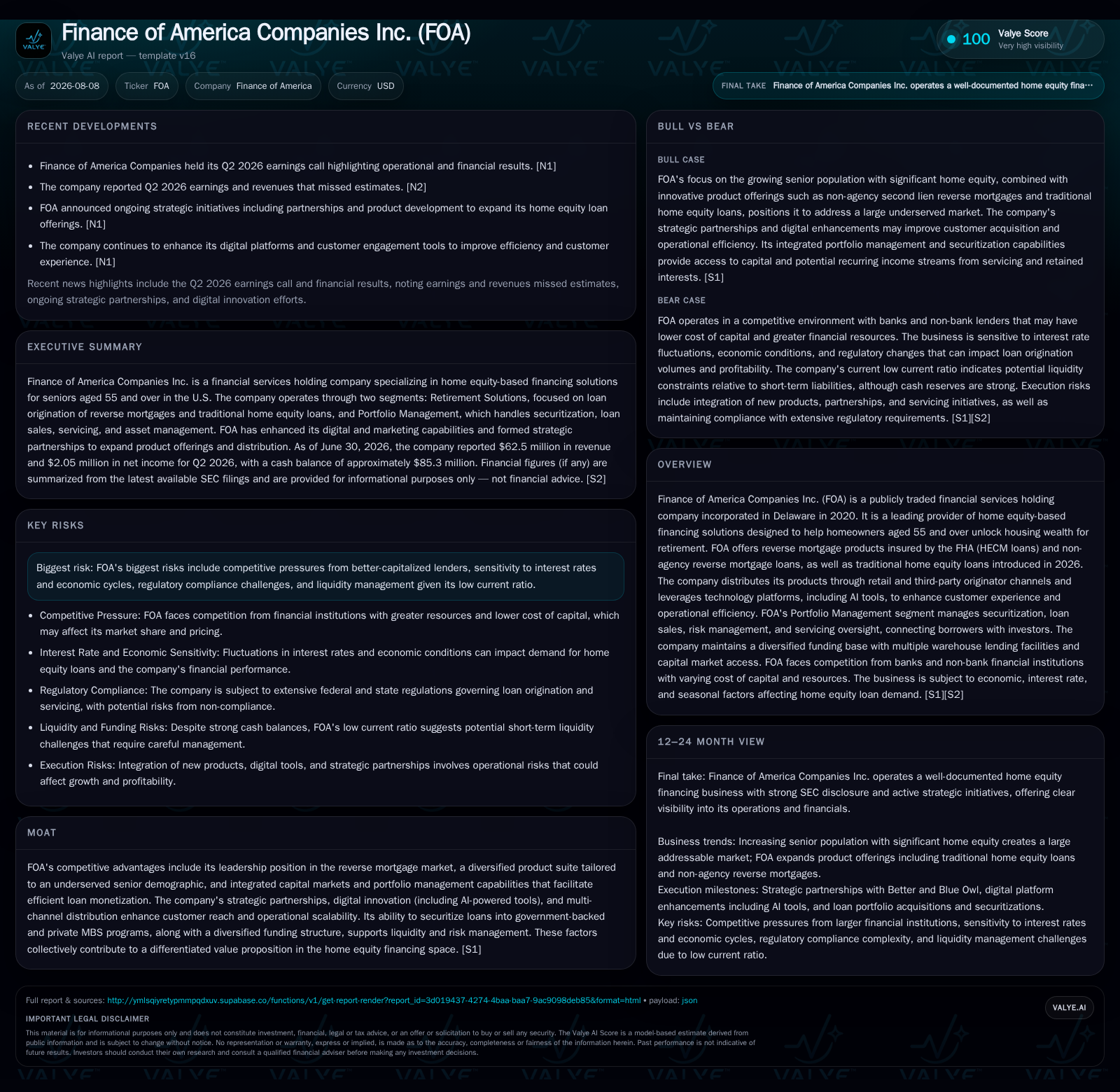
In its latest quarterly filing, Finance of America Companies Inc. reported sustained loan origination momentum driven by a combination of FHA-insured HECM reverse mortgages and recent entry into traditional home equity loans. The acquisition of a $5.2 billion servicing portfolio from Onity Mortgage expands FOA’s footprint in loan servicing scale, bolstering recurring income potential. This operational progress is paired with a diversified funding base through multiple warehouse lending facilities and strategic partnerships, notably with Blue Owl Capital, supporting liquidity amidst interest rate volatility and competitive pressures. While the company faces constraints such as a low current ratio indicating liquidity tightness and ongoing regulatory compliance demands, its multi-channel distribution approach and product innovation position it well to capture growth in the underserved senior homeowner financing segment.
Q2 2026 Operational Momentum: Origination Trends and Portfolio Expansion
Finance of America Companies Inc. (FOA) reported steady operational gains in the second quarter of 2026, anchored by sustained origination volumes in its FHA-insured Home Equity Conversion Mortgages (HECM) reverse mortgage products alongside initial contributions from newly launched traditional home equity loans [S2]. The recent acquisition of Onity Mortgage’s reverse mortgage servicing portfolio further amplified FOA’s scale by adding approximately $5.2 billion in unpaid principal balance across roughly 20,000 HECM loans [S7]. This sizeable portfolio acquisition not only expands FOA's servicing assets but also enhances recurrent fee income, reinforcing the company's integrated footprint across loan origination and servicing.
This dual growth vector is particularly relevant given the demographic trends underscoring FOA’s addressable market: an aging U.S. population with growing housing wealth yet low penetration rates for reverse mortgages among eligible seniors [S1]. While interest rate fluctuations have tempered some demand dynamics industry-wide, FOA's balanced product mix partly mitigates sensitivity by addressing varying borrower preferences within the senior cohort [N1]. The addition of traditional home equity loans—originated primarily for borrowers seeking higher loan-to-value solutions than those permissible under reverse mortgages—further diversifies revenue streams and leverages existing distribution channels [S6].
Product Innovation Beyond Reverse Mortgages Strengthens Addressable Market Reach
FOA’s expansion into traditional home equity lending marks a strategic evolution from its established leadership in reverse mortgages toward a more comprehensive suite of home equity-based products tailored for seniors [S1]. The introduction of non-agency second lien reverse mortgages earlier enhanced flexibility for borrowers maintaining primary mortgages while accessing additional liquidity without monthly payments [S6]. These products create a niche within the underserved senior market with specific credit structures that appeal to customers balancing lower-rate first liens with flexible second lien debt.
By complementing FHA-insured HECM offerings with non-agency products and now traditional home equity loans sold primarily on a servicing-released basis to investors, FOA addresses gaps left by competitors who often specialize narrowly. This product breadth supports cross-selling potential through its multi-channel network encompassing proprietary retail platforms and third-party originators (mortgage brokers), crucial for scaling penetration among diverse borrower profiles [S1].
Capital Markets Savvy Behind Loan Securitization and Funding Stability
FOA's Portfolio Management segment orchestrates securitization strategies critical to funding origination volumes while managing investor relations and risk retention [S1]. Through securitizing HECM loans into government-backed Home Equity Conversion Mortgage-Backed Securities (HMBS) guaranteed by Ginnie Mae, alongside private-label issuance of non-agency reverse mortgage securities valued near $2 billion in 2025, the company has demonstrated strong capital market execution capabilities [S4][S13].
Additionally, FOA benefits from robust warehouse lending facilities—totaling 15 lines with 11 counterparties—providing approximately $1.7 billion in committed and uncommitted capital access as of December 2025 [S4]. This diversification mitigates concentration risk usually observed when lenders rely heavily on single-source liquidity. Coupled with its strategic partnership with Blue Owl Capital that includes a $2.5 billion purchase commitment framework for originated or acquired loans, FOA secures flexible capital to sustain growth even amid higher interest rate environments that challenge origination economics [S6]. This layered funding structure balances holding certain higher-yield non-agency loans for investment with active sales strategies to manage liquidity.
Competitive Dynamics: Balancing Scale, Distribution Channels, and Product Breadth
FOA occupies a distinctive competitive position as one of the few publicly traded financial services firms focusing primarily on home equity financing solutions aimed at seniors [S1]. Its direct competition ranges from specialized reverse mortgage lenders such as American Advisors Group to broader traditional home equity lenders like Quicken Loans operating at larger scale but without similar senior-focused product specialization.
The company’s dual-channel origination model—retail platform plus third-party originators—enables broad geographic reach while leveraging broker networks that drive significant volume nationally [S1]. Investment in AI-enabled underwriting tools enhances operational efficiency and customer experience quality, which may offset some disadvantages against lenders benefiting from lower-cost capital or extensive economies of scale [N1]. However, regulatory compliance burdens common across players introduce cost challenges that can pressure margins under cyclical funding conditions [S24][N2].
Growth Drivers: Demographics, Technology Integration, and Partnership Leverage
Underlying FOA's business case is solid demographic momentum: daily increments of U.S. residents turning 65 years old number over 11,000 according to Census data cited in filings [S1]. Rising housing wealth particularly among this cohort aligns well with increasing demand for products enabling retirees to convert illiquid real estate assets into retirement income streams.
Technological innovation acts as an enabler rather than driver per se; AI applications improve credit assessment precision and expedite servicing workflows reducing costs while enhancing borrower satisfaction metrics—a valuable competitive differentiator given the complexity inherent to reverse mortgage underwriting [N1][S6]. Rising rates generally suppress loan origination volumes industry-wide; hence monitoring change in funded originations relative to prevailing rates is critical.
Liquidity indicators represent an acute watchpoint: FOA has reported a notably low current ratio near 0.05 historically as per companyfacts data implying tightly matched short-term assets versus liabilities [F1]. While this reflects the typical asset-liability mismatch in mortgage lending relying on longer-duration receivables funded through revolving credit lines rather than cash equivalents alone, it flags heightened sensitivity to credit facility availability or disruptions in securitization markets.
Additionally, regulatory compliance spanning federal FHA program rules for HECMs plus diverse state-level consumer finance statutes impose significant operational overheads. Increasing scrutiny by regulatory bodies demands ongoing investments in compliance infrastructure including cybersecurity governance highlighted at the board level to mitigate information security risks intrinsic to handling sensitive borrower data [S1][S24].
Forward Indicators: Early Demand Signals, Servicing Enhancements, and Capital Deployment Plans
For subsequent quarters, key performance indicators include tracking adoption rates for newly introduced traditional home equity loans post-October 2025 launch as these will materially affect revenue diversification trajectories [N1][S3]. Servicing portfolio quality metrics such as delinquency levels or prepayment speeds will also serve as early signals on credit risk trends impacting future earnings stability.
Operationally, progress on internal servicing capability enhancements aimed at streamlining maturity resolutions and improving borrower engagement could reduce loss incidence while potentially lowering servicing expenses over time—areas management is actively prioritizing after the Onity portfolio acquisition integration [S4][S8]. Lastly, expanded utilization or amendments to warehouse facility commitments will be instructive regarding capital deployment appetite amid ongoing macroeconomic uncertainties.
Financial Profile Discussion: Liquidity Position, Debt Structure, and Profitability Outlook
FOA’s balance sheet evidences typical leverage characteristics within specialized mortgage lending businesses reliant on capital markets funding. At June 30, 2026, cash and equivalents stood at approximately $85 million [F1]. Total debt was approximately $358 million and net debt about $272 million as of December 31, 2025, based on the latest available data [F1]. This level conveys leverage risks albeit mitigated by committed warehouse lines forming part of diversified financing sources.
In summary, Finance of America Companies is tactically expanding both product scope and portfolio scale supported by sophisticated capital markets access and strategic alliances. The company leverages demographic-driven demand for retirement-focused home equity solutions while evolving its platform amid interest rate headwinds and liquidity vigilance requirements. Monitoring soon-to-emerge metrics on traditional loan uptake alongside funding cost trends will clarify trajectory sustainability over coming quarters.
Disclaimer: This is research-only, informational analysis and not investment advice. It may include AI-generated interpretation and general industry context. Always verify important details using primary sources.

Comments