
Cohen & Co's Growth Anchored in NAV-Based Investments and Convertible Capital Structure
The latest quarterly results highlight Cohen & Co’s revenue expansion fueled by specialized asset segments and strategic capital framework.
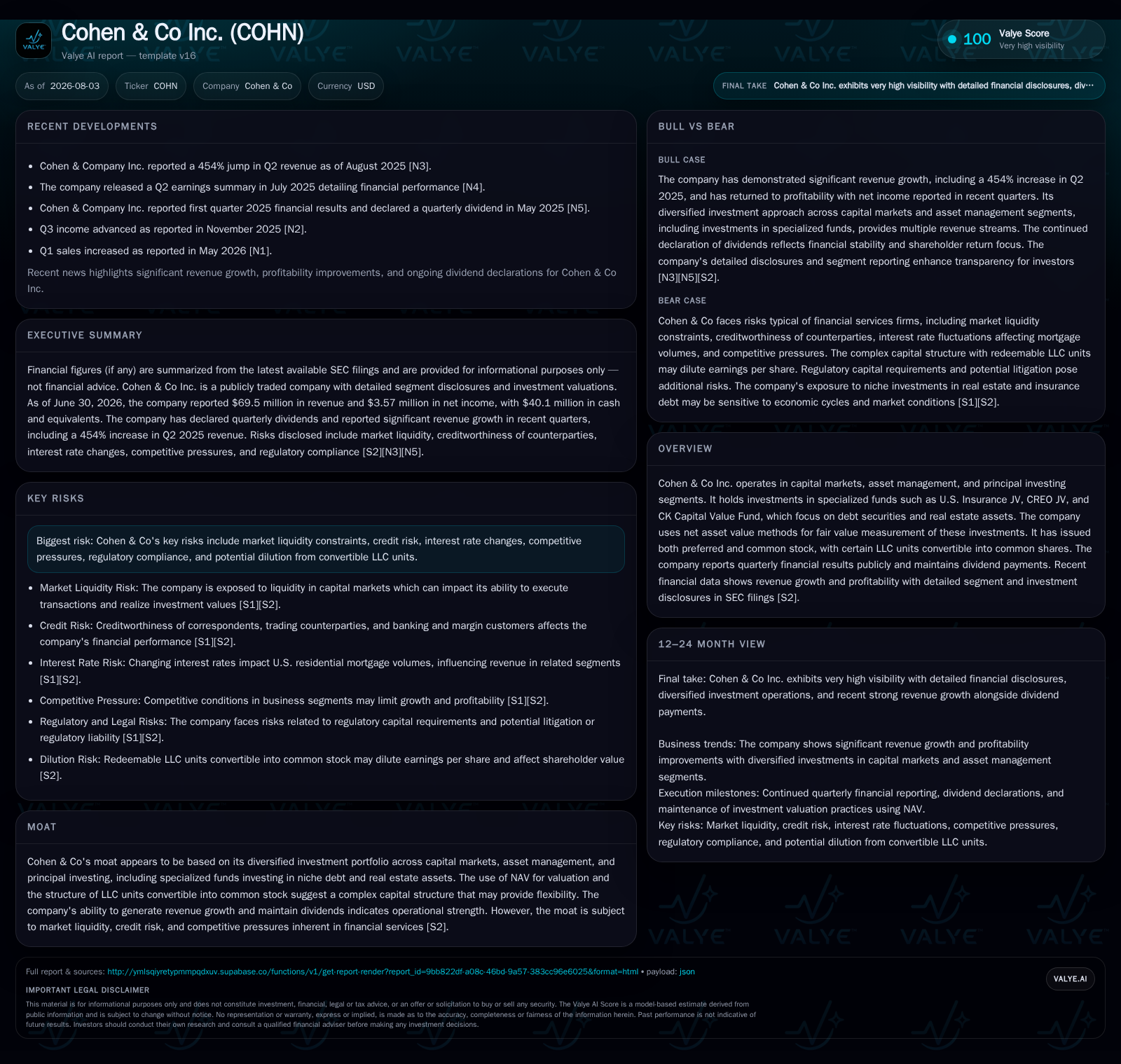
Cohen & Co Inc. reported solid operational progress in Q2 2026 with continued revenue growth supported by its diversified portfolio including insurance debt, commercial real estate loans, and European real estate assets valued via net asset value (NAV) methods. The complex capital structure featuring convertible LLC units adds flexibility but presents dilution considerations. The firm’s exposure to credit risk, liquidity constraints, and interest rate fluctuations requires ongoing risk management. Its dividend sustainability ties closely to investment income stability within a competitive asset management landscape dominated by both large multi-strategy firms and niche specialists.
Recent Operating Update Highlights
Cohen & Co Inc.’s Q2 2026 filing reinforced its ongoing momentum with reported revenue growth across its three primary business segments: capital markets, asset management, and principal investing [S2]. The company disclosed stable investment activities through specialized funds—the U.S. Insurance Joint Venture focuses on USD-denominated debt of small to mid-sized insurers; the CREO JV invests primarily in multi-family commercial real estate mortgage-backed loans; while the CK Capital Value Fund holds office buildings chiefly in the Netherlands [S1]. Valuation of these funds relies on net asset value (NAV) or equivalent methods under ASC 820 guidance, positioning the firm to reflect fair value reasonably but also leaving reported income sensitive to market liquidity and credit conditions.
Notably, the company maintains a complex capital framework involving convertible LLC units that non-controlling interests hold. These units can be redeemed for either cash reflecting ten-day average market prices or converted at a one-tenth share ratio into common stock [S1]. This mechanism injects potential dilution into earnings per share calculations when conversion is not anti-dilutive but provides structural financial flexibility.
The Q2 disclosures excluded certain indirect overhead costs—such as executive, legal, IT, human resources expenses—and interest expense from segment profitability presented to the chief operating decision maker (CODM) [S1]. These exclusions help highlight performance drivers distinctly attributable to core investment activities versus corporate support functions
Business Model Fundamentals
Cohen & Co operates predominantly as a multifaceted asset manager coupled with principal investment activities. Its revenue streams likely blend management fees earned on assets under management (AUM), performance fees contingent on investment returns exceeding benchmarks, interest income generated from debt securities held within funds, dividends from real estate holdings, and realized/unrealized capital gains on principal investments.
Clients typically consist of institutional investors seeking exposure to alternative asset classes like insurance-linked securities or commercial real estate debt with geographic specialization (e.g., Dutch office properties). Fund structures accommodate investor liquidity preferences while employing NAV-based valuations which must align periodically with audited financials to maintain transparency.
Convertible LLC units offer an additional layer of capital raising flexibility while integrating shareholder alignment mechanisms via conversion rights tied to common equity. However, this also necessitates careful earnings-per-share dilution monitoring especially amid rising share price environments or redemption waves.
Profitability hinges on volume (AUM growth), fee rate maintenance/pricing power in a competitive fee environment, credit spread capture especially in niche insurance debt sectors, and prudent risk allocation across the portfolio mix. Expense control over indirect overhead supports margin expansion though variable operating expenses linked to fund performance can induce episodic swings.
Industry Structure and Competitive Positioning
Operating within the broad Asset Management and Investment Services industry segment that includes firms like BlackRock known for scale diversification; Carlyle specializing in private equity alternatives; Brookfield's infrastructure/real estate focus; Apollo’s credit strategies; and KKR’s principal investing verticals—Cohen & Co positions itself at a smaller scale but leverages niche expertise in insurance debt and selective real estate funds.
The company’s use of joint ventures as fund vehicles offers both growth capacity and risk diversification benefits but requires robust valuation procedures given illiquidity inherent in specialty debt instruments. The convertible unit setup introduces a relatively uncommon capital structure element compared to pure-stock publicly traded peers which may appeal to specific investor profiles valuing downside protection through redemption options.
NAV-based reporting is standard in alternative asset segments yet demands continuous monitoring of underlying portfolio credit risks and valuation integrity amidst shifting macroeconomic factors such as interest rate volatility impacting debt pricing [S1]. Regulatory oversight intensifies around valuation fairness given fair value measurement implications for investor reporting.
Growth Drivers
Several structural trends underpin Cohen & Co’s growth prospects:
- Increasing allocations by global institutional investors toward alternative investments including specialty insurance-linked debt and real estate assets due to historically low correlations with traditional equities.
- Rising demand for tailored fund structures fostering diversification via joint ventures enabling targeted geographic or sector exposure.
- Continued innovation in investment products leveraging data-driven risk analytics enhancing portfolio construction efficiency.
- Favorable regulatory frameworks facilitating fund formation while bolstering investor protections akin to those applied at larger peer firms.
- Established track records within niche sectors attracting incremental capital inflows that feed into management fees and performance incentive streams.
Measurable KPIs supporting this growth lens include Assets Under Management (AUM) expansion rates across funds measured via NAV increases plus new investor commitments; investment income growth reflecting portfolio yield capture; dividend payout stability signaling cash flow reliability; and tighter expense ratios evidencing operational leverage.
Risks and Constraints
Cohen & Co faces typical sector risks highly relevant given its portfolio composition:
- Liquidity risk inherent in multi-family commercial mortgage loans or international office buildings may delay exit timing affecting NAV reliability [S1].
- Credit risk particularly concentrated in smaller insurers’ debt instruments exposes the portfolio to default cycles requiring vigilant underwriting and reserves.
- Interest rate fluctuations can depress fixed income returns or real estate valuations thereby constraining distributable income available for dividends.
- Competitive pressures from both global mega-managers offering scale advantages and specialized boutiques targeting similar niches can compress fees or pressure deal pipelines.
- Regulatory risk related to compliance with evolving accounting standards for fair value measurements plus disclosure requirements concerning convertible securities’ dilution dynamics.
- Convertible LLC units pose dilution risk impacting shareholder earnings especially if widespread conversions occur amid positive market sentiment triggering earnings-per-share caution.
- Operational complexity managing separate legal entities (joint ventures) mandates effective governance controls ensuring consistency in reporting accuracy.
What to Watch Next
Key near-term indicators will center around:
- Quarterly NAV updates for core funds—U.S. Insurance JV, CREO JV, CK Capital Value Fund—to gauge portfolio valuation trends reflective of credit cycles or property market dynamics.
- Volume movements including new capital raises or partial redemptions of convertible LLC units which influence share count dynamics.
- Segment-specific profitability shifts highlighting where capital markets versus asset management versus principal investing revenues expand or contract especially amid market uncertainty.
- Dividend declarations aligned against realized investment income serving as a barometer of underlying cash generation sustainability.
- Regulatory developments impacting valuation disclosures or conversion mechanics of LLC units potentially affecting investor perception.
Financially supportive data from Q2 2026 reveals cash balances totaling approximately $40 million with no outstanding debt reported ensuring conservative leverage positioning as of quarter-end [S2][F1]. Continued zero-leverage enhances financial flexibility amid uncertain markets at present.
Financial Profile Discussion
As of June 30, 2026, Cohen & Co maintains a strong liquidity position with roughly $40 million in cash and equivalents without recorded debt obligations [F1], suggesting no immediate refinancing concerns or covenant pressures. This net cash posture provides a buffer supporting dividend distributions even when facing potential NAV volatility due to macroeconomic factors [S2].
Convertible LLC units’ impact manifests mainly through diluted EPS adjustments rather than direct liabilities providing a non-cash capitalization mechanism enhancing financial maneuverability without burdening balance sheet leverage directly [S1]. This feature warrants close attention as conversion activity can shift equity base metrics episodically.
The highlighted risks underscore standard operational vigilance requirements faced by firms navigating liquidity-sensitive portfolios augmented by convertible capital structures. Investors tracking this company should prioritize upcoming NAV developments along with convertible unit activity as main demand signals influencing near-term performance outcomes.
Disclaimer: This is research-only, informational analysis and not investment advice. It may include AI-generated interpretation and general industry context. Always verify important details using primary sources.

Comments