
Corcept Therapeutics Advances Specialty Pharma Growth with Lifyorli Launch and Cortisol Modulator Pipeline
Corcept’s recent quarterly results reflect strengthening revenue from its cortisol modulators portfolio, including newly commercialized oncology drug Lifyorli, amid sustained investment in clinical and commercialization activities.
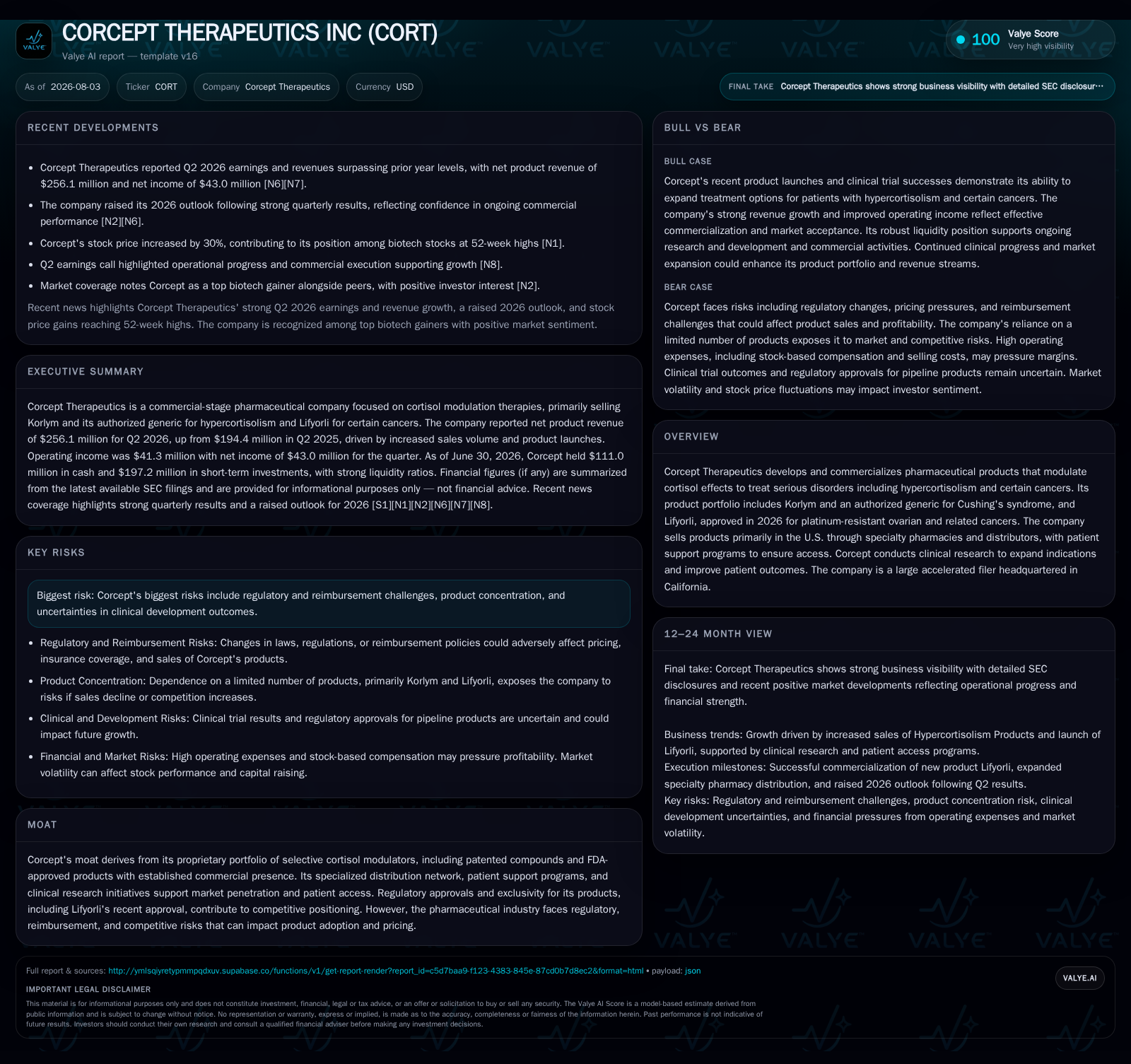
In Q2 2026, Corcept Therapeutics reported accelerated revenue growth driven primarily by its established Hypercortisolism Products and the first full quarter contribution from Lifyorli, approved in early 2026 for platinum-resistant ovarian cancer. Corcept leverages a focused business model centered on selective cortisol modulators to treat endocrine disorders and certain cancers, combining patented compounds with targeted commercialization through specialty pharmacies. The company’s competitive positioning benefits from FDA approvals and exclusivity but faces typical biotech risks such as regulatory hurdles and reimbursement pressure. Its financial profile shows strong liquidity supporting ongoing research and patient access programs. Key near-term growth drivers include expanding Lifyorli market penetration and advancing additional compounds in its development pipeline.
Recent Operating Update Highlights
ogy assets [S23]
Cash and cash equivalents stood at $111 million at quarter-end with total marketable securities surpassing $513 million, providing strong liquidity buffers to fund ongoing trials and commercial scale-up efforts without near-term capital raises [F1], [S2]. The current ratio exceeded 2.8x underscoring solid working capital management [F1].
Business Model Analysis: Therapeutic Focus and Commercial Strategy
Corcept operates within the pharmaceutical value chain primarily as an innovator in selective cortisol modulation chemistry with proprietary drug candidates targeting serious disorders with significant unmet need such as Cushing’s syndrome (hypercortisolism) and selected cancers exhibiting resistance to conventional chemotherapy agents. The company’s revenue derives directly from pharmaceutical product sales to patients mostly within the U.S., facilitated through an exclusive distribution arrangement with Curant Health Georgia LLC for direct-to-patient fulfillment via specialty pharmacies plus specialty distributors serving hospital pharmacies and other institutional buyers [S24], [S13].
The core product Korlym addresses hypercortisolism by blocking glucocorticoid receptors; its authorized generic counterpart broadens price competitiveness while maintaining brand loyalty supported by prescriber engagement through field medical liaisons. Recently introduced Lifyorli expands Corcept’s portfolio into oncology space treating platinum-resistant epithelial ovarian, fallopian tube or peritoneal cancer when paired with nab-paclitaxel chemotherapy—a strategic extension that diversifies revenue streams albeit with higher development complexity given oncology reimbursement constraints and prescribing ecosystems distinct from endocrinology indications [S13], [S5].
Important facets of Corcept's go-to-market approach include patient support initiatives offering medication access programs free-of-charge to eligible patients which mitigate payer-related barriers especially given the specialized population size; these costs are recognized as selling expenses rather than revenue reducing reported margins but facilitating adherence metrics crucial for long-term market penetration [S16]. Revenue recognition accounts separately for direct shipments to patients versus sales to specialty distributors with provisions for government rebates, chargebacks, estimated returns, co-pay assistance deductions affecting net realized revenue levels [S24].
Industry Landscape and Competitive Positioning
Within the biopharmaceutical industry segment focused on endocrine disorders coupled with niche oncology indications, Corcept maintains a defensible competitive position anchored on FDA approvals granted since 2012 for Korlym (with supplemental authorized generics launched in 2024) and the recent milestone regulatory clearance for Lifyorli in early 2026. This combination lends patent exclusivity protection across multiple cortisol modulating molecular series totaling over one thousand novel compounds developed internally facilitating potential pipeline expansion beyond current indications [S13], [S5].
Competition includes large pharmaceutical firms with broader oncology portfolios potentially bringing their own agents into platinum-resistant cancer treatment regimes alongside generics impacting hypercortisolism treatment economics. However, Corcept sustains differentiation through focused receptor modulation mechanisms ensuring clinical relevance against cortisol-driven pathologies—a niche not widely crowded—plus specialty pharmacy partnerships enabling tailored patient experience overshoot compared to mass-market channels.
Reimbursement uncertainties pose a common industry-wide headwind intensified by government action such as the Inflation Reduction Act which imposes inflation-based rebates on Medicare pharmaceuticals as well as enabling CMS negotiation authority over select drugs affecting net pricing power starting mid-decade onward—pressures likely to shape margins negatively unless mitigated via patient volume or new indication approvals offsetting average selling price erosions [S27]
Growth Drivers
The primary near-term growth catalyst is revenue ramp from Lifyorli following its commercial launch combining relacorilant with nab-paclitaxel chemotherapy addressing previously underserved platinum-resistant ovarian cancer patients with limited options post bevacizumab treatment failure—an area where efficacy gains translate into meaningful adoption by oncologists familiar with chemotherapy adjunctive strategies. Observing uptake velocity at specialty pharmacies will be a key operational KPI as will ongoing clinical trial results supporting label expansions or alternative combination regimens enhancing market size assumptions.
Continued penetration of Korlym authorized generics contributes incremental volume growth even amid pricing moderation due to channel mix impacts. Corcept’s R&D pipeline advancement focusing on newer selective cortisol modulators targeting additional oncologic or metabolic conditions represents a medium-term avenue for diversification reducing reliance on product concentration risks inherent in its two-product primary portfolio today [S13]. Ongoing expenditure alignment indicates cost discipline balancing developmental progression while sustaining commercial infrastructure expansion necessary to maximize return on recent FDA approvals.
Risks and Watchpoints
Principal risks comprise regulatory uncertainties including potential clinical setbacks or prolonged approval timelines for pipeline assets; pricing pressure driven by payer policies especially Medicare rebate frameworks inherent within IRA legislation; high concentration risk due to significant dependence on a narrow set of products; intellectual property challenges as patents erode; litigation threats typical to pharma sector; plus supply chain or manufacturing disruptions affecting product availability given reliance on specific active pharmaceutical ingredient procurement strategies classified partly as strategic inventory extending beyond normal operating cycles [S21], [S22], [S26].
Monitoring evolving reimbursement dynamics post-inflation rebate implementation will be critical as it impacts gross-to-net revenue conversion ratios directly affecting profitability metrics. Additionally, successful expansion of indications or achievement of regulatory milestones for pipeline corticosteroid receptor modulators will materially influence medium-term growth trajectory.
What to Watch Next
Investors and industry observers should track quarterly sales progress reports emphasizing Lifyorli volume growth curves relative to company guidance revisions disclosed in earnings releases extending through late 2026. Clinical trial milestones forthcoming over next 12-18 months involving novel selective cortisol modulators under study for various endocrine-oncology intersections will indicate future R&D productivity.
Evaluate updates regarding patient support program efficacy impacting adherence rates which can drive demand sustainability in orphan or rare disease segments where Corcept competes. Also watch any commentary relating to evolving payer contracts affecting reimbursement levels or formulary placements particularly within Medicare Part B/D sectors under governmental price negotiation frameworks introduced by IRA legislation.
Financial Profile Discussion
Corcept Therapeutics entered Q2 2026 with a robust balance sheet characterized by cash equivalents totaling approximately $111 million complemented by short- and long-term marketable securities aggregating above $513 million providing solid liquidity amid biotech industry capital intensity demands for R&D investment [F1], [S2]. Total debt outstanding was approximately $45 million as of June 30, 2026, with a net cash position reflecting strong liquidity and prudent leverage management [F1].
Current assets exceeded current liabilities nearly threefold yielding a current ratio of approximately 2.86 which supports operational flexibility including inventory build-up categorized partially as non-current strategic stock intended to buffer supply chain uncertainties around active pharmaceutical ingredients critical for continuous drug supply chain integrity [F1], [S21], [S22].
Operating expenditures continue balancing between increased marketing/sales investments required for commercial launches—including field medical liaison staffing—and controlled R&D spend demonstrating efficient allocation aligned with milestone-driven project pipelines predominantly focused on oncology expansion alongside base hypercortisolism treatments maintenance costs.
Overall, Corcept's financial footing appears well-positioned to sustain multi-year innovation cycles characteristic of biotech/pharma sector dynamics while navigating competitive reimbursement pressures and regulatory complexity.
This analysis synthesizes public SEC filings dated July 29, 2026 ([S2], [S3]) supplemented by recent earnings commentary ([N4], [N9]) without providing investment advice.
Disclaimer: This is research-only, informational analysis and not investment advice. It may include AI-generated interpretation and general industry context. Always verify important details using primary sources.

Comments