
Hybrid Cloud Leadership and Goodwill Risks Define Unisys' Strategic Crossroads
Unisys’ Q2 2026 results underscore advances in AI-integrated hybrid cloud offerings alongside a full goodwill impairment in its Digital Workplace Solutions division, highlighting both growth potential and valuation challenges.
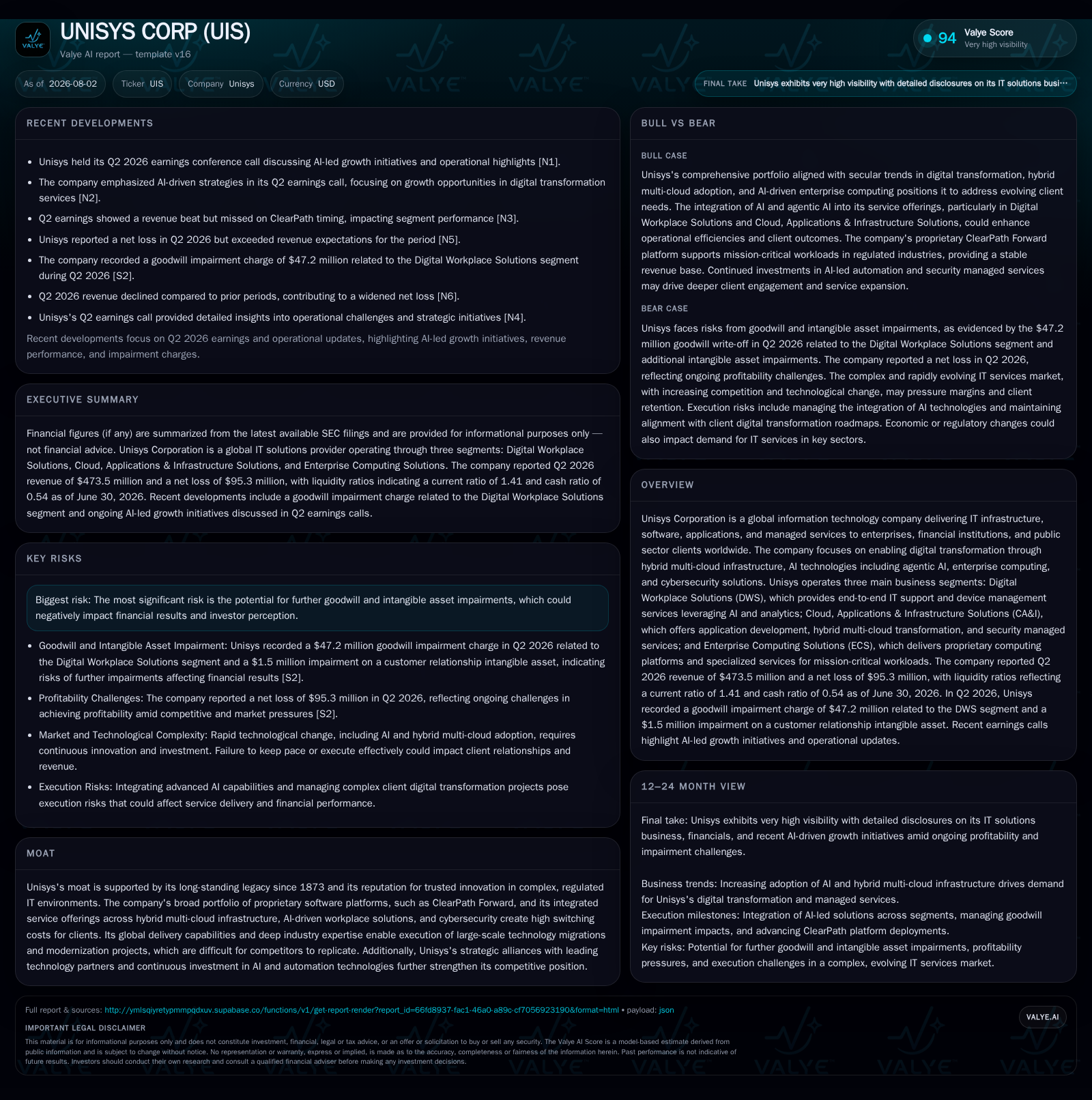
In its latest quarterly filing, Unisys recorded a $47.2 million goodwill impairment charge related to its Digital Workplace Solutions unit, signaling revised expectations for future cash flows and prompting reappraisal of that segment’s profitability. Concurrently, Unisys is progressing its strategy of embedding AI-driven automation across its managed services and hybrid multi-cloud infrastructure solutions, driving growth in higher-margin offerings. The company’s proprietary ClearPath Forward platform remains central to its enterprise computing segment, acting as a bridge between legacy license revenues and emerging SaaS-like models. Balancing these dynamics amid competitive pressures, client retention demands, and evolving technology adoption frames Unisys’ near-term trajectory.
Q2 Operating Results Spotlight Buy-Side Concern: Full DWS Goodwill Impairment Triggers Reevaluation
Unisys’ Q2 2026 quarterly report disclosed a significant goodwill impairment charge totaling $47.2 million assigned to its Digital Workplace Solutions (DWS) reporting unit, fully writing off the carrying amount of goodwill for that segment [S2]. This impairment stemmed from triggering events that led management to revise downward expected future cash flows from DWS, reflecting shifts in demand or competitive pressures impacting profitability. Additionally, a smaller $1.5 million intangible customer relationship asset was impaired concomitantly. The full write-down sharpens focus on the sustainability of earnings from DWS—a historically important component for recurring managed services—raising questions about client retention dynamics or price erosion within this division. Going forward, stabilization would require either meaningful contract renewals at favorable terms or visible improvement in operational cash generation forecasts signaled through subsequent earnings releases.
Proprietary Platforms and Hybrid Multi-Cloud Services Define Revenue Streams and Client Stickiness
At the core of Unisys’ business model is ClearPath Forward, a proprietary collection of software platforms that deliver secure transaction processing at scale across on-premises and cloud environments [S1],[S4],[S6]. This platform underpins the Enterprise Computing Solutions (ECS) segment's revenue through a blend of licensing fees and ancillary service engagements such as application development and modernization. Crucially, ClearPath Forward is also evolving toward a SaaS-style delivery model to capture market shifts—but this transition entails near-term cash flow timing impacts as upfront license revenues convert into spread-out subscription fees [S1]. Alongside proprietary software revenues is the growing Cloud, Applications & Infrastructure (CA&I) segment focusing on hybrid multi-cloud management and security services. These managed service contracts offer more predictable recurring revenue streams and increase switching costs via integrated infrastructure operations tailored for complex enterprise and public sector clients facing stringent compliance requirements.[S6] Unisys leverages global delivery centers to orchestrate large-scale migrations and cloud integrations efficiently—an execution capability challenging for many competitors lacking similar scale or domain expertise.[S8]
AI-Driven Transformation Fuels Growth Opportunities but Tests Margin Leverage and Execution Risks
Recent earnings calls reveal management’s commitment to embedding AI-driven automation across Digital Workplace Solutions and cloud infrastructure offerings,[N1],[N2] aiming to accelerate client digital transformation journeys with agentic AI capabilities within workplace productivity tools and IT operations automation. This integration targets expanding higher-margin revenue pools while renewing relevance against competitors aggressively advancing their own AI-enabled platforms.[N1] However, investments in AI capabilities can compress margins short term due to required R&D outlays and specialized talent deployment[S2]. Furthermore, complex legacy system integrations create project delivery risks that may affect utilization rates—a critical margin lever in managed services. Achieving desired scale efficiencies without diluting service quality remains an ongoing challenge with direct consequence for future profitability trends.
Competitive Landscape: Positioning Within IT Services Leaders and Enterprise Software Vendors
Within the global IT services ecosystem, Unisys occupies an integrator role pairing proprietary software assets with professional services—a position comparable to enterprise software firms like IBM or Oracle who also balance platform sales with consulting engagements. Its distinct moat arises from legacy technology trust built since 1873 combined with specialized know-how serving regulated industries where deep compliance expertise and operational resilience are paramount.[S1] Compared to peers such as DXC Technology focusing primarily on infrastructure outsourcing, Unisys’ hybrid cloud offerings seek higher margin capture through value-added AI automations. Yet it faces mounting competition from hyperscale cloud providers (AWS, Azure) whose native cloud platforms increasingly commoditize infrastructure layers while pushing their own professional service accelerators. Client retention rates and contract renewal consistency against these dynamics will be key performance differentiators.
Growth Trajectory Hinges on Managed Services Expansion and SaaS Transition Dynamics
Unisys’ growth strategy depends heavily on increasing sales velocity within managed services contracts alongside gradually shifting ClearPath Forward licensing toward SaaS delivery.[S1],[S2] Managed services contracts generate stable recurring revenues supported by long-term agreements enhancing client stickiness. However, SaaS migration brings timing risks: subscription models slow initial cash inflows despite potentially higher lifetime value.[S1] Customer resistance to platform changes also introduces risk that installed base attrition could temporarily outpace new wins if migration programs encounter delays or adoption challenges. Successfully landing new logo accounts with AI-enhanced service bundles will complement organic expansion efforts among existing client relationships.[N3]
Risk Factors: Goodwill Write-Offs, Pricing Pressures, and Complex Client Retention Challenges
The recent DWS goodwill impairment crystallizes one material risk: potential further intangible asset writedowns if similar downgrades occur elsewhere or assumptions worsen due to macroeconomic pressures or competitive actions.[S2] Pricing pressure remains acute in commoditized segments of IT consulting where discounting is common among rivals vying for market share.[S1] Additionally, regulatory compliance obligations add complexity to Unisys contracts—especially in public sector accounts—which heighten the operational hurdles for contract renewals amid evolving legal standards (e.g., GDPR, emerging AI regulations).[S11],[S13] Maintaining high contract renewal rates is essential given the company’s reliance on its installed base revenues; losses here would cause disproportionate revenue declines given long sales cycles required for new client acquisition.
'Watchpoints': Contract Renewals, New Sales Momentum, AI Adoption Milestones, and Financial Stability Metrics
Key indicators to monitor include reported contract renewal rates over consecutive quarters as signals of installed base health along with bookings momentum on newly launched AI-enabled managed service products appearing in earnings commentary.[N3], [S2] Since ClearPath SaaS migration timing impacts reported revenue recognition patterns,[N3] tracking both backlog figures plus pipeline conversion rates will provide early visibility into longer-term ARR growth trends.
The company’s liquidity posture is buffered by approximately $324 million cash on hand as of June 30, 2026 while total debt stood near $713 million at year-end 2025 yielding net debt around $389 million; the resulting current ratio near 1.41 reflects manageable short-term obligations versus assets[F1]. Ongoing scrutiny of leverage ratios relative to covenant thresholds within credit facilities will indicate flexibility in funding continued strategic investments amid tighter operating income margins impacted by impairments.[S5],[S21]
Financial Profile Discussion: Balance-Sheet Cushion Offsets Impairment Headwinds, Setting Stage for Sustainable Execution
Unisys maintains a capital structure characterized by notable indebtedness dominated by secured notes due 2031 with a non-investment grade rating profile,[S10] which imposes operating covenants limiting discretionary financial actions.[S5],[S21] Despite these constraints, liquidity measured through cash reserves ($324 million) relative to short-term liabilities sustains operational runway supporting ongoing investments in AI capabilities and cloud infrastructure transitions[F1]. However, continued non-cash goodwill or intangible impairment charges have depressed net income figures recently,[F1] complicating valuation perceptions among investors sensitive to asset write-offs beyond purely operational results. The ability to demonstrate margin recovery via growing higher-value managed services contracts coupled with steady contract renewals will be instrumental in offsetting negative accounting impacts from legacy asset impairments.
Maintaining strong client relationships while navigating technological transitions amid competitive crowding by hyperscalers will determine whether Unisys can retain its differentiated niche as an integrator offering proprietary platforms enriched by AI-driven automation alongside hybrid cloud infrastructures.
Disclaimer: This analysis does not constitute investment advice but aims to provide an informed perspective on Unisys Corporation’s operational developments based on its latest filings and industry context.
Disclaimer: This is research-only, informational analysis and not investment advice. It may include AI-generated interpretation and general industry context. Always verify important details using primary sources.

Comments