
LendingClub's Digital Marketplace Bank Balances Diversified Loan Growth with Capital and Liquidity Strengths
Latest quarterly filings reveal LendingClub's focus on disciplined loan origination, robust capital buffers, and active share repurchase amid a dynamic fintech banking landscape.
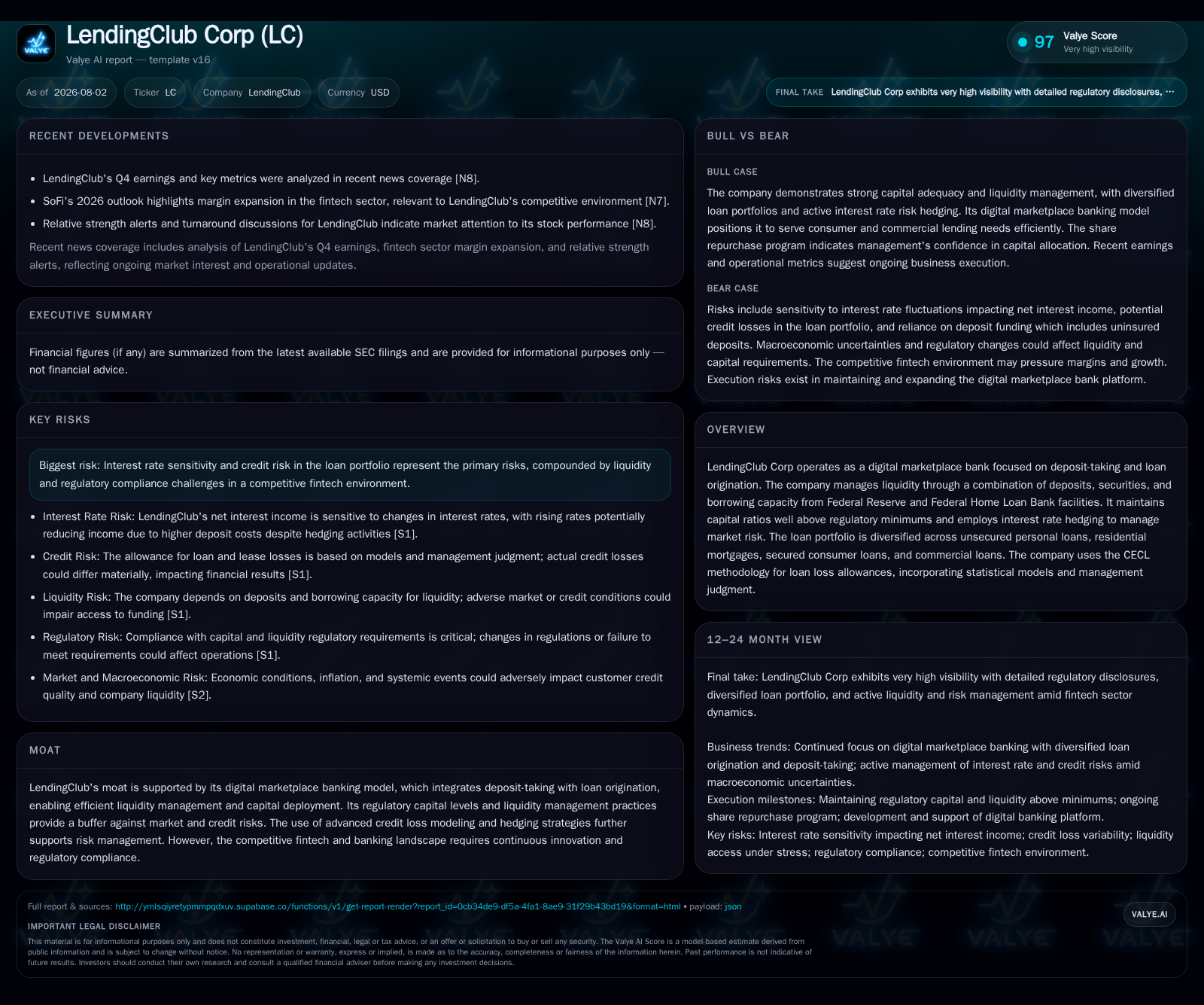
LendingClub Corp reported continued expansion in loan originations, sustained capital adequacy well above regulatory minimums, and proactive liquidity management in its latest quarterly 10-Q. The company operates a hybrid digital marketplace bank model, integrating deposit-taking with diversified loan portfolios including unsecured personal loans, mortgages, and commercial loans. Strategic emphasis on CECL credit loss modeling and interest rate hedging underpins risk control. Share repurchases remain active, reflecting management’s confidence amid competitive fintech pressures and macroeconomic uncertainties.
Recent Operating Update: Execution Amid Uncertainty
LendingClub's latest Form 10-Q filing for Q2 ended June 30, 2026 highlights steady progress on several fronts critical to its hybrid digital marketplace bank strategy [S2]. The company actively pursued its $100 million share repurchase authorization approved late 2025, buying back approximately $50 million worth of shares through mid-2026 at an average price near $16.81 per share [S22]. This underscores management’s conviction in the firm’s valuation amidst broader fintech sector volatility.
From an operational perspective, LendingClub disclosed continued diversification of its loan portfolio with total loan originations growing to $9.6 billion in 2025, representing a roughly one-third increase over prior years [S18]. Notably, about one-quarter of these originations are held for investment on balance sheet rather than immediately sold or securitized, signaling confidence in asset quality and yield enhancement opportunities.
Capital metrics remain a cornerstone: the Common Equity Tier 1 (CET1) ratio is reported at 17.4%, substantially surpassing the Basel III regulatory minimum plus required conservation buffer of around 9.5% combined [S27]. This buffer offers resilience against credit shocks or market stress. Similarly, the Tier 1 leverage ratio at roughly 12% exceeds the minimal regulatory threshold by a comfortable margin [S27]. Liquidity management is prudent—total deposits at LC Bank reached nearly $10 billion by end-2025 complemented by sizeable borrowing capacity from Federal Reserve Discount Window ($3.3 billion available) and Federal Home Loan Bank ($0.68 billion) facilities [S6][S15].
Business Model Nuances: Digital Marketplace Banking Hybrid
LendingClub operates a platform marrying a digital lending marketplace with traditional banking functions centered on deposit-taking and loan origination [S1]. This duality positions the company uniquely versus pure fintech lenders that largely rely on off-balance-sheet structures or pure loan marketplaces. By holding a mix of loans across unsecured personal (marketplace loans), secured consumer, residential mortgages, and diversified commercial loans—including equipment finance—LendingClub balances fee income streams against net interest margin (NIM) derived from funded assets.
Revenue drivers hinge largely on NIM expansion enabled through deposit gathering at competitive rates alongside efficient use of securities portfolios and access to federal borrowing lines to fund loans [S1][S6]. Fee income from loan origination complements these interest-based revenues but represents a smaller proportion relative to banks focused solely on fee-generating services.
The company's strategic adoption in early 2026 of fair value accounting for held-for-investment loans originated since January increases income statement volatility but provides real-time reflection of credit risk changes versus amortized cost accounting [S1]. Meanwhile, LendingClub applies CECL methodology rigorously across portfolio segments to estimate allowances for expected credit losses proactively—a critical practice given economic headwinds noted in recent risk disclosures [S9][S21].
Industry Structure: Competitive Pressures and Regulatory Overlay
Within the digital marketplace banking and consumer lending industry, LendingClub faces competition from pure-play fintech lenders such as SoFi Technologies and Upstart Holdings which emphasize AI-driven underwriting or niche product focus. Traditional players like Discover Financial Services and Synchrony Financial offer scale advantages in distribution but may lack LendingClub’s platform integration breadth.
Regulatory scrutiny is significant given LendingClub’s status as a federally chartered national bank coupled with holding company oversight by the Federal Reserve Board (FRB) [S28]. Compliance encompasses capital adequacy minima (risk-weighted asset ratios), liquidity coverage mandates, anti-money laundering controls, consumer protection rules overseen by CFPB, and regular examinations by OCC [S21][S28]. Regulatory constraints also limit dividend payouts from LC Bank to LendingClub Corporation affecting capital allocation strategies [S10][S27].
Technological innovation remains crucial to maintaining underwriting accuracy and customer acquisition efficiency amid fierce pricing competition especially in unsecured personal lending—historically a higher-risk segment where delinquency trends can rapidly shift based on macroeconomic developments [S18][S9]
Growth Drivers: Loan Origination Expansion Supported by Deposits and Technology
Key growth levers include expanding originations within both marketplace-focused unsecured personal loans as well as secured consumer finance products supported by improving data analytics capabilities that sharpen risk models under CECL assumptions [S1][S18]. Residential mortgage origination growth taps into digital native consumers preferring streamlined online processes versus legacy lender experiences.
Deposit gathering from retail customers fuels funding cost advantages relative to wholesale funding lines; as deposits grow persistently ($9.95 billion end-2025 vs $9.1 billion prior year) with roughly 88% FDIC insured balances providing stability [S6][S18]. Enhancements in mobile banking platforms bolster customer retention and cross-selling opportunities.
Interest rate environments remain mixed—while rising rates can erode fixed-rate asset valuations they support higher deposit yields enhancing margins when effectively hedged via interest rate swaps or similar instruments designed to mitigate net interest income volatility [S15][S16]
Cost discipline is maintained despite investments in technology infrastructure including capital expenditures exceeding $95 million planned in 2026 focusing on property improvements acquired in prior year plus software development supporting digital platform scalability [S7]
Risks and Watchpoints: Credit Quality Dynamics to Regulatory Complexity
Primary risks derive from potential borrower credit deterioration amid inflationary pressures and macroeconomic uncertainty heightened by geopolitical developments such as the ongoing Iran conflict referenced as an indirect factor affecting U.S. inflation trends impacting borrower repayment capacity [S2][S9][S24]. Monitoring delinquency rates across unsecured versus secured segments will be vital.
Interest rate sensitivity persists despite hedging—fixed-rate assets backed by primarily variable-rate liabilities (deposits) create earnings sensitivity that could pressure net interest margins should funding costs rise faster than asset yields adjust [S15]. Ensuring capital buffers adequately absorb credit losses without restricting growth will be imperative.
Regulatory compliance costs continue rising as examinations intensify; any adverse enforcement findings or litigation exposures—while historically not material—remain potential disruptors legally or operationally [S9][S21]. Additionally, restrictions on dividend payments constrain returns to shareholders.
Competition from agile fintech entrants leveraging AI-enhanced underwriting models forces constant innovation lest LendingClub lose market share especially among younger digitally native borrowers favoring seamless user experience coupled with competitive pricing.
What to Watch Next: Demand Indicators and Execution Signals
Investors should closely follow updates on quarterly loan origination volumes disaggregated by segment (marketplace unsecured personal vs secured vs mortgage vs commercial), trends in allowance for credit losses vis-à-vis actual delinquencies/defaults reported quarterly alongside NIM trajectories reflecting hedging effectiveness under changing rate environments [S2][S18].
Deposit growth composition—insured vs uninsured mix—and any shifts in average funding cost will be key liquidity metrics affecting margin outlook. Monitoring share repurchase activity pacing within the $100 million program provides insight into management’s confidence level regarding balance sheet strength versus stock valuation.
Finally, any material regulatory developments including examination outcomes or changes in capital requirements could reshape strategic flexibility; similarly, technological upgrade rollouts affecting borrower acquisition efficiency may significantly impact competitive positioning vis-à-vis peers like SoFi or Upstart.
Financial Profile Discussion
LendingClub's financial profile reflects disciplined balance sheet management supporting an expanding loan portfolio financed primarily via deposits supplemented by federal borrowing lines enhancing liquidity coverage ratios comfortably above regulatory minima [S6][S27]. Its CET1 capital ratio registered a robust 17.4% at fiscal year-end December 31, 2025 compared to minimum requirements near 7%, providing ample cushion against credit loss shocks or unexpected stresses [S27]. The Tier 1 leverage ratio stood at approximately 12%, underscoring conservative leverage policy relative to peer digital marketplace banks which may operate closer to threshold levels.
Net interest income grew significantly driven by both volume expansion in loans held for investment and improved deposit funding efficiency yielding elevated net interest margins around 6% annually—a reflection of favorable asset yield curves combined with active hedging against rising rates [S18][S15]. Non-interest income also rose markedly due to enhanced fee generation from origination activities within marketplace segments.
Operating expenses increased following investments in infrastructure expansion including property acquisition ($74.5 million cash outlay in office building) and software development expenditures projected near $95 million in coming periods reflecting strategic prioritization of platform scalability [S7]. Efficiency ratio rationalization remains a medium-term focus area balancing growth-oriented spend with profitability targets.
Provisions for credit losses were elevated but aligned with CECL forward-looking assessments adjusting through economic scenario overlays particularly relevant given macro uncertainties including inflation trajectory influences referenced within recent SEC filings [S9][S21][S24]. The effective articulation between modeling assumptions and realized delinquencies will remain critical to sustainably managing earnings volatility.
In summary, LendingClub maintains conservative capitalization levels coupled with broad liquidity sources placing it favorably within the digital marketplace banking ecosystem characterized by rapid innovation requirements balanced against regulatory compliance imperatives and macroeconomic variability impacts.
Disclaimer: This is research-only, informational analysis and not investment advice. It may include AI-generated interpretation and general industry context. Always verify important details using primary sources.

Comments