
GLPI's Rental Revenue Strengthens Amid Interest Rate and Tenant Credit Risks
Gaming & Leisure Properties reports solid Q2 2026 results while highlighting macroeconomic and regulatory challenges influencing its gaming-focused REIT model.
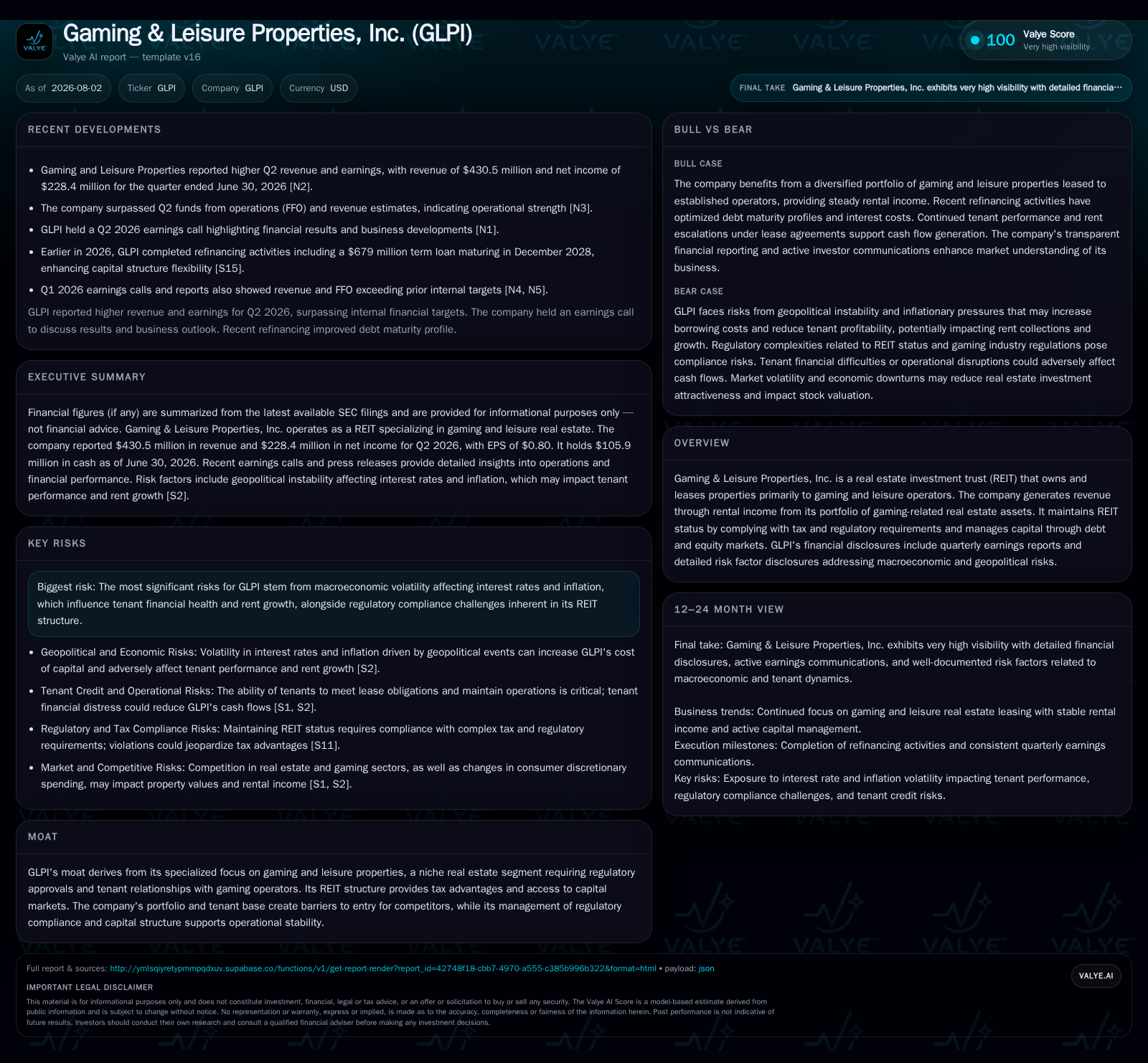
Gaming & Leisure Properties, Inc. (GLPI) posted higher rental income and funds from operations in Q2 2026, benefiting from stable lease agreements with gaming operators. The company’s focused portfolio of casino and leisure properties supports durable, contractually obligated rental streams, reinforced by escalation clauses tied to tenant revenue or inflation. However, rising interest rates and geopolitical-driven inflationary pressures increase borrowing costs and pose risks to tenant creditworthiness and rent growth potential. Regulatory complexities inherent in gaming property ownership remain a critical compliance factor. GLPI’s capital allocation continues to prioritize development funding and acquisitions, balancing risks across debt maturities and market conditions.
Recent Operating Update
Gaming & Leisure Properties (GLPI) reported a strong operating performance in its Q2 2026 filing dated July 30, 2026, exceeding consensus revenue and funds from operations (FFO) estimates [S2][N3]. Rental income growth was supported by high occupancy rates across its portfolio of casino and leisure real estate assets leased primarily to gaming operators. The company emphasized that sustained demand in the gaming sector underpinned stable contractual cash flows despite ongoing macroeconomic volatility.
Additionally, a concurrent 8-K filing detailed the company’s reaffirmation of its capital allocation strategy focusing on development funding—specifically projects like the Bally’s Chicago Casino Resort—and prudent management of debt maturities [S3][S10]. These moves reflect GLPI’s need to balance growth funding while mitigating refinancing risks during rising interest rate environments.
Business Model Overview
GLPI operates as a specialized real estate investment trust (REIT) owning gaming-focused properties such as casinos and related leisure facilities [S1]. Revenue is derived predominantly from rental income generated under long-term leasing contracts with gaming operators serving as tenants. These leases typically feature structured rent escalation clauses based on tenant revenues or inflation indices, enabling potential upside linked to tenant operational success.
The monetization mechanics hinge on maintaining high occupancy rates coupled with strong tenant creditworthiness. The gaming industry’s regulatory intensity mandates that GLPI ensure tenants comply with all applicable licenses and operational standards since their ability to generate cash flow directly affects GLPI’s rental collection. Lease agreements usually encompass non-cancellable commitments spanning multiple years, providing predictable net operating income (NOI) streams that underpin the trust’s distribution capacity.
Capital expenditures (CapEx) incurred relate mostly to property upkeep or strategic expansions tied to new developments within the portfolio. The REIT structure affords significant tax advantages but requires strict adherence to distribution thresholds and asset/income tests mandated by Internal Revenue Code provisions.
Industry Structure and Competitive Position
GLPI occupies an entrenched position within the niche sub-sector of gaming-related REITs, sharing competitive space with entities like MGM Growth Properties or similar PE-backed real estate owners affiliated with prominent casino operators. Compared to diversified commercial REITs with broad hospitality exposure, GLPI’s focused property type entails higher regulatory complexity but also differentiated barriers due to licensing requirements unique to gaming venues.
Key industry dynamics include tenant concentration risk given limited large-scale tenants in this segment; thus monitoring tenant performance is crucial. Lease terms often negotiate rent escalations sensitive to discretionary consumer spending at these venues—a factor closely tied to broader economic conditions.
Capital markets access differentiates top-tier players; GLPI’s ability to raise equity or issue unsecured notes at reasonable costs supports ongoing acquisitions or construction commitments. Regulatory compliance impacts whether properties can be owned or transferred at all—delays or legal challenges can stall asset integration or disrupt revenue flows.
Growth Drivers
GLPI’s path forward leverages several structural drivers: continued expansion of legalized gambling markets boosts demand for casino properties; rising consumer discretionary spending underpins tenant revenues facilitating rent escalations; strategic capital deployment into high-potential developments like Bally’s Chicago expands asset base;
the secured availability of capital through debt/equity issuance enables selective accretive acquisitions; enhancement of tenant credit profiles facilitates better coverage ratios improving cash flow certainty; moreover regulatory approvals opening new geographic markets create additional acquisition opportunities.
Macro factors also play a role: controlled inflation may enhance contractual rent adjustments that link payments directly to CPI figures or revenue percentages. Simultaneously, positive operating trends among tenants reduce risk premiums embedded in GLPI’s cost of capital.
Risks and Watchpoints
The dominant risks facing GLPI stem from macroeconomic volatility impacting both capital costs and tenant viability [S2][S6]. Heightened geopolitical tensions have driven yields higher—elevating borrowing expenses—which compress valuation multiples common in REIT sectors reliant on spread arbitrage between financing costs and NOI yields. Inflationary pressures raise operational costs for tenants amid uncertain pricing power on their part potentially restraining revenue-linked rent escalations.
Tenant concentration risk persists given reliance on a relatively small number of large casino operators whose credit health dictates rent collection reliability; any material deterioration could force renegotiations or defaults impacting funds from operations. Compliance risk encompasses maintaining REIT tax qualifications alongside navigating volatile regulatory frameworks governing casino operations nationally and regionally – lapses here could jeopardize structural benefits or asset usability.
Additional watchpoints include progress on major development projects funded partially by GLPI commitments—their timely completion drives future NOI growth assumptions—and liquidity dynamics surrounding upcoming debt maturities which determine refinancing flexibility amid fluctuating market conditions [S10][S28]
What To Watch Next
Key milestones influencing near-term outlook include quarterly updates on occupancy rates and lease renewals signaling tenant retention strength; FFO trajectories reflecting operational cash generation quality; updates on construction progress of notable developments such as Bally’s Chicago Casino Resort;
debt maturity schedules highlighting rollover risks; regulatory developments affecting property ownership criteria; and evolving macroeconomic indicators including interest rate trends or inflation metrics that drive financing cost assumptions.
Monitoring earnings communications for management commentary on potential changes in lease escalation enforcement or amendments stemming from tenant negotiations will illuminate rent growth sustainability under recessionary risks or spending shifts. Enhanced transparency around tenant diversification efforts or new market entries would indicate reduced concentration threat.
Conclusion
Gaming & Leisure Properties remains a leading player in the niche gaming real estate investment trust space with robust contractual rental income underpinned by regulated casino operator tenants. Its recent Q2 2026 results affirm resilience in rental stream generation amid interest rate headwinds and inflationary pressures affecting operating costs for tenants. Ongoing risks reside mainly in macroeconomic volatility influencing cost of capital and discretionary consumer spending along with complex regulatory demands dictating holding structures. Careful monitoring of tenant health metrics alongside disciplined capital raising underpin sustainable growth while preserving favorable tax status—a critical moat element amid competitive leisure real estate ecosystems.
This report reflects analysis grounded firmly on publicly available SEC disclosures complemented by sector-standard valuation lenses without offering investment research views.
Disclaimer: This is research-only, informational analysis and not investment advice. It may include AI-generated interpretation and general industry context. Always verify important details using primary sources.

Comments