
Floor & Decor's Q2 2026 Performance Highlights Industry-Specific Demand and Inventory Dynamics
Recent quarterly results illustrate how shifting foot traffic, customer mix, and inventory management intersect with Floor & Decor’s specialty hard surface flooring retail model amid evolving market conditions.
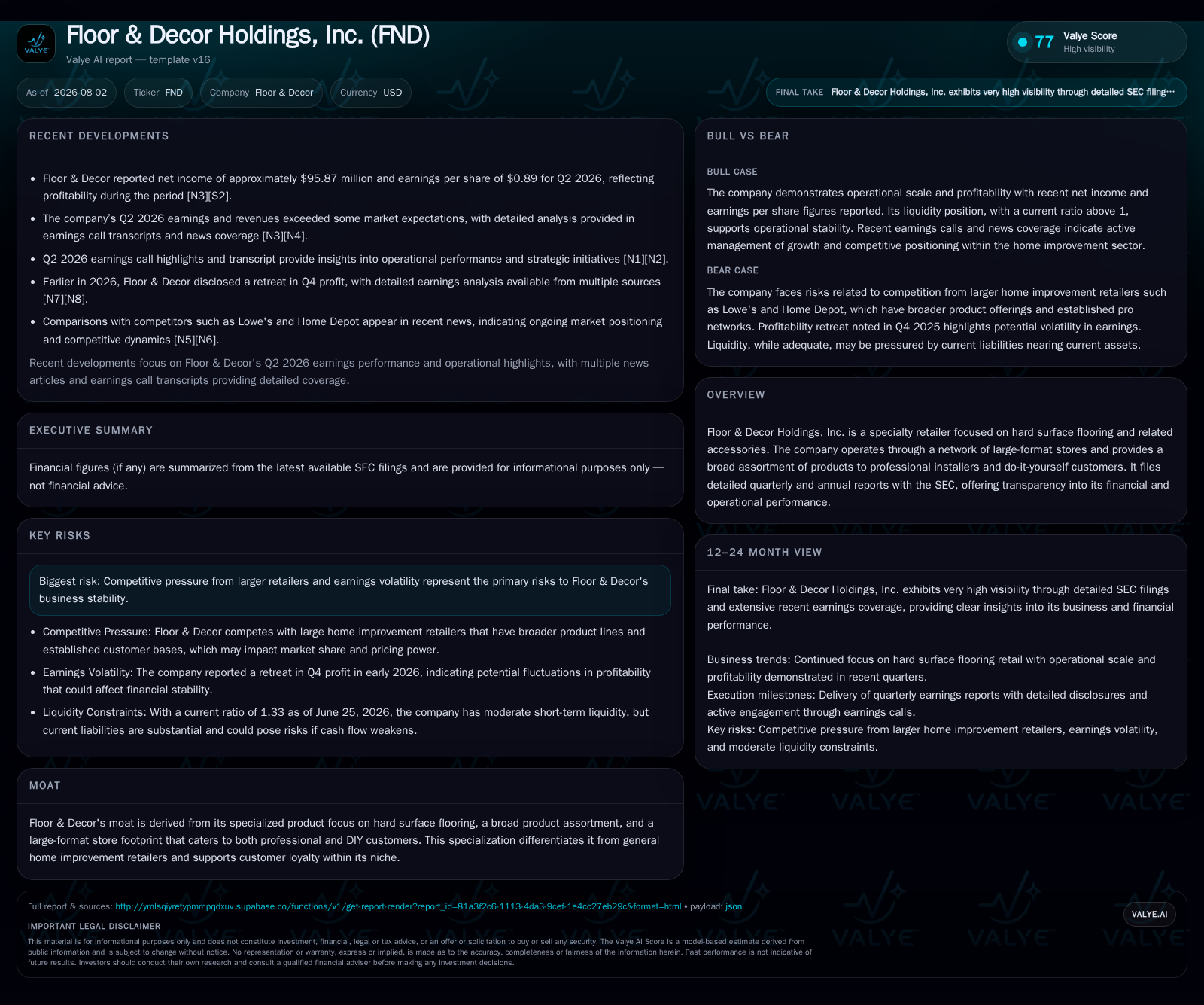
In Q2 2026, Floor & Decor demonstrated modest positive same-store sales growth driven by stabilized foot traffic and a nuanced shift in customer composition between professional installers and DIY buyers. The company’s extensive large-format store network and broad product assortment support differentiated pricing power but operate under margin pressure from supply chain costs and inventory markdown cadence. Competitive dynamics against larger home improvement chains underscore the importance of vendor leverage and inventory efficiency to sustain profitability. Near-term growth hinges on housing market activity and omnichannel expansion, while risks include intensified competition and markdown-related margin erosion.
Q2 Operational Update: Evolving Foot Traffic and Customer Mix Shaping Revenue Trends
Floor & Decor's Q2 2026 results reflect a resilient specialty retail model exhibiting modest same-store sales increases fueled by stable foot traffic despite headwinds from a cooling housing market. As reported in the July 30, 2026 10-Q filing, comparable store sales growth returned positive momentum after some softness in prior quarters, indicating effective adaptation to changing customer behavior [S2]. Earnings call disclosures highlighted that professional installers accounted for an increased share of transactions relative to do-it-yourself (DIY) consumers during the quarter, contributing to a lift in average ticket size due to higher volume orders per transaction [N1], [N3]. This subtle shift is critical because professional customers tend to generate more consistent revenue with higher margins per sale compared to price-sensitive DIY buyers.
This dynamic suggests Floor & Decor’s pricing power is partially insulated by its strong appeal to contractors who prioritize assortment breadth, product availability, and installation accessories bundled with flooring purchases. Foot traffic metrics reportedly stabilized following targeted marketing spend and improved service delivery in stores known for their large-format experiential environments, which remain central to the purchase decision given flooring's tactile nature. This contrasts with many home improvement categories more amenable to e-commerce substitution. Confirmation of these patterns will emerge from follow-up quarterly data tracking comp sales versus foot traffic correlation.
The Specialty Retail Model: Customer Segmentation Drives Product Mix and Pricing Power
Floor & Decor operates within the niche specialty hard surface flooring retail industry where differentiation hinges on extensive product assortments including tile, wood, laminate, stone flooring options, along with complementary installation accessories. The business derives revenue primarily from selling these products via a network of large-format stores targeted both at professional installers requiring bulk quantities and specification expertise, as well as at DIY consumers seeking selection variety under one roof—an offering that general home improvement chains like Lowe's or The Home Depot only partially replicate at scale [S1]
The company's retail strategy leverages operational scale with vendor relationships that provide sourcing cost advantages enabling competitive pricing without sacrificing margin. Its distinct product mix oriented towards harder-to-source flooring materials creates barriers vis-à-vis broad-spectrum home centers dependent on commoditized SKUs. However, this specialization entails higher inventory complexity demanding efficient markdown cadence management to avoid obsolescence-induced margin erosion.
Competitive Context: Large-format Differentiation Amid DIY Trends and Home Improvement Giants
Within the competitive landscape Floor & Decor competes explicitly against general home improvement retailers who operate sizeable flooring categories yet lack the focused assortment depth and store format scale dedicated exclusively to flooring products. This specialization yields an experiential shopping advantage especially for professional installers who prefer tailored high-volume suppliers over generalized channels.
While home improvement giants such as Lowe’s Companies Inc. and The Home Depot possess broader customer bases and omnichannel reach including enhanced e-commerce platforms, Floor & Decor’s large-format stores serve both as showrooms and inventory hubs that favor immediate fulfillment needs typical for hard surface flooring buyers who often require physical inspection before purchase [S1], [S2]. Maintaining this differentiation requires ongoing investment in store network expansion balanced against capital intensity inherent in large-format real estate.
Inventory Efficiency as Margin Lever: Supply Chain Nuances and Vendor Relations Impacting Profitability
Inventory management remains pivotal for Floor & Decor as product variety combined with raw material cost volatility pressures gross margins. In Q2 2026 filings, the company referenced ongoing efforts to optimize inventory turnover rates amidst rising costs linked to supply chain disruptions seen industry-wide affecting key raw materials input prices [S2]. A higher markdown cadence was evident which signals reactive pricing adjustments necessary to clear slower-moving SKUs yet risks compressing profitability if not carefully calibrated.
Vendor leverage through scale offers Floor & Decor negotiating power to mitigate input cost inflation; however, constraints persist due to global logistics uncertainties that intermittently affect stock availability particularly for specialty or imported tiles and stones. These factors dictate close coordination between procurement teams and merchandising planning units to balance assortment breadth without excessive inventory build-up leading to shrinkage risk. Continued monitoring of days inventory outstanding serves as an actionable KPI here.
Growth Drivers from Housing Market Dynamics to Expanded Omnichannel Penetration
Macro tailwinds supporting Floor & Decor’s growth trajectory include favorable demographic trends driving housing demand alongside robust renovation activity benefitting specialty flooring sales. The demand from professional installers further stabilizes revenue amid cyclicality in consumer DIY spending patterns.
Strategically, geographic expansion of the store base into untapped regions enhances footprint density important for brand presence while investments into omnichannel capabilities augment customer acquisition beyond traditional brick-and-mortar channels. Although e-commerce penetration remains secondary given product tangibility needs inherent in flooring selection decisions, facilitated online engagement tools complement the overall buyer journey enhancing convenience especially for repeat professionals and design consultations [N2].
Potential Constraints: Competitive Pressures, Market Volatility, and Inventory Risks to Monitor
Despite structural growth opportunities, Floor & Decor faces notable headwinds that warrant vigilance. Competition intensifies not only from entrenched large home improvement chains extending their flooring assortments but also from online-only retailers offering convenience albeit limited tactile experience. A slowdown in housing markets could disproportionally impact DIY spending reducing foot traffic inflows.
Inventory obsolescence risk persists amid rapid style changes or trend shifts necessitating frequent markdowns that penalize gross margins alongside inflationary pressures in labor and logistics costs outlined in risk disclosures within recent filings [S26], [S29]. Credit risk related to professional customers’ payment terms represents another operating dimension requiring active credit management protocols.
What Investors Should Watch – Upcoming Guidance, Expansion Cadences, and Demand Signals
Near-term indicators worth monitoring include updated company guidance on comparable store sales trajectories reflecting sustained foot traffic normalization or improvements post-Q2 seasonality. Execution pace of announced new store openings will signal commitment to expansion strategy while enhancements or innovations within omnichannel platforms offer insight into digital sales contribution scaling.
Metrics tracking shifts in mix between professional installer revenue versus DIY consumers can validate sustained pricing power assumptions influencing average ticket size trends. Additionally, gross margin movements linked explicitly to supply chain stabilization or vendor negotiated cost relief will clarify margin resilience amid external cost dynamics.[S2], [N2]
Financial Profile Discussion – Capital Structure Supporting Expansion with Current Liquidity Snapshot
Floor & Decor maintains a robust financial position underpinned by a senior secured credit facility refinanced in June 2026 providing $800 million revolving commitments plus a $200 million term loan maturing in 2033 supporting liquidity flexibility for operational needs including capital expenditures tied to store expansions [S4], [S5], [F1]. Total debt stood at approximately $200 million with a current ratio of 1.33 evidencing adequate short-term asset coverage relative to liabilities as of June 25, 2026 [F1].
Gross margin pressure noted stems primarily from elevated procurement costs despite strategic vendor leverage while SG&A expenses align proportionally with expanded store operations constraining operating income margin improvements temporarily [S2]
Overall cash conversion efficiency remains tied tightly to inventory management success given the nature of large-format hard surface flooring retail where working capital deployment is significant.
This report synthesizes data solely from publicly filed SEC documents combined with earnings commentary without providing investment advice or projections. All numeric metrics are sourced directly from cited filings or company disclosures for factual fidelity.
Disclaimer: This is research-only, informational analysis and not investment advice. It may include AI-generated interpretation and general industry context. Always verify important details using primary sources.

Comments