
Ingevity Corp Reorients Growth with Strategic Portfolio Focus and Sustainability Edge
Ingevity is streamlining its specialty chemicals portfolio by divesting non-core assets and emphasizing sustainability-driven innovation to mitigate market cyclicality and regulatory challenges.
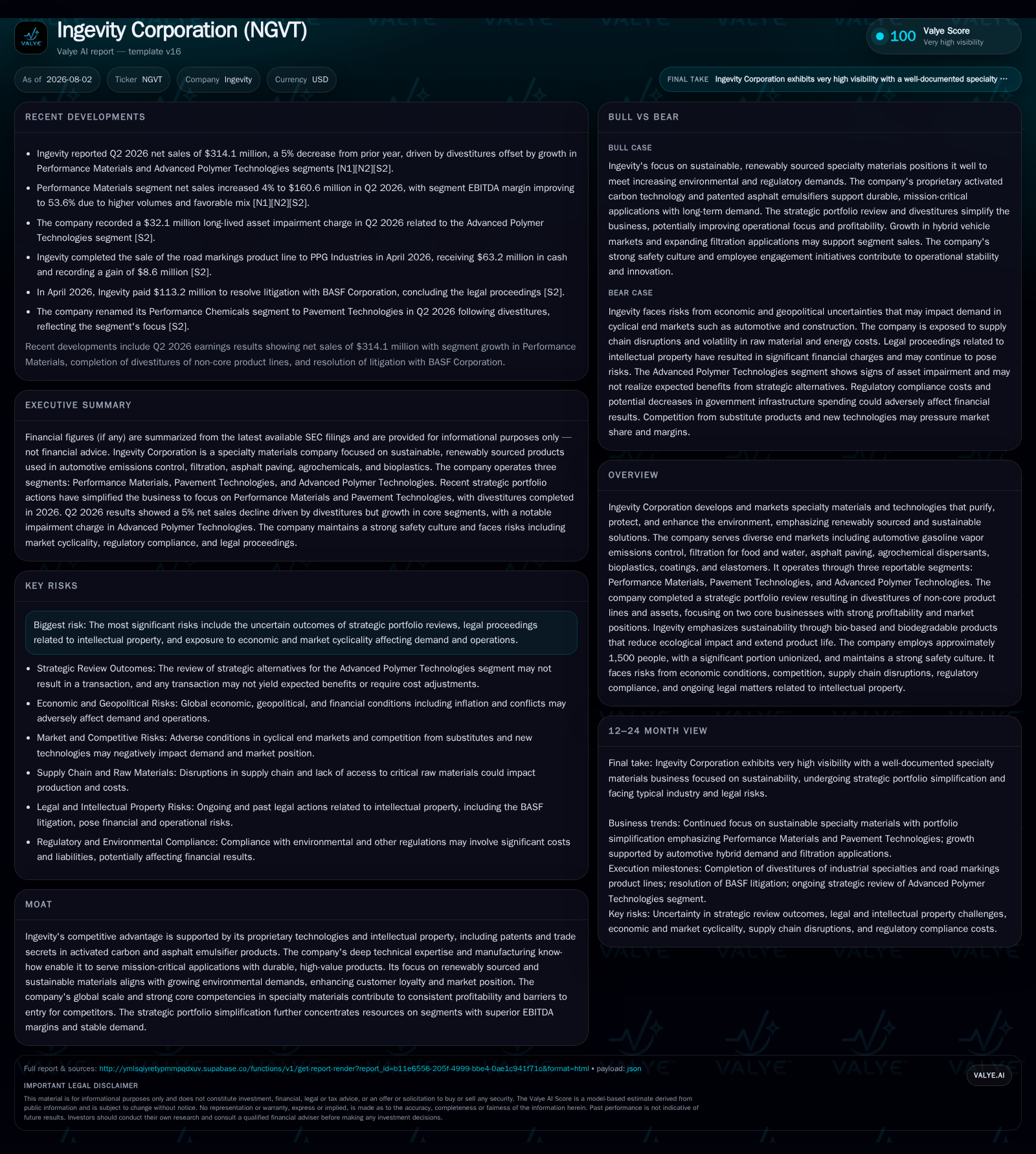
Ingevity Corporation’s latest quarterly filing highlights continued execution of its strategic portfolio simplification, centering on two high-margin segments—Performance Materials and Pavement Technologies. This refocus enhances exposure to sustainable specialty chemicals such as activated carbon for automotive emissions control and warm-mix asphalt additives. While automotive market softness pressures carbon product volumes, pricing increases and mix improvements support margin resilience. The company maintains stable liquidity with $97 million cash and nearly $247 million undrawn revolving credit capacity, offsetting a temporary operating cash flow deficit driven by litigation settlements and working capital investments.
Strategic Portfolio Transformation: Focusing on Core High-Margin Segments
Ingevity’s July 2026 quarterly filing confirms progress in its strategic portfolio simplification initiated in late 2024. The company completed the sale of its North Charleston crude tall oil refinery and divested the majority of its industrial specialties product line by January 2026. These moves reduce exposure to lower-margin, more cyclically sensitive businesses within Performance Chemicals while sharpening focus on two core reportable segments—Performance Materials and Pavement Technologies—that define the "New Ingevity" [S1][S2][S16]. This approach aligns with specialty chemical industry trends prioritizing portfolio optimization to enhance EBITDA margins, improve capital allocation efficiency, and reduce operational complexity.
The divestitures eliminate commodity-adjacent or less differentiated product lines that historically constrained profitability. While such transactions carry inherent execution risk, their completion demonstrates management’s commitment to reallocating resources toward specialty materials with durable demand supported by proprietary technology.
Sustainably Engineered Specialty Chemicals: Business Model Highlights
Ingevity's business model revolves around manufacturing specialty materials tailored for demanding industrial applications requiring technical performance combined with sustainability benefits. The Performance Materials segment primarily produces activated carbon products used in automotive gasoline vapor emissions control systems—a regulated market underpinned by tightening air quality standards globally. Meanwhile, Pavement Technologies markets warm-mix asphalt emulsifiers like Evotherm P35, recently approved for use in Germany, illustrating momentum in sustainable infrastructure solutions [N5][S12].
These offerings feature significant content from renewably sourced raw materials, aligning with increasing customer demand for environmentally responsible products. This focus supports pricing power because bio-based specialty chemicals deliver differentiated performance relative to traditional fossil-derived substitutes. Such specialization creates barriers to entry due to complex manufacturing know-how alongside compliance expertise.
Customer relationships are anchored in long-term contracts or recurring orders from automotive suppliers, road construction firms, agrochemical producers, and filtration companies requiring consistent supply of engineered chemical inputs. Revenue variability is influenced by production volume cycles—especially automotive manufacturing—and pricing that incorporates raw material cost pass-through.
Competitive Moat Rooted in Proprietary Technology Amid Market Pressures
Ingevity's competitive edge derives from a portfolio of patents and trade secrets covering activated carbon manufacturing processes and asphalt emulsifier chemistries. This intellectual property protects against substitution risks while enabling trusted solutions critical for regulatory compliance in emissions control.
Despite volume headwinds from declining internal combustion engine vehicle production—a trend partially offset by recent hybrid vehicle growth—the company sustains EBITDA margin stability near mid-50% through annual price increases and favorable product mix shifts [S2]
Pavement Technologies delivers high-teens EBITDA margins supported by regulatory endorsements that facilitate broader adoption globally. Its warm-mix asphalt additives reduce energy consumption during paving and lower greenhouse gas emissions compared to conventional hot mix alternatives.
Compared with diversified specialty chemical peers such as Ashland Global Holdings (additives/coatings) or Cabot Corporation (activated carbon), Ingevity’s concentrated emphasis on sustainability-led innovation reinforces differentiation within automotive emissions controls and infrastructure chemical niches.
Growth Drivers: Regulatory Trends and Renewables Adoption
Key growth catalysts include tightening global air quality regulations mandating stringent gasoline vapor emission controls that sustain demand for activated carbon products. Concurrently, increased infrastructure spending drives uptake of innovative pavement technologies like Evotherm P35 that enable environmentally friendlier road construction methods [N5][S22].
Expansion into bioplastics for coatings and agrochemical dispersants represents adjacent opportunities fueled by rising end-customer preference for bio-based inputs replacing legacy petrochemical alternatives. Incorporating higher renewable content enhances sustainability metrics over time, reinforcing pricing leverage.
Research & development investments remain vital for maintaining technological relevance and fostering customer loyalty amid intensifying competition from alternative materials providers or emerging filtration technologies worldwide.
Risks: Automotive Cyclicality, Supply Dependencies, Litigation Exposure
Performance Materials’ reliance on internal combustion engine vehicle production exposes it to cyclical downturns driven by consumer shifts toward battery electric vehicles despite transient hybrid gains [S2]. Such cyclicality can cause short-term volume declines but is partly mitigated through pricing actions as evidenced recently
Operational risks include dependence on third-party utility providers (e.g., water treatment, compressed air) at key plants. Disruptions could arise from labor disputes or plant shutdowns; notably, discontinued operations at a UK co-located provider raise concerns about potential cost increases or delays in securing alternatives [S1].
Ongoing intellectual property litigation poses financial exposure highlighted by the $113 million settlement payment made in the first half of 2026 impacting operating cash flow [S11]. Monitoring these legal developments remains critical given potential earnings impact.
Raw material input price volatility also pressures margins when defensive pricing lags inflationary cost increases.
What to Watch: Portfolio Review Outcomes and Demand Indicators
The pending review of strategic alternatives for the Advanced Polymer Technologies (APT) segment represents a significant upcoming catalyst within 2026; whether resulting in divestiture or restructuring will materially affect portfolio composition and cost structure [S1][N1]. Close attention is warranted given prior transaction complexities.
Success metrics include new product commercialization rates—especially in renewably sourced specialties—achievements against sustainability targets measuring renewable content percentages, and backlog growth signaling robust customer order momentum despite cyclical headwinds.
Sales trends across Performance Materials versus Pavement Technologies will illustrate management’s effectiveness balancing mature automotive emission control pressures against infrastructure-related growth fueled by regulatory approvals.
Financial Profile Discussion: Stable Liquidity Amid Operating Cash Flow Volatility
At June 30, 2026, Ingevity held $97.4 million in cash complemented by nearly $247 million undrawn capacity under its revolving credit facility providing ample liquidity cushions amid operational uncertainties [S2][F1]. Net debt approximates $1.1 billion reflecting typical leverage profiles among capital-intensive specialty chemical peers managing sizable fixed asset bases.
Operating cash flow was negative $15.8 million during H1 2026 primarily due to the $113 million litigation settlement payment coupled with working capital investments including elevated accounts receivable and inventory partially offsetting stronger EBITDA generation [S11]. Nevertheless, investing cash inflows exceeding $150 million from recent divestitures provided additional financial flexibility without immediate liquidity strain.
Interest expense decreased modestly year-over-year benefiting from refinanced credit facilities despite steady gross debt levels; capital expenditures are budgeted at a moderate $40-$60 million focusing mainly on maintenance alongside selective growth projects aligned with the streamlined portfolio strategy [S2][S4]
Overall financial flexibility remains sound allowing sustained operations through economic cycles while supporting continued investment in innovation critical for maintaining competitive positioning.
Disclaimer: This is research-only, informational analysis and not investment advice. It may include AI-generated interpretation and general industry context. Always verify important details using primary sources.

Comments