
Ribbon Communications Battles Profitability Amid Network Modernization Demand
Despite solid operational cash flow and robust service offerings, Ribbon faces margin pressure and leverage challenges in a transforming telecom market.
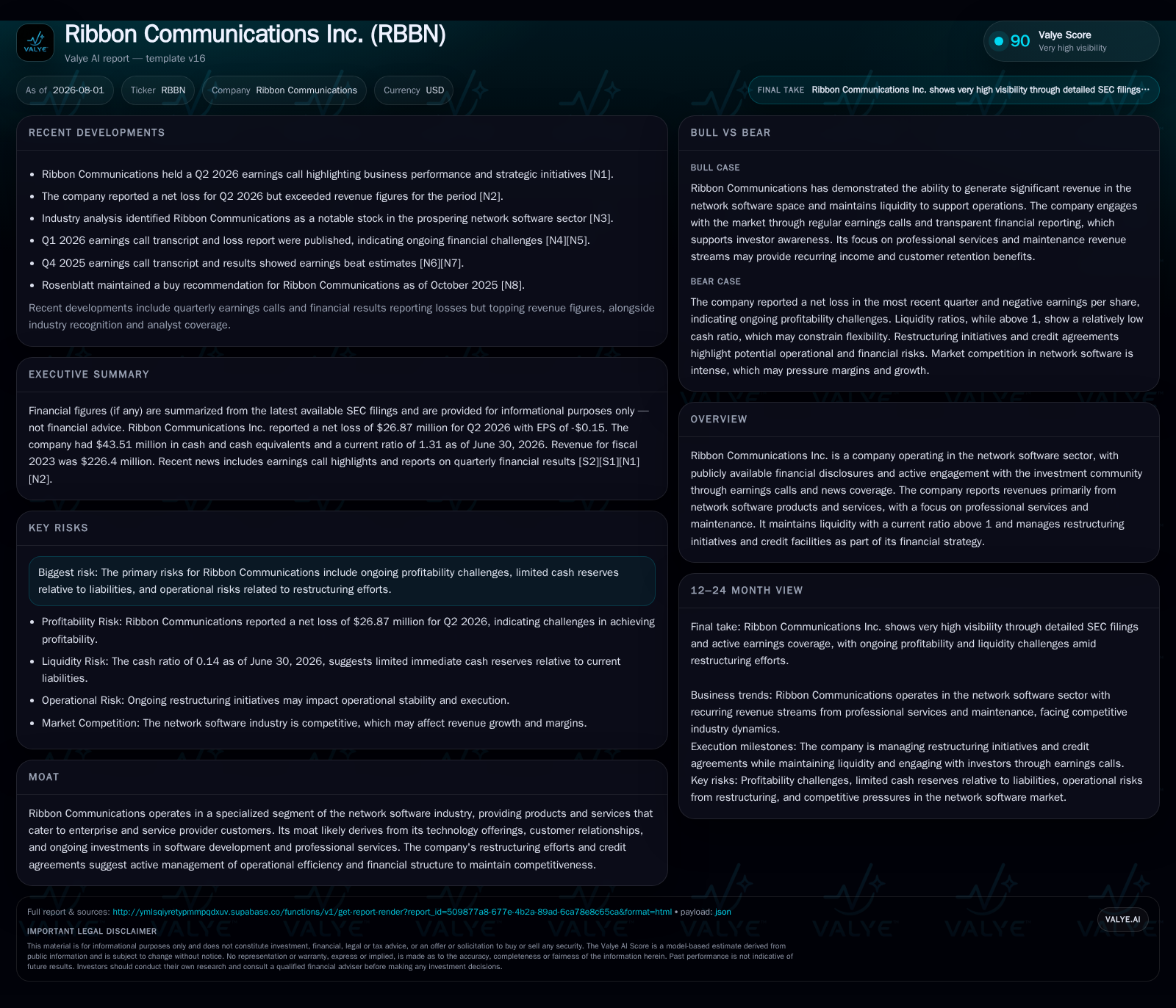
Ribbon Communications Inc. reported a widening net loss in the first half of 2026 despite topline growth driven by its network software and services portfolio. The company's business is anchored in providing service providers and enterprises with network modernization solutions amid a global shift to telco cloud and software-defined networking. While recurring revenues from maintenance and professional services offer some income stability, restructuring charges and high leverage weigh on financial flexibility. Growth depends on capitalizing on industry migration trends to IP and cloud architectures while managing operational efficiencies.
Recent Operating Update: Q2 Widening Loss Highlights Financial Strain
Ribbon Communications Inc.’s latest quarterly filing for Q2 ended June 30, 2026, reveals a growing net loss totaling $61.4 million for the half-year period compared with $37.3 million in H1 2025, signaling escalating challenges in hitting profitability targets [S2]. This deterioration stems partly from ongoing restructuring expenses designed to streamline operations during competitive pressures and shifts within the telecommunications infrastructure landscape. Despite this headline loss expansion, the company continues generating positive operating cash flows supported by recurring maintenance contracts and professional services revenues that help offset volatility in product sales [S2]. The persistence of these losses underscores the tension between Ribbon's investment needs in R&D around telco cloud migration technologies and the need for operational discipline.
Business Model: Software-Driven Network Solutions With Mixed Revenue Streams
Ribbon operates predominantly within the network software and telecommunications infrastructure sector by supplying service providers and enterprise clients a comprehensive suite of products including network software licenses, high-performance networking hardware appliances, alongside associated professional services such as deployment consulting, system integration, maintenance contracts, and support [S1]. The monetization model balances one-time product sales with more stable recurring revenue streams primarily from maintenance agreements and professional service engagements.
Customers span telecom operators engaged in complex network modernization projects transitioning from legacy TDM phone lines to more flexible IP-based networks capable of supporting next-generation applications such as 5G and edge computing. Enterprise verticals including finance, government, education, utilities, and transportation also contribute demand for Ribbon’s secure connected voice and data delivery platforms [S1]. This diversity offers some demand shielding but service provider contracts remain a critical revenue lever.
Revenue drivers depend heavily on successful sales cycle completion — often extended due to large-scale network infrastructure projects — contract renewals for maintenance agreements that underpin recurring revenue visibility, plus adoption rates for new software releases aligned to evolving network architectures like telco cloud, SDN, and NFV. Cost structures combine fixed elements inherent in R&D investments to maintain competitive platform capabilities alongside variable operations expenses linked to service delivery.
Industry Structure and Competitive Position
The telecommunications infrastructure industry where Ribbon participates is marked by rapid technological transitions demanding continuous innovation. The sector includes upstream hardware manufacturers (e.g., Cisco Systems), integrated telecom software vendors (like Nokia), cloud infrastructure platform providers enabling virtualized networks, plus various enterprise communication solution firms. Within this environment, Ribbon’s relative specialization lies in providing competitive network software products combined with tailored professional services aimed at easing migration efforts during the shift toward cloud-native telco environments.
Entry barriers are defined by complex technology requirements coupled with long-established operator relationships central to securing large enterprise or tier-one service provider contracts. Ribbon’s moat appears rooted in its technology portfolio encompassing voice/data delivery platforms suitable for high-bandwidth connectivity demands plus its ability to bundle these solutions with consulting and support services during network upgrade phases. In contrast to peers offering integrated end-to-end solutions including extensive hardware lines (e.g., Cisco), Ribbon must continuously differentiate through software innovation focus while managing pricing pressure particularly on commoditized hardware segments.
Growth Drivers
Key secular growth factors supporting Ribbon’s business involve accelerating migration away from legacy circuit-switched TDM systems toward IP-enabled architectures deployable via telco clouds using software-defined networking principles [S1]. This evolution enables operators to reduce operating costs by replacing expensive physical infrastructure with virtualized functions managed through automation — a process Ribbon facilitates through its products tailored for such transitions.
Other expansion catalysts include the rollout of 5G networks which increases demand for edge computing nodes requiring reliable voice/data platforms; heightened enterprise security needs driving upgrades in data delivery infrastructure; rising penetration of managed network services where customers outsource operations; plus regulatory mandates compelling service providers to modernize aging networks enhancing connection quality. These drivers collectively create opportunity windows for Ribbon’s professional services segment vital for system migrations.
Risks and Watchpoints
Ribbon faces notable headwinds including sustained profitability challenges exacerbated by substantial restructuring charges aimed at cost containment which weigh on near-term earnings clarity [S2]. Financial leverage at approximately $285 million net debt relative to cash reserves presents constraints requiring careful liquidity management particularly if market conditions impair free cash flow generation.
Additional risks center on customer concentration given dependence on several large service providers whose procurement cycles can be lengthy and unpredictable; pricing pressures fueled by commoditization trends in hardware components; technical integration difficulties arising during complex legacy-to-IP migrations; plus cybersecurity vulnerabilities inherently present in deploying sophisticated network software platforms at scale. Failure to accelerate product adoption rates or renew long-term maintenance contracts could adversely affect revenue stability.
Operationally, the success of ongoing restructuring plans remains a watchpoint—slippage could prolong margin pressure or impair investment capacity needed for development in cutting-edge cloud-native solutions aligned with market expectations.
What To Watch Next
Market participants should monitor upcoming quarterly disclosures detailing progress in reducing operating losses post-restructuring efforts alongside updates on contract backlogs or significant new customer wins indicative of pipeline health. Particular attention is warranted on gross margin trends separating hardware versus software contribution shifts which signal improved mix leverage effects.
Tracking R&D expenditures will elucidate Ribbon’s commitment toward enhancing cloud-native product offerings critical amid intensifying competition from major telecom software platform vendors who blend hardware/software tightly. Furthermore, indicators such as customer renewal rates for maintenance agreements or changes in average contract duration provide early signals about recurring revenue robustness.
Finally, any changes in liquidity position or new debt arrangements will influence assessment around balance sheet flexibility crucial given the capital intensity typical of telecom infrastructure investments.
Financial Profile Discussion
As of June 30, 2026, Ribbon held cash and equivalents totaling roughly $43.5 million against total debt obligations close to $329 million yielding net debt near $285 million—a leverage position demanding close management especially amidst reported operating losses [F1], [S2].
This financial posture illustrates typical developmental phase trade-offs experienced by specialized telecom technology providers navigating industry transformation periods — balancing investment demands versus profitability pressures while leveraging established client relationships enabling recurring revenue streams that partially mitigate cash flow cyclicality.
This analysis is based exclusively on publicly available SEC filings ([S1], [S2], [S3]), company factsheet data ([F1]), recent earnings call disclosures ([N1], [N2]), alongside contextual framing derived from industry-standard knowledge models designed for network software and telecommunications infrastructure sectors. It does not constitute investment advice but provides an independent evaluation grounded strictly in documented evidence.
Disclaimer: This is research-only, informational analysis and not investment advice. It may include AI-generated interpretation and general industry context. Always verify important details using primary sources.

Comments