
Eastman Chemical’s Specialty Chemicals Growth Accelerates with Molecular Recycling and Pricing Power
Q2 2026 results reveal robust volume-driven sales gains, margin expansion amid cost pressures, and advances in sustainability-led innovation.
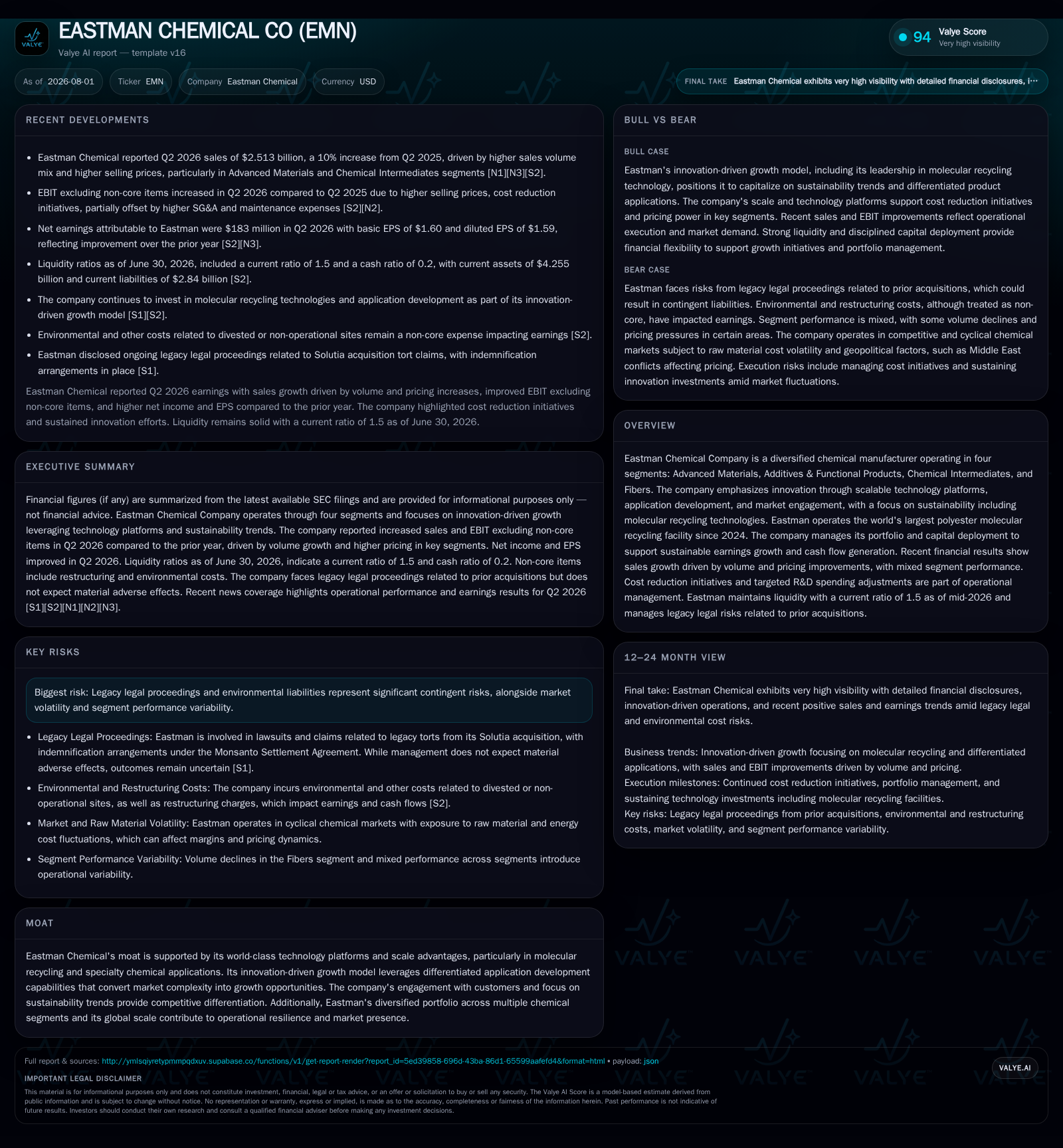
Eastman Chemical Company reported second quarter 2026 revenue growth driven by increased volume across Advanced Materials and Chemical Intermediates segments and strong selling price realization. Operating income excluding non-core items improved on sustained cost reduction initiatives despite elevated raw material and energy costs. Molecular recycling remains a key differentiator with the world's largest polyester recycling facility operational since 2024. The company’s diversified specialty chemicals portfolio supports resilience amid mixed segment performances and macroeconomic volatility. Liquidity remains solid with a current ratio of 1.5 and net debt consistent with manageable leverage levels. Material legacy environmental and legal liabilities persist but currently do not materially threaten financial stability.
Recent Operating Update
Operating profit excluding non-core items grew by nearly 16% to $320 million from $275 million last year, signaling Eastman’s ability to pass through input cost increases while benefiting from ongoing cost reduction programs [S2][S6][S19]. Despite rising SG&A expenses driven mainly by variable compensation adjustments, disciplined expense management helped preserve earnings gains. Environmental-related costs—a key element of non-core charges—fell sharply to $8 million in Q2 from $40 million a year prior, indicating progress on legacy remediation efforts
Notably, Eastman's sustained focus on innovation driven by molecular recycling has reinforced its competitive positioning. Operating since 2024, the company's polyester molecular recycling facility is the largest worldwide, enabling circular economy solutions that meet growing customer demand for sustainable specialty chemicals [S1]. This scale advantage leverages Eastman’s world-class technology platforms to deliver differentiated products critical to high-growth sectors such as packaging, consumer goods, and automotive applications.
Business Model Overview
Eastman Chemical operates across four primary specialty chemicals segments: Advanced Materials (AM), Additives & Functional Products (AFP), Chemical Intermediates (CI), and Fibers. Its revenue generation stems from producing highly engineered chemical products with tailored performance characteristics sold predominantly through direct customer engagement and application development partnerships.
The company's innovation-driven model leverages large-scale technology platforms including molecular recycling—a key source of differentiation granting cost-effective sustainable inputs—and specialized formulation capabilities that convert technological complexity into customized end-use solutions.
Revenue mechanics hinge on sales volume growth from expanded market penetration combined with selling price realization enabled by product differentiation plus periodic price adjustments reflecting raw material cost fluctuations. Mix uplift from high-margin additive specialties also factors into revenue quality improvements over time.
Margins depend on operational efficiency gains through cost reduction initiatives targeting manufacturing processes and supply chain optimization alongside effective raw material procurement strategies amid cyclical commodity pricing trends. R&D spending remains targeted rather than expansive, focusing primarily on advancing sustainability platforms such as recycled content technologies while reducing less strategic expenditures.
Industry Structure and Competitive Positioning
The specialty chemicals sector is characterized by intense focus on innovation intensity, close customer collaboration for application-specific product development, and sustainability mandates increasingly shaping product portfolios. Eastman competes among diversified specialty chemical manufacturers including Dow Inc., Celanese Corporation, BASF, Mitsubishi Chemical, and LyondellBasell who offer a mix of commodity-linked intermediates plus high-margin advanced materials.
Eastman's moat is fortified by its molecular recycling capability that integrates circularity into polymer product streams at scale—a relatively rare asset in the sector—and its breadth across value chain segments providing operational resilience against cyclical volumes or pricing erosions in any one segment.
Moreover, the company’s ability to engage customers directly through dedicated application development teams facilitates premium pricing power not easily replicated by commodity producers reliant solely on scale advantages. This blend of technology leadership and service orientation aligns well with fast-growing end markets demanding environmentally optimized solutions.
Growth Drivers
Several structural growth drivers underpin Eastman’s outlook:
- Molecular Recycling Expansion: The facility inaugurated in 2024 scales proprietary chemical recycling technology, fostering entry into circular supply chains favored by global sustainability regulations.
- Price Realization Ability: The company successfully raised selling prices to offset input inflation particularly within the CI segment amidst Middle Eastern supply tightness [S6].
- Application Development Excellence: Customer-tailored innovations concentrated on thermoplastics, films, coatings, textiles, and personal/home care products create recurring demand enhancement opportunities.
- Targeted Cost Efficiencies: Continuous improvement programs reduce unit costs improving margin capture even amid volatile raw material markets.
- Foreign Exchange Benefits: Favorable currency effects contributed modestly to first half sales growth supporting geographic diversification impacts.
Risks and Constraints
Despite positive momentum, several watchpoints endure:
- Legacy Legal and Environmental Liabilities: Ongoing asbestos-related litigation via Solutia subsidiary represents contingent liabilities though presently assessed as non-material for financial health [S1]. As of June 30, 2026, current assets reached approximately $4.26 billion against current liabilities near $2.84 billion yielding a current ratio of about 1.5—consistent with healthy liquidity management practices typical for integrated chemical producers [F1].
Net debt stood near $3.69 billion calculated from total borrowings less cash reserves around $566 million as of the latest available periods indicating moderate leverage manageable within investment-grade credit profile parameters given stable cash flows [F1][S2]
In summary, Eastman Chemical’s recent quarterly performance underscores its capability to navigate raw material cost headwinds through pricing power supported by innovation-led differentiation focused on sustainability themes like molecular recycling—aligning well with specialty chemicals sector trends favoring advanced materials providers delivering bespoke solutions in growing end-markets.
Disclaimer: This is research-only, informational analysis and not investment advice. It may include AI-generated interpretation and general industry context. Always verify important details using primary sources.

Comments