
Tenax Therapeutics Advances Phase 3 Trials Amid Strong Liquidity but Faces Capital Needs and Regulatory Risks
Completion of enrollment and near-term topline data for oral levosimendan position Tenax at a key inflection, with cash runway solid but requiring future financing to support regulatory and commercialization milestones.
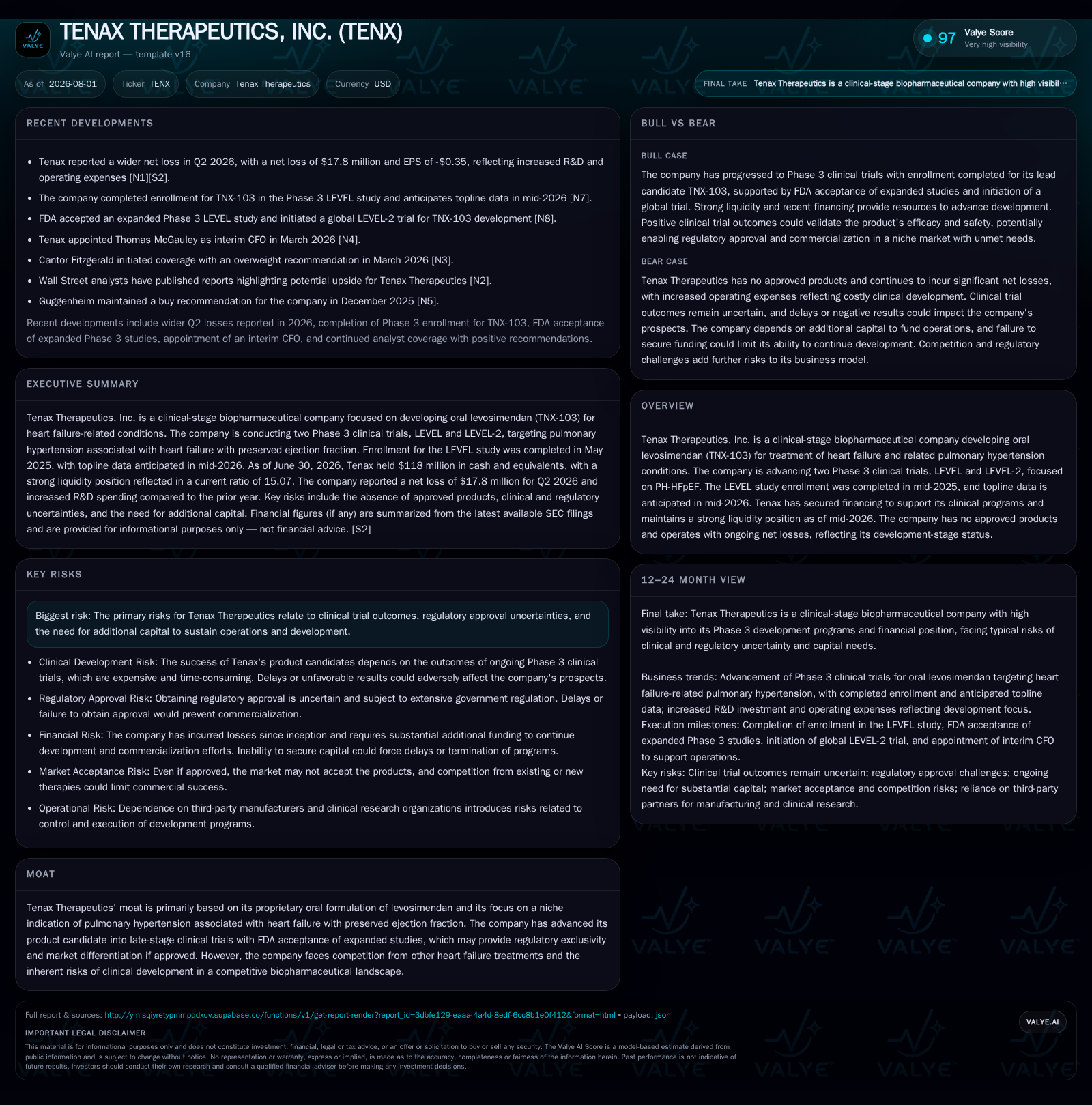
Tenax Therapeutics continues advancing oral levosimendan as a treatment for pulmonary hypertension linked to heart failure with preserved ejection fraction (PH-HFpEF), completing enrollment in the LEVEL Phase 3 trial and expecting topline data in August 2026. The company maintains a robust liquidity position with $118 million cash and no debt as of mid-2026, though it acknowledges substantial future capital needs beyond current cash to complete trials, file regulatory applications, and commercialize potential approvals. Tenax’s business model remains typical of clinical-stage biotechs—no product revenue yet, heavy reliance on equity financing and licensing agreements, and exposure to regulatory risk. Its proprietary oral formulation offers differentiation in a congested heart failure indication, but milestone payment obligations and ongoing net losses underscore operational challenges ahead.
Recent Operating Update: Clinical Progress Anchors Near-Term Outlook
Tenax Therapeutics reported completion of patient randomization in its pivotal LEVEL Phase 3 trial evaluating oral levosimendan for treatment of pulmonary hypertension associated with heart failure with preserved ejection fraction (PH-HFpEF) by the end of Q1 2026. Topline results are expected imminently in August 2026 [S2][S16]. Concurrently, the company initiated its LEVEL-2 Phase 3 trial in December 2025 with ongoing enrollment anticipated through the end of 2027 [S16]. These twin late-stage clinical assets represent the immediate catalysts shaping Tenax’s development pathway.
Such progress is critical because PH-HFpEF is a complex niche within cardiopulmonary therapeutics marked by limited approved options and substantial unmet medical need. The oral formulation of levosimendan under evaluation differentiates Tenax from injectable or hospital-administered competitors, potentially enabling outpatient chronic management—a meaningful factor in physician adoption and payer reimbursement discussions.
Business Model: Development-Stage Biopharma Focused on Levosimendan
Tenax operates as a typical clinical-stage biopharmaceutical company without product revenues to date. Its monetization strategy centers on progressing novel drug candidates through costly clinical development phases toward regulatory approval, then leveraging milestones, licensing deals, or direct commercialization upon successful market entry [S1][S2]. Currently, Tenax prioritizes levosimendan (TNX-103) over its secondary candidate imatinib due to the former's more advanced development stage and clearer regulatory path
This model involves high fixed R&D expenses reflected in rising payroll costs tied to expanding clinical operations—payroll expense grew by $0.8 million in the first six months of 2026 compared to prior year [S2]
Intellectual property rights underpinning levosimendan include granted U.S. patents extending through at least 2039–2040, complemented by exclusive license amendments with Orion Pharmaceuticals covering worldwide oral and subcutaneous formulations [S26][S21]. Under this license, Tenax owes tiered royalties on sales plus staged milestone payments totaling up to $60 million contingent on U.S. FDA approval ($10 million), Japanese approval ($5 million), and cumulative commercial sales milestones ($45 million) [S21][S27]. These obligations will affect profitability post-commercialization but are aligned with industry norms where licensors participate in upside potential.
Industry Structure and Competitive Position
Within the broader landscape of clinical-stage biopharma focused on cardiovascular and pulmonary diseases, Tenax’s emphasis on PH-HFpEF places it alongside peers developing targeted therapies for heart failure subtypes—entities like MyoKardia (acquired by Bristol-Myers Squibb) or Corvia Therapeutics illustrate competitive benchmarks though they focus on related yet distinct indications or mechanisms.
The FDA’s acceptance of two global Phase 3 programs is a positive regulatory signal that supports Tenax’s pathway; however, cardiopulmonary therapeutics remain fraught with clinical risk owing to patient heterogeneity, endpoint complexity (often exercise capacity or hemodynamic improvements), and safety considerations given chronic administration contexts. Oral levosimendan’s novel delivery mode could confer competitive advantage if efficacy/safety profiles prove favorable.
Growth Drivers
Key growth drivers for Tenax converge around successful Phase 3 data releases—August 2026 topline readout will materially influence regulatory filing plans and investor sentiment [N1]. Positive data could unlock accelerated FDA review pathways given orphan designation status or unmet medical need qualification.
Additional drivers include timely recruitment completion for LEVEL-2 facilitating a sustained pipeline presence through late 2027 [S16] and strategic partnerships which may provide non-dilutive capital or commercialization expertise if pursued.
The expanded license agreement terms reducing capsule pricing to Orion improve potential gross margins post-launch while securing supply continuity—important operational factors for scaling commercial production [S21][S24]. Moreover, macro trends such as an aging population increase heart failure prevalence which could expand the target addressable market if/when approvals occur.
Risks and Watchpoints
Tenax faces typical risks inherent in clinical-stage biotech: clinical trial outcomes remain uncertain especially given prior setbacks with imatinib indicating tolerability challenges [S26]. Any delay or unfavorable efficacy/safety data could impair valuation markedly.
Regulatory uncertainty persists around approval timing and required label claims; Tiered royalties plus high upfront milestone payments create considerable financial commitments that may pressure future operating margins [S5][S7][S27]
Capital sustainability is another concern despite robust current liquidity ($118 million cash at June 30, zero debt) because anticipated funding needs extend beyond current resources—covering ongoing trials through at least mid-2028 plus initial commercialization activities necessitates further equity offerings or partnerships [S2][S16][S14]. Dilution risk is real given reliance on frequent financing rounds.
Competitive pressure exists from established heart failure therapies as well as new entrants targeting pulmonary hypertension indications; differentiation via oral delivery must translate into measurable patient benefit to gain traction against entrenched standards of care.
What to Watch Next
Investors and industry observers should monitor the imminent topline data from the completed LEVEL trial expected by August 2026—a pivotal inflection point influencing regulatory submission timing.
Enrollment progress updates from the ongoing LEVEL-2 study will indicate timeline adherence toward end-2027 completion [S16]. Management commentary around capital raising plans post-topline will clarify funding runway adequacy beyond current cash balances.
Regulatory dialogues including potential FDA interactions concerning accelerated approval requests or labeling research views will also be significant milestones determining pathway velocity.
Updates regarding partnership discussions or licensing expansions could reduce capital burden while bolstering commercialization leverage — qualitative signals here matter for medium-term outlooks.
Financial Profile Discussion
Disclaimer: This is research-only, informational analysis and not investment advice. It may include AI-generated interpretation and general industry context. Always verify important details using primary sources.

Comments