
Alliant Energy’s Q2 2026 Earnings Gap Highlights Regulatory and Growth Execution Challenges
Q2 2026 results show revenue growth overshadowed by earnings misses tied to cost pressures and regulatory approval delays.
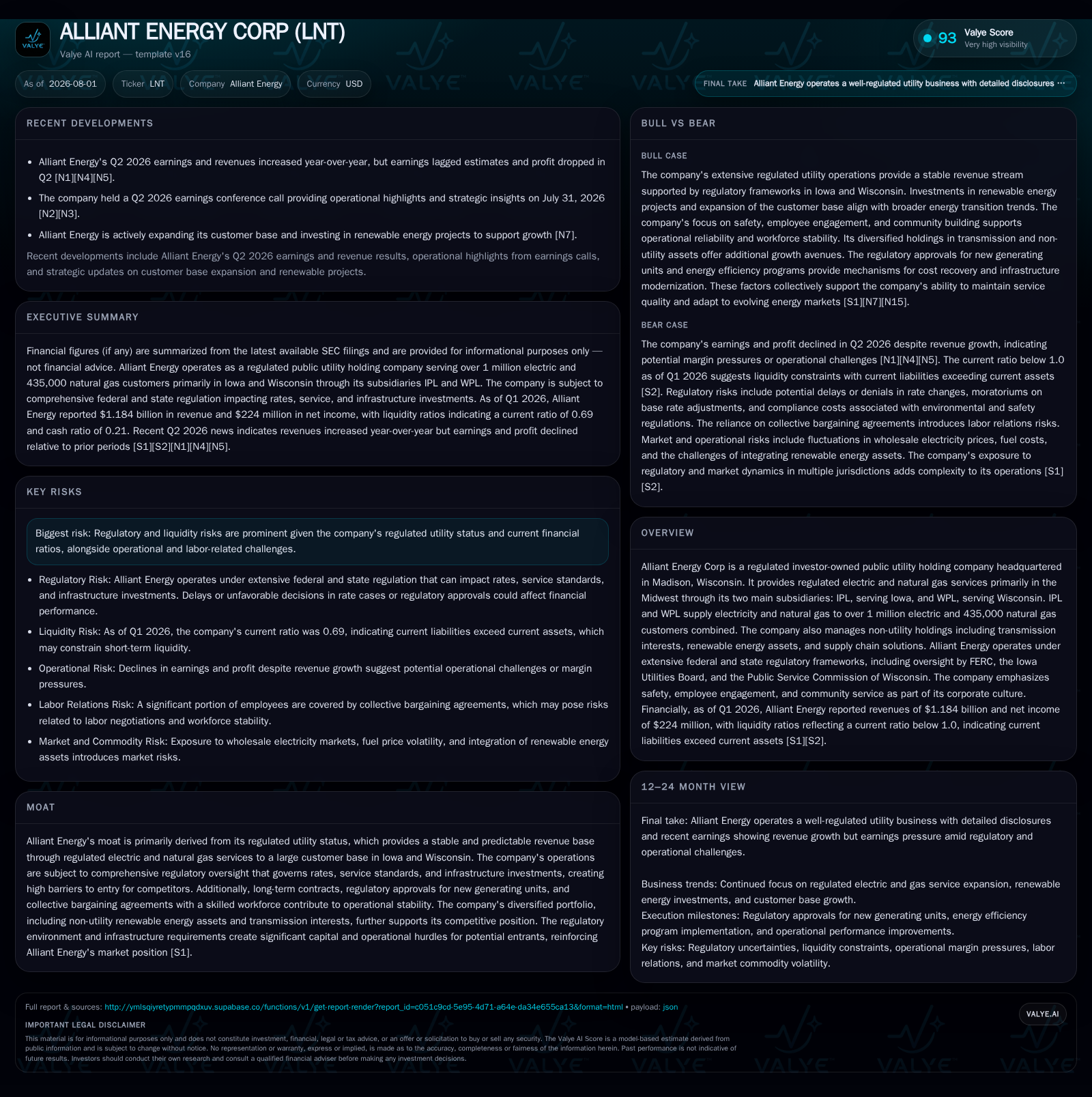
Alliant Energy reported second-quarter 2026 revenues that grew year-over-year, reflecting steady customer demand across its two main utilities, IPL and WPL. However, earnings missed expectations due to operating cost increases and timing lags in regulatory approvals for rate recoveries, indicating emerging execution risks. The company’s regulated utility model offers stable cash flows supported by a large customer base in Iowa and Wisconsin, but growth is tempered by challenges in capital project delivery and uncertainties around serving large load growth customers, such as data centers. Alliant’s diversified portfolio—including transmission interests and renewable assets—provides additional but limited earnings diversification, while the financial profile remains consistent with typical industry leverage and liquidity patterns. Near-term investor focus will remain on upcoming rate case decisions, capital expenditure pacing, and large customer contracting progress.
Q2 2026 Operating Results Reveal Strains on Earnings Growth
The operating margin compression suggests rising input costs or inefficiencies linked to ongoing infrastructure investments that have yet to be fully reflected in approved tariffs. Such dynamics introduce near-term volatility atypical for a historically steady regulated utility business.
Stable Regulated Utility Model Anchored by IPL & WPL Customer Base
These utilities enjoy virtual monopoly franchise rights granted through state public utility commissions—the Iowa Utilities Board (IUB) for IPL and the Public Service Commission of Wisconsin (PSCW) for WPL [S1]. This regulatory framework governs allowed rates through periodic rate cases which set tariffs designed to recover prudently incurred costs plus an authorized return on equity (ROE). Consequently, Alliant’s revenue streams are largely stable and predictable with pricing power confined within the confines of regulation.
Operationally, the company manages electric generation assets alongside transmission infrastructure ownership via non-utility holdings [S1]. It encompasses generation dispatch, load forecasting to meet system peak demands, distribution network maintenance, and customer billing—all tightly integrated into the regulated value chain
Regulatory Oversight Shapes Rate Base Expansion and Investment Returns
Public utility commissions critically shape Alliant’s investment returns by approving capital expenditures that expand the regulated rate base—essentially the asset base upon which allowed ROE is earned. Capital investments focus on modernizing aging infrastructure, integrating renewable energy projects into the grid mix, enhancing reliability metrics such as SAIDI/SAIFI (service interruption indices), and expanding capacity to serve increasing load demands [S1][S2]
However, regulatory procedures introduce inherent delays between incurring costs from new projects and receiving tariff approval to recover these expenses. This lag affects near-term earnings despite underlying rate base growth prospects. Moreover, regulators impose ROE limits that cap profit margins—mandating a careful balance between investment scale and commensurate shareholder returns.
Recent filings suggest some slippage in expected timeline approvals may be pressuring earnings visibility as management continues submitting petitions seeking cost recovery [S2]. This mirrors industry-wide challenges faced by regional peers like CMS Energy or Duke Energy within Midwest jurisdictions dealing with evolving environmental regulations affecting generation asset compliance.
Renewable Integration and Transmission Holdings Provide Diversification Benefits
Beyond its core utility operations, Alliant Energy holds non-utility interests contributing additional albeit smaller profit centers. A significant platform includes Alliant Transmission Investments (ATI), holding minority stakes in American Transmission Company (ATC), a standalone for-profit transmission-only company [S1]. This exposure provides stable fee-based income decoupled from retail load variability.
Additionally, Alliant maintains a 50% equity interest in a 225 MW wind farm located in Oklahoma—representing a strategic move towards cleaner fuel mix diversification aligned with decarbonization trends [S1]. While incremental relative to overall revenues dominated by regulated utility services (~$4.36 billion trailing revenue at year-end 2025), these assets support gradual transition toward renewables without destabilizing core cash flows.
Moreover, leasing arrangements like the Sheboygan Falls Energy Facility—a simple-cycle natural gas plant operated under long-term lease to WPL—offer operational flexibility for capacity needs amid shifting fuel economics [S1]
Load Growth Drivers: Opportunities and Contractual Complexity From Large Customers
A key growth vector lies in serving large industrial customers including data centers whose escalating electricity demands present upside volume opportunities [S23][S24]. However, this segment introduces significant complexity due to substantial upfront capital commitment requirements for generation turbines or enhanced transmission capacity that must proceed before realizing returns
Regulatory approvals are necessary not only for contract ratemaking but also siting permits often challenged by community opposition citing environmental concerns such as land use or water consumption [S24]. This opposition can delay or derail project timelines affecting planned demand additions.
Furthermore, reliance on concentrated large loads heightens counterparty risk; contract terminations or demand reductions could materially impact forecasted revenues creating volatility uncommon to generally stable retail bases [S23]. The company acknowledges risks around timely construction of pipeline expansions needed for gas-fired peakers essential during peak loads from such clients [S24].
Thus while attractive for incremental load growth amid broader residential-commercial demand saturation, these contractual relationships inject regulatory approval risk alongside operational execution hazards.
Risks From Capital Execution, Regulatory Decisions, and Demand Variability
Alliant’s filings emphasize multiple confirmed risks including escalation or delays in capital projects driven by supply chain constraints or labor availability—common in today’s utilities sector given global inflationary pressures [S1][S2]. Any such overruns impact allowed costs recovered via rates only if regulators accept prudence evaluations.
Demand side uncertainty arises from evolving customer behavior influenced by distributed-generation adoption or efficiency programs potentially curbing volumetric growth needed to underpin new infrastructure economics [S22][S27]. At the same time environmental compliance mandates are tightening—necessitating further investment increasing capital intensity.
Together these risks create potential earnings volatility despite nominally stable regulated frameworks—a caution echoed broadly among regional peers facing similar structural headwinds requiring proactive management agility.
“Looking Ahead”: Milestones for Rate Cases, Load Growth, and Capital Projects
Investor focus will sharpen on several upcoming milestones critical for clarifying Alliant’s near-term outlook. These include decisions on pending or forthcoming rate cases at IUB (IPL jurisdiction) and PSCW (WPL jurisdiction) which will determine allowed returns impacting profitability trajectory [S2][N2].
Additionally monitoring progress on generation facility constructions meant to serve new large-load customers will provide signals on execution capability crucial for revenue realization. Renewables integration initiatives aligned with regional decarbonization policies will also require updates reassuring stakeholders about sustainable future cash flow sources.
Active investor engagement during quarterly calls has already highlighted management emphasis on advancing these priorities while balancing liquidity preservation amidst ongoing capital deployment efforts [N2]
Financial Position Supports Capital Needs Amid Leverage Management
Credit agreements contain covenants restricting leverage levels capped around debt-to-capital ratios close to industry norms ensuring sufficient financial flexibility to fund ongoing capital expenditures targeting modernization and growth projects without excessive refinancing risk [S7]
This financial stance supports near-term operational plans but mandates careful monitoring given cyclical capital needs paired with intermittent regulatory cost recovery timing acknowledged as pressure points during Q2 results.
Disclaimer: This analysis is grounded solely on publicly available SEC filings (), company facts data ([F1]), and recent news reports (). It does not constitute investment advice but aims to provide an informed industry-focused view respecting disclosure standards.
Disclaimer: This is research-only, informational analysis and not investment advice. It may include AI-generated interpretation and general industry context. Always verify important details using primary sources.

Comments