
Extra Space Storage's Portfolio Scale and Capital Strategy Sustain NOI Growth Amid Zoning Constraints
Strong operational performance and disciplined capital management underpin Extra Space Storage's steady expansion in a capital-intensive, regulation-sensitive industry.
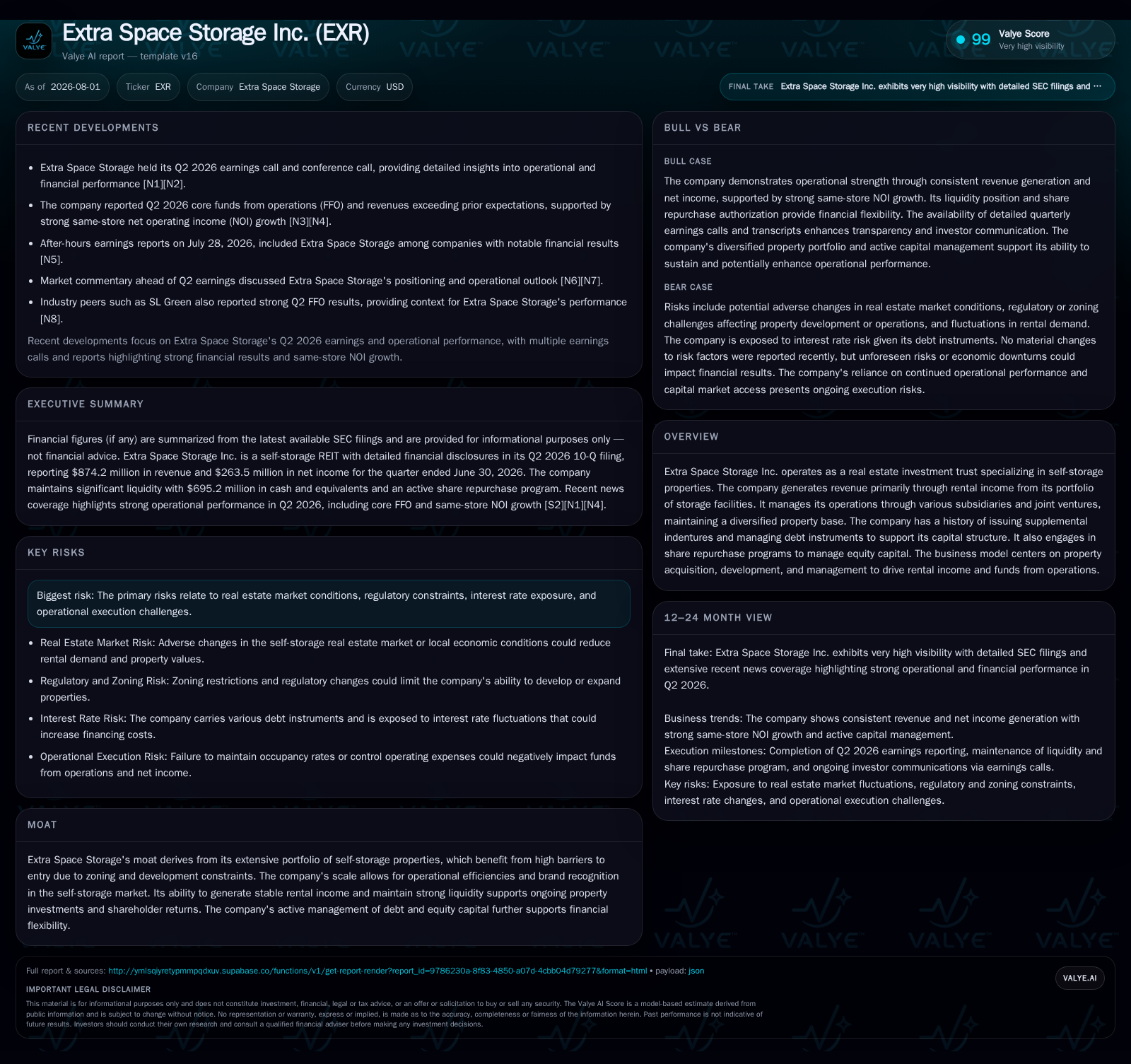
Extra Space Storage (EXR) reported solid Q2 2026 results, highlighted by robust same-store net operating income growth and effective leverage of its extensive property portfolio. The company's business model, focused on rental income from self-storage properties combined with active portfolio management and joint ventures, benefits from significant barriers to entry such as zoning restrictions. EXR maintains financial flexibility through a diversified capital structure and a substantial undrawn credit facility while continuing selective property acquisitions and redevelopment. Key growth drivers include expanding urbanization trends and inflating rental rates, but risks persist from regulatory constraints and interest rate fluctuations.
Recent Operating Update
Extra Space Storage Inc. delivered its 10-Q for the quarter ended June 30, 2026, confirming robust operational momentum across its portfolio. Notably, there were no material changes to previously disclosed risk factors [S2]. The company maintained occupancy improvements supported by strategic rental rate increases, contributing to strong same-store net operating income (NOI) growth during the quarter [N1]. Additionally, no shares were repurchased under the board-approved $500 million three-year buyback program during Q2, leaving $349 million of authorization remaining—a conservative approach reflecting sensitivity to prevailing market dynamics [S2]. There were also no defaults on senior securities or changes in officer trading plans during the quarter.
This quarterly snapshot affirms stability in EXR's operational parameters ahead of expected continued growth but underscores management's caution during macro uncertainties.
Business Model
Extra Space Storage functions primarily as a Real Estate Investment Trust (REIT) specializing in self-storage facilities. Its revenue mix centers almost entirely around rental income generated from leasing individual storage units to both residential and business customers across the United States. The company employs proactive pricing strategies enabled by dynamic online marketing platforms that allow real-time adjustment of rental rates based on local supply-demand dynamics [S1][N1]. High occupancy rates remain crucial to revenue generation since each vacant unit represents lost cash flow and dilutes economies of scale.
Strategically, EXR focuses on acquiring existing properties ranging from fully stabilized assets to Certificate of Occupancy stores—newly completed facilities that have yet to reach full occupancy [S1][S8]. Acquisition of such stores trades off short-term earnings dilution against long-term upside as lease-up occurs over two to four years
Operationally, EXR manages day-to-day leasing, maintenance, customer service, and security directly or through subsidiaries. It also operates numerous joint ventures where partner entities provide most equity capital while EXR retains control over operations—aligning incentives yet sharing financial risk [S1]. These structures aid balance sheet leverage optimization and enable disciplined capital deployment.
Revenue variability is chiefly influenced by occupancy rates, lease renewal efficacy, rental rate adjustments ('lease spreads'), and minor seasonal trends typical for consumer storage demand. Capital expenditures focus heavily on redeveloping existing locations to optimize unit mixes or extend useful life while selectively investing in new developments primarily via joint ventures.
Industry Structure and Competitive Position
The self-storage REIT landscape is characterized by high fragmentation outside a few large players like Public Storage and CubeSmart. Barriers to entry are notably reinforced by zoning restrictions that limit new construction permitting frequency—generally confining supply growth despite expanding demand. This unique characteristic benefits incumbents such as EXR with sizable portfolios allowing scale advantages including brand recognition, centralized marketing technology platforms, operational efficiencies in staff deployment and procurement.
EXR maintains one of the most geographically diversified portfolios among self-storage REITs with hundreds of properties distributed across major urban centers and growing secondary markets [S1]. This diversification mitigates localized demand shocks or competitive pressures.
Competitively, the company leverages technology for dynamic pricing—which peers have also increasingly adopted—and strong customer service frameworks supporting high lease renewal rates. Its reputation as a reliable acquirer facilitates favorable negotiations when entering multi-store portfolio deals or negotiating land acquisition for developments.
Growth Drivers
Key growth engines comprise:
- Demographic Trends: Increased urbanization coupled with transient population movements fuels demand for flexible self-storage options catering primarily to households downsizing or between homes as well as small-to-medium businesses needing supplementary space.
- Rental Rate Increases: Inflationary pressures alongside localized supply tightness enable periodic rent hikes without significant occupancy degradation; these 'lease spreads' materially enhance NOI beyond mere occupancy gains.
- Acquisitions: EXR continues targeting accretive purchases of both stabilized assets and under-leased newly built properties, leveraging its large undrawn revolving credit capacity for rapid deployment.
- Development Pipeline: By investing selectively in ground-up projects—often via joint ventures—EXR aims to capitalize on scarcity-induced price premiums upon store stabilization.
- Portfolio Optimization: Frequent redevelopments focusing on unit-mix adjustments enhance average unit sizes or formats appealing more effectively to shifting customer preferences.
Risks and Watchpoints
Despite positive fundamentals, several risks warrant attention:
- Zoning/Regulatory Constraints: While barriers protect incumbents against oversupply, they also hamper growth flexibility if regulations become more restrictive or municipal opposition increases.
- Interest Rate Exposure: With aggregate net debt approximating $3.07 billion (total debt minus cash) per latest data [F1], rising borrowing costs could pressure interest coverage metrics depending on refinancing terms.
- Economic Sensitivity: A prolonged economic downturn could diminish discretionary consumer/business spending on storage solutions tempering occupancy gains.
- Operational Execution Risk: Sustained high service levels are essential for repeat customers; lapses could affect renewal rates negatively.
- Joint Venture Dependencies: Relationships with partners involve shared governance risks; divergence in strategic priorities or financial capacity may delay expansions or disposals.
- Capital Market Volatility: Equity issuance remains an option for financing but is subject to market receptivity; unfavorable conditions may force reliance on higher-cost debt financing.
Monitoring these factors through quarterly NOI trends, occupancy metrics relative to peer benchmarks, refinance activity on maturing notes due in late 2026–2029 horizon [S5], and regulatory developments will inform assessment of EXR's sustainable growth trajectory.
What to Watch Next
Key upcoming indicators include:
- Quarterly same-store NOI growth rates versus prior periods and peer averages assessing margin pressure or pricing power shifts,
- Progression on leases at newly acquired Certificate of Occupancy properties providing early signals on expected lease-up durations,
- Updates on joint venture expansions or new partnerships indicating pipeline robustness,
- Management commentary on share repurchase program utilization signaling confidence levels in capital deployment efficiency,
- Tracking interest coverage ratios especially after any refinancing events through late 2026,
- Potential regulatory changes impacting development approvals or operating cost structures,
- Dividend payout sustainability monitored through core FFO per share evolution as announced in earnings releases [N4][N14]
Financial Profile Discussion
At June 30, 2026, Extra Space Storage held approximately $695 million in cash and equivalents [F1]. The latest available total debt and net debt figures date back to 2017, with total debt near $3.76 billion and net debt around $3.07 billion [F1]. Share repurchases have been minimally executed recently despite board authorization indicating prudent cash conservation aligned with investment opportunities’ returns expectations [S2].
Overall cash flow generation is enhanced by stable recurring rents bolstered by modest CapEx outlays concentrated mostly on redevelopment rather than new builds which carry upfront drag during lease-up phases [S1]
This analysis integrates SEC disclosures and recent company commentary highlighting Extra Space Storage Inc.’s effective exploitation of scale advantages while navigating typical self-storage REIT sector headwinds such as zoning constraints and interest rate pressures. Investors should observe forward same-store NOI dynamics along with liquidity measures and refinancing updates for evolving insight into execution sustainability within this capital-intensive real estate niche.
Disclaimer: This report is for informational purposes only and does not constitute investment advice or research views.
Disclaimer: This is research-only, informational analysis and not investment advice. It may include AI-generated interpretation and general industry context. Always verify important details using primary sources.

Comments