
Fuse Group's Multi-Sector Strategy Faces Capital and Commercial Viability Challenges
Fuse Group reports persistent net losses and liquidity stress in its mining, biotech, and consulting ventures, highlighting risks amid stalled acquisitions and absent revenue growth.
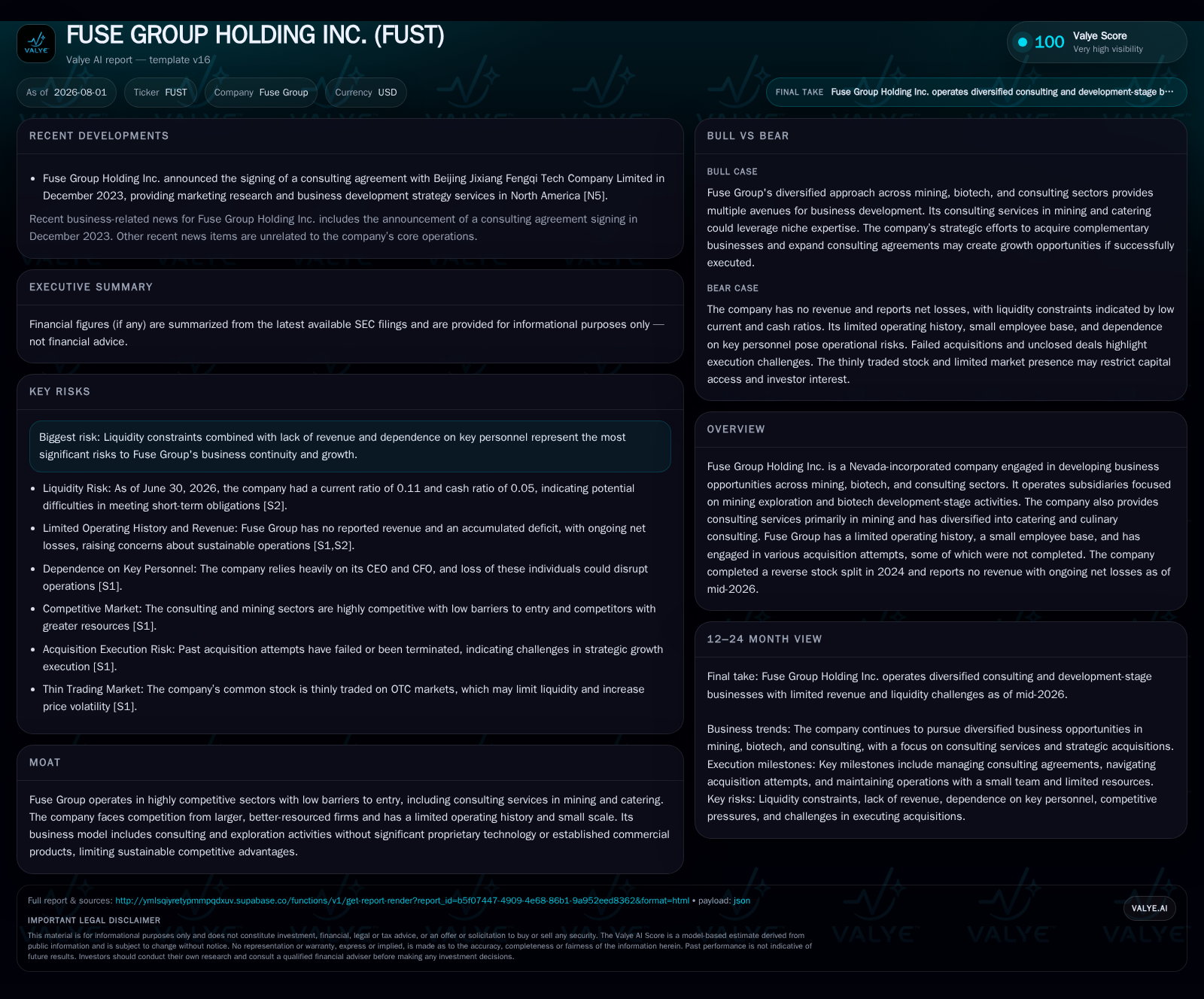
The July 31, 2026, quarterly filing reveals Fuse Group Holding Inc.’s ongoing operational difficulties characterized by negative net income, minimal revenue generation, and a precarious current ratio of 0.11. Despite efforts to diversify across mining exploration, biotech development, and consulting services, the company has yet to secure meaningful revenue streams or complete key acquisition transactions critical to scaling its asset base. A 2024 reverse stock split intended to stabilize market positioning has not alleviated capital constraints. Fuse Group’s strategic challenges reflect typical early-stage sector risks coupled with intensified liquidity pressures that threaten near-term operational viability.
Q2 Update Confirms Intensifying Liquidity Constraints Amid No Revenue Growth
Fuse Group Holding’s most recent quarterly report as of July 31, 2026 highlights a continuation of negative operating trends that sharply constrain near-term sustainability [S2]. Reported revenue remains negligible at approximately $46,000 as of September 30, 2025 [F1], reflecting minimal commercial activity across its diversified subsidiaries. Operating losses persisted at roughly $278,000 for the same period [F1], driving a widening net loss profile typical of early-stage exploration and development firms. Critically, the company’s current ratio stood at an alarming 0.11 at quarter-end [F1], evidencing a severe mismatch between current assets ($35.9 million) and liabilities ($326 million) that underscores urgent liquidity risk.
The pronounced imbalance between current liabilities and assets indicates that without external capital injections or successful asset monetization—namely completion of acquisition agreements—the company faces imminent operating challenges. This situation underlines why sustaining operations hinges heavily on financing events or progressing stalled mineral concession transfers that would expand its asset base.
Consulting Services Remain Core But Low-Margin Amid High Competitive Pressure
Fuse Group’s consulting offerings largely focus on providing due diligence support to mining clients seeking acquisition targets and strategic advisory in market research roles within both mining and biotech segments [S1,S9]. Historically, these engagements have involved vetting mine ownership titles and assessing operational readiness—services charged on a fee basis.
However, the company’s consulting footprint remains constrained by limited contract duration and small-scale client engagements. For instance, an advisory agreement with a Beijing-based client expired in December 2024 without renewal [S18], indicating a lack of sustained revenue streams from this segment. The consulting business faces stiff competition from specialized firms like SRK Consulting in mining or IQVIA in biotech advisory sectors—which possess entrenched reputations and deeper resources—resulting in difficult pricing dynamics and client retention hurdles.
Mining Concessions Acquisition Roadblocks Undermine Exploration Ambitions
Central to Fuse Group’s growth plan is consolidation of mineral concessions in Mexico acquired via an oral agreement initiated in mid-2018 involving rights to five mining locations valued at $1 million [S1,S11]. This deal was contingent on government approval to transfer underlying mining concessions into a Mexican corporate entity controlled by Fuse Processing.
However, as documented through late 2025 filings [S3], the equity transfer process remains incomplete pending Mexican government sanction—a common regulatory hurdle faced by junior explorers attempting surface-rights acquisition outside their home jurisdictions. The inability to obtain surface rights or necessary permits prevents advancement toward tangible exploration targets with potential value creation.
This stalled transaction exemplifies how smaller players like Fuse Group confront protracted regulatory reviews and permit delays not typically experienced by established industry peers such as Pan American Silver or First Quantum Minerals who benefit from scale advantages and local regulatory relationships. Without clear resolution here, mineral asset portfolio expansion—and subsequent resource valuation steps—remain speculative.
'Biotech Pipeline’ Still Developmental With No Commercial Milestones Achieved
Fuse Biotech Inc., the company's subsidiary targeted toward vaccine, immunological treatment, and diagnostic product R&D, continues to operate firmly in a development-stage mode [S1,S6]. Notably absent from filings are indications of major research milestones achieved, partnerships formalized, or regulatory approvals sought—all crucial precursors to commercialization.
A previously proposed acquisition of E-Mo Biotech Holding Inc. designed to bolster the biotech pipeline was formally terminated in late 2021 after failing to close [S6,S8]. This event reflects broader execution risks endemic to early-stage biotech ventures reliant on securing licenses or pipeline development progress prior to generating income.
Given typical sector characteristics where enterprises like Moderna or BioNTech invest years pre-commercialization incurring steep cost burdens without revenues, Fuse Biotech’s profile aligns with high-cost developmental investment absent near-term sales prospects. Such profile intensifies the company’s cash burn rate pressure without offsetting capital inflow.
Reverse Stock Split: Market Navigation Tactic Without Immediate Operating Impact
In mid-2024, Fuse Group executed a reverse stock split at a ratio of one-for-five shares intending primarily to meet OTC market listing standards rather than for fundamental business improvements [S3,S6]. Although reducing shares outstanding can psychologically reset share price markers enhancing perceived value among investors,
no evidence suggests this maneuver translated into material capital inflows or alleviated chronic cash constraints.
Share certificates initially prepared for acquisition consideration were later canceled due to reevaluation of the underlying transaction terms [S3]. Thus, capital market mechanics around the reverse split have yet to translate into tangible financing advantages aiding operational scaling.
Growth Path Stumbles on Capital Limits, Regulatory Delays, and Competitive Moat Deficiencies
Synthesizing the company’s operating indicators reveals that despite strategic ambitions spanning mining concessions accumulation, biotech R&D progression, and consulting expansions,
Fuse Group is hampered by funding scarcity compounded by regulatory hurdles (notably surface rights approvals), intense competition from well-established service firms,
and a lack of proprietary assets limiting sustainable competitive moats [F1,S5,S7]. The prolonged absence of completed acquisitions combined with stagnant consulting contract life cycles signals structural challenges rather than cyclical issues.
Peer comparisons further emphasize these constraints; pure-play explorers enjoy broader resource access allowing fee-based services augmentation alongside exploration success while development-stage biotechs frequently demonstrate clearer milestone-linked funding rounds underpinning runway extension []. Fuse Group lacks these clearer validation triggers currently.
'Watchpoints' Spotlight Cash Burn Rate And Successful Asset Transfers as Triggers For Re-rating Potential
Key near-term indicators merit close monitoring due to their potential to alter Fuse Group’s outlook. These include: - Completion of mineral concession equity transfers enabling active exploration targeting; - Renewal or expansion of consulting contracts particularly with noted domestic/international clients; - Ability to extend cash runway through fresh capital raises or strategic partnerships mitigating immediate funding shortfalls [S2,S11]. Failure on any front perpetuates operational risk while progress could provide re-rating catalysts amidst existing uncertainty
Financial Profile Discussion: Balance Sheet Highlights Signal Urgency In Funding Strategy
As per the June 30, 2026 snapshot from company filings [F1], Fuse Group shows cash and equivalents totaling $17.9 million juxtaposed against current liabilities exceeding $326 million,
yielding a critically low current ratio near 0.11 indicative of heightened liquidity stress severely impairing short-term financial flexibility.
With no commercial revenues materializing sufficiently across segments thus far, the management faces an imperative balancing act between conserving cash burn rate and pursuing capital transactions vital for sustaining business continuity. The financial snapshot corroborates earlier qualitative risk assessments emphasizing Fuse Group's dependence on external financing events amid competitive pressures and thin operating scale.
Disclaimer: This is research-only, informational analysis and not investment advice. It may include AI-generated interpretation and general industry context. Always verify important details using primary sources.

Comments