
Digital Realty Trust Advances Hyperscale Strategy with Northern Virginia Acquisition and Geographic Expansion
DLR strengthens its global hyperscale data center portfolio through strategic acquisitions and development initiatives in 2026.
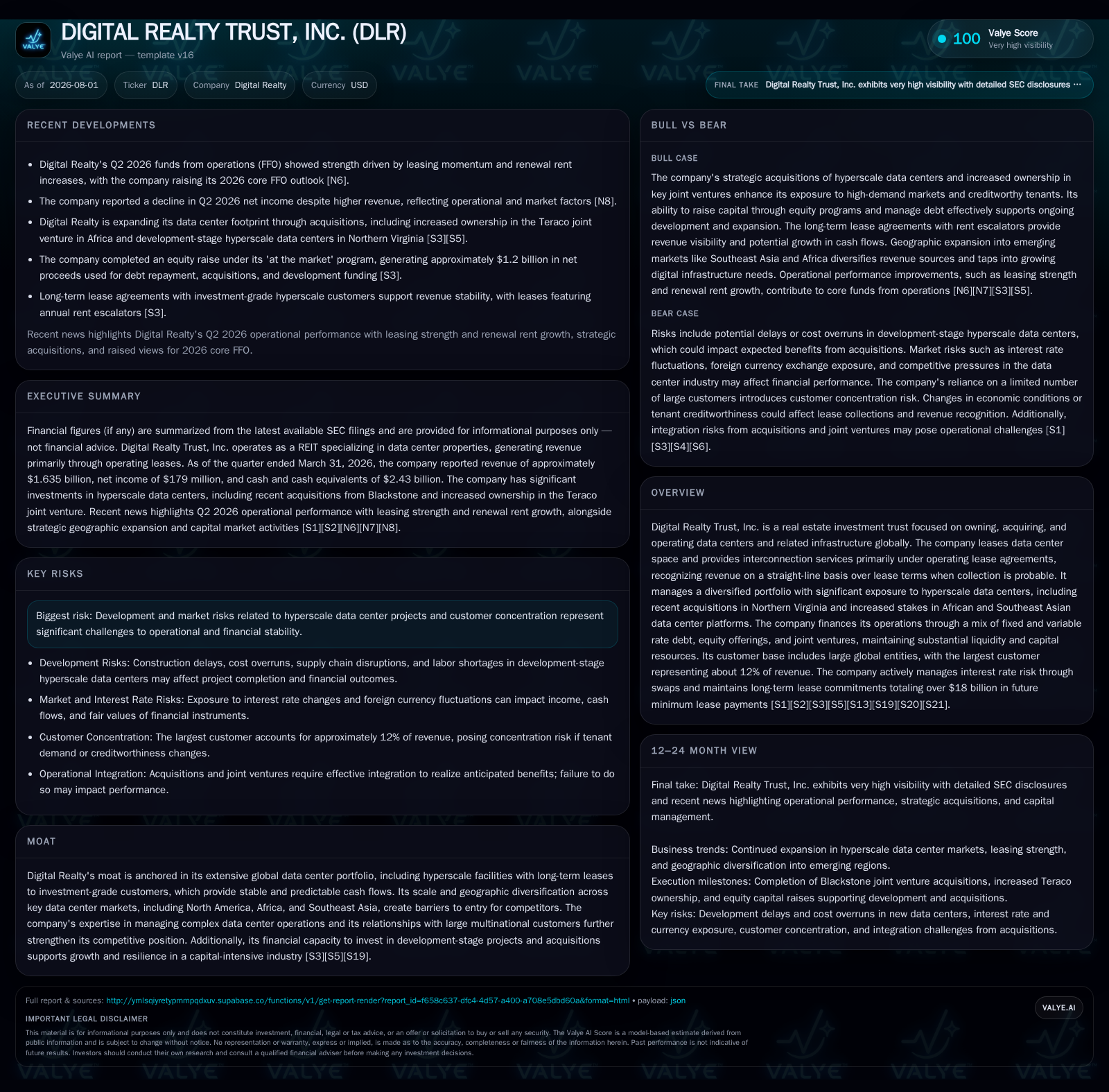
Digital Realty Trust, Inc. (DLR) reported significant portfolio expansion in the second quarter of 2026 anchored by the acquisition of Blackstone’s interests in key Northern Virginia hyperscale data centers. This transaction enhances DLR's ownership in strategic markets with triple-A rated tenants under long-term leases, supporting predictable cash flows and growth. Meanwhile, the company is increasing its presence in emerging data center hubs such as Africa via its Teraco platform and expanding land holdings near Kansas City for future development. These moves deepen DLR's competitive moat through scale, diversification, and hyperscale exposure, although development risks and customer concentration remain notable challenges. Financially, the company maintains ample liquidity with over $2.4 billion in cash as of Q1 2026, balanced against a sizable but manageable debt load.
Recent Operating Update: Strategic Acquisitions Propel Portfolio Growth
The acquisition is expected to be leverage neutral initially and accretive to Core Funds From Operations (FFO) per share starting in 2027 as properties stabilize commercially following ongoing development expenditure completion scheduled through mid-2027 and early-2028 [S7][S10]. The estimated stabilized capitalization rate surpassing 6.5% suggests attractive yield characteristics aligned with market benchmarks for prime hyperscale assets in this region. However, management acknowledges inherent risks including potential construction delays, cost overruns, permitting hurdles, and market condition volatility that could affect timing or cash flow realization substantially [S7][S8].
Concurrent with this acquisition, Digital Realty also expanded its footprint outside traditional hubs by increasing its interest to a controlling stake (77%) in the Teraco joint venture platform situated in Africa—one of the fastest-growing digital infrastructure markets globally—through equity issuance worth approximately $644 million in shares [S8][S15]. This maneuver deepens geographic diversification while aligning exposure with emergent demand drivers such as rapidly expanding cloud adoption and digitization in emerging economies.
Separately, a significant land acquisition near Kansas City (Astra Enterprise Park) involving roughly 1,440 acres sets the stage for a new data center campus with utility arrangements ensuring provisioned power capacity up to two gigawatts upon full buildout projected by early 2028 and beyond [S5][S10]. Securing large-scale utility infrastructure upfront is fundamental given energy consumption intensity is a critical bottleneck for sustainable data center expansion.
Business Model: Capital-Intensive Leasing with Hyperscale Focus
Digital Realty operates principally as a real estate investment trust owning a broad portfolio of data center properties worldwide which it leases primarily under operating lease agreements recognizing revenue on a straight-line basis over lease terms when collection is probable [S1]. Its customers are predominantly large multinational technology enterprises including hyperscale cloud providers whose demanding requirements necessitate extensive power density, redundancy engineering, carrier-neutral interconnection services, and scalable rack space environments.
The company’s revenue mechanics revolve around leasing secure space inclusive of tenant improvements where applicable; pricing derives from rental rates per usable square foot or per kilowatt provisioned reflecting market conditions and tenant credit profiles. Lengthy average lease terms coupled with tenants’ investment-grade parent corporations underpin revenue stability while structured annual escalators embedded within contracts support organic rental growth.
Digital Realty also supplements base rents via interconnection services facilitating direct network traffic exchange vital for hybrid cloud architectures—an increasingly important revenue lever aligned with broader industry trends favoring interconnected digital ecosystems.
Capital deployment focuses on acquisitions (such as Blackstone assets), greenfield developments (e.g., Astra Enterprise Park), and opportunistic investments scaling exposure to high-growth geographies including Africa and Southeast Asia where digital adoption growth rates outpace mature markets.
Industry Structure and Competitive Position
As a leader among Data Center REITs competing alongside firms like Equinix and CyrusOne, Digital Realty distinguishes itself through an expansive global footprint exceeding several thousand megawatts of operational capacity distributed across premier markets. Unlike regional players or cloud providers owning proprietary infrastructure limited to captive use cases, DLR serves a diversified tenant base across hyperscale operators, enterprises, telecommunications companies, and governmental clients.
The capital-intensive nature of the business demands substantial upfront investments not only for property acquisition but also ongoing maintenance capital expenditures driven by technological upgrades addressing evolving standards on power usage effectiveness (PUE), resilience measures, and regulatory compliance concerning environmental sustainability.
Scale confers several advantages including bargaining power over suppliers/utilities, ability to construct build-to-suit tailored facilities at efficient cost structures, and enhanced visibility into tenant demand patterns enabling proactive capacity management. Geographic spread reduces volatility arising from localized economic fluctuations or regulatory shifts; however concentrated exposure remains notably high in core U.S. markets like Northern Virginia.
While competitors similarly target hyperscale tenants evidenced by rising multi-megawatt renewals underpinning demand strength industry-wide, DLR’s recent Blackstone acquisition specifically secures access to newly commissioned campus-scale projects fully leased at creditworthy terms thereby reinforcing competitive moat elements centered on asset quality AND operator relationships.
Growth Drivers
Digital Realty benefits from secular tailwinds fueling data center demand: accelerating cloud migration driving exponential server utilization growth; rise of edge computing propelled by IoT expansion; increasing needs for cross-cloud interconnection reflecting hybrid deployment models; plus emergent deployments tied to forthcoming technologies such as AI workloads necessitating ultra-high density power provisioning.
Strategically augmenting presence in high-growth frontier regions like Africa via Teraco elevates potential upside notably due to limited competing scale operators combined with nascent digital infrastructure investment phases promising multi-year runway for supply-constrained markets.
Development pipeline expansions anchored by large acreage acquisitions backed by secured utility capacity will enable sustained capacity additions matching forecast demand trajectories subject to successful execution amid cyclical construction cost volatility risks.
Furthermore, incremental interconnection service offerings capture expanding hybrid networking spending enhancing recurring revenue streams beyond basic leasing income producing marginally higher profitability per square foot metrics.
Risks and Watchpoints
Key risks cluster around execution uncertainty of complex construction projects especially large build-to-suit hyperscale campuses whereby supply chain issues or labor shortages could delay or inflate costs altering projected returns as seen around the Blackstone acquisition sites [S7][S8].
Customer concentration poses risk case given that approximately one customer accounts for nearly 12% of revenues; loss or non-renewal of such tenants could materially impact cash flow absent replacement demand from other parties [S1]
Market competition intensifies pressure on rental rate increases particularly where newer supply ramps up rapidly impacting stabilized capitalization rates achievable on newly developed assets [S7]
Regulatory dynamics including zoning restrictions or environmental mandates elevate complexity requiring adept navigation amidst growing sustainability focus potentially raising capital expenditure requirements further compressing yields.
What To Watch Next
Financial Profile Discussion
Recent equity sales under "at-the-market" programs have generated over $1 billion net proceeds during early-mid 2026 deploying capital toward development funding plus debt reduction demonstrating prudent balance sheet management amid volatile interest rate environment impacting borrowing costs directly [S8][N2]
Core funds from operations are anticipated to benefit from accretion related to newly consolidated Blackstone assets once stabilized reflecting improved net operating income profiles compared against purchase consideration underwriting metrics detailed earlier indicating cap rates exceeding typical portfolio averages frequently observed near mid-to-high single digits in prime U.S. markets.
The foregoing analysis reflects information available from SEC filings dated up through July 31, 2026 alongside corroborating industry reports without constituting any investment advice or forecasts related thereto.
Disclaimer: This is research-only, informational analysis and not investment advice. It may include AI-generated interpretation and general industry context. Always verify important details using primary sources.

Comments