
Federated Hermes Surpasses Expectations with Record Asset Growth Amid Regulatory Shifts
Federated Hermes posts record assets under management and strong earnings while managing evolving regulatory challenges impacting fee structures and product offerings.
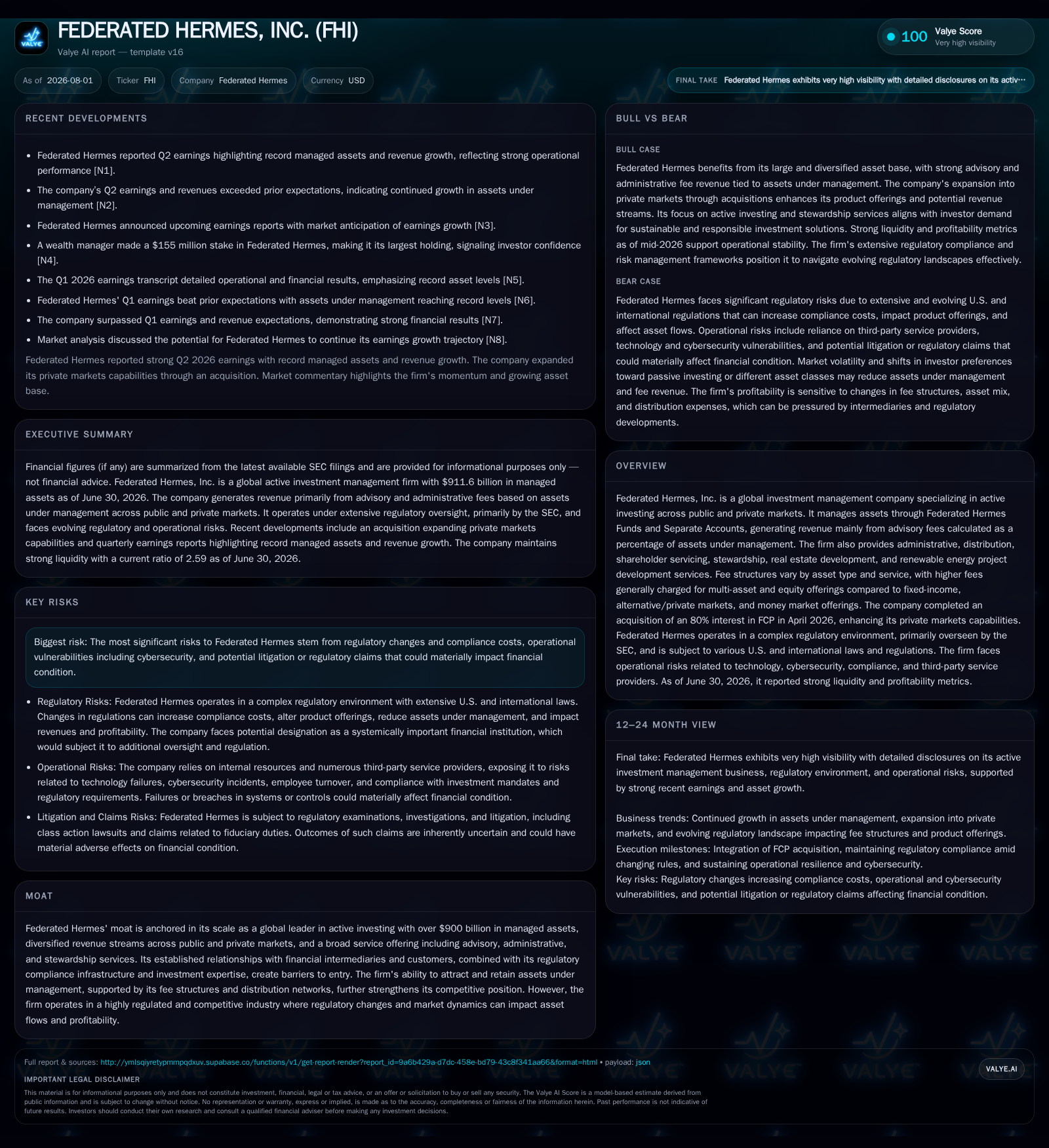
Federated Hermes delivered robust second-quarter results in 2026, highlighted by a record $911.6 billion in assets under management driven by strong net inflows and favorable market conditions. The firm’s diversified active management platform, complemented by the recent acquisition of a majority stake in FCP to bolster private market offerings, continues to underpin revenue stability amid shifting regulatory frameworks affecting product design and fees. While distribution expenses remain a significant cost driven by intermediary payments, Federated Hermes leverages its scale and broad service mix to manage margin pressures alongside rising compliance costs. Operational risks such as cybersecurity and evolving fund regulations remain watchpoints going forward.
Record Asset Growth Anchored by Diverse Product Mix During Regulatory Evolution
Federated Hermes reported second-quarter 2026 assets under management (AUM) reaching a new high of $911.6 billion as of June 30, driven primarily by strong net inflows coupled with favorable capital market performance across both public and private sectors [S2]. This milestone is significant as it underpins the firm's core revenue driver—advisory fees—which are largely tied to the breadth and composition of AUM. The record AUM reflects robust client demand across multi-asset and equity strategies despite ongoing macroeconomic uncertainties. Furthermore, this growth is supported by the firm’s recent strategic expansion into private markets through the acquisition of an 80% interest in FCP earlier in 2026 [S2], which broadens Federated Hermes' footprint in alternative investments characterized by longer redemption horizons.
Importantly, these developments unfold during evolving regulatory landscapes that continue to shape product design and fee structures. The European Securities and Markets Authority (ESMA) has engaged on fund tokenization frameworks that could reshape investor interaction models with funds — for example allowing direct dealings between investors and tokenized funds without intermediation [S2]. Additionally, EU money market fund reforms emphasize maintaining certain working liquidity assets (WLA) thresholds as early warning indicators rather than binding minimums [S2]. Such regulatory initiatives suggest increased complexity for product compliance but do not yet indicate immediate material restrictions on Federated Hermes’ offerings.
Revenue Composition Insights: Advisory Fees, Distribution Costs, and Fee Waivers in Focus
Federated Hermes’ revenue model predominantly derives from investment advisory fees calculated as a percentage of average net assets managed across various investment products and strategies [S2]. Advisory fee rates are not uniform but instead vary significantly across asset classes; multi-asset and equity offerings command relatively higher fees compared to lower-yielding fixed income or money market products where investor sensitivity to fees is greater. Private markets feature lower fee rates than public multi-asset due to their illiquidity profile but contribute positively via longer-term stable fee bases.
A critical margin factor is distribution expense incurred through payments made to financial intermediaries who market these funds—primarily calculated as a portion of net assets attributable to particular intermediary relationships [S2]. Federated Hermes tends to allocate a greater share of revenue earned from money market and multi-asset funds to intermediaries than it does from fixed income or alternatives. This distribution cost dynamic introduces variability in margin profiles dependent on asset mix shifts toward or away from certain product categories.
To balance competitiveness with profitability, Federated Hermes implements fee waiver programs aimed at maintaining expense ratios within acceptable bounds mandated by regulatory or contractual standards—a common practice among asset managers today [S2]. Fee waivers serve as a tactical tool to preserve client retention without broadly raising headline fees that could deter inflows or prompt redemptions.
Expanding Private Market Footprint through Strategic Acquisitions Enhances Growth Runway
The acquisition of an 80% interest in FCP marks a strategic pivot enhancing Federated Hermes’ capabilities within private markets—an area growing in institutional investor demand due to its attractive diversification potential and return profiles amid low interest rate environments [S2]. Private markets investments typically entail longer holding periods with limited redemption liquidity, contrasting notably with daily redeemable public funds. This shift diversifies fee streams toward more stable recurring revenues less vulnerable to short-term market volatility or redemption spikes.
Such an expansion also differentiates Federated Hermes relative to peers like Goldman Sachs Asset Management who have long emphasized private markets but may face different scale or product breadth constraints. Federated’s integrated approach combining advisory, stewardship (notably ESG-related), administration, and shareholder servicing positions it well within the full-service active investment value chain.
Navigating Regulatory Developments Influencing Product Design and Compliance Expenses
Recent regulatory developments heighten compliance complexity for Federated Hermes without immediate disruptions but pose mid-to-long term margin pressures. The U.K.’s Financial Conduct Authority (FCA) proposes replacing existing Alternative Investment Fund Managers Directive (AIFMD)-based rules with a bespoke Alternative Investment Funds Sourcebook tailored by firm size; this three-tier classification system would impose scaling obligations proportionate to assets under management size [S2]. While still nascent, such rule restructurings necessitate enhanced governance frameworks and increased operational expenditure.
In parallel, EU regulations governing money market funds introduce resilience-focused metrics like Working Liquidity Assets thresholds intended as early warnings rather than mandatory limits [S2]. These nuanced requirements underscore regulatory intent to safeguard investor protection without unduly constraining product viability but will require ongoing monitoring for potential impact on asset flows toward government versus institutional prime funds.
Effective navigation of these evolving standards represents a key operational challenge with direct consequences on fund structuring decisions, pricing power sustainability, and overall business economics.
Competitive Profile: Leveraging Scale Against Global Peers in Active Management Landscape
Federated Hermes competes within a highly competitive global asset management industry dominated by large diversified players such as BlackRock whose scale advantages include expansive distribution networks, broad product suites across passive-to-active spectra, and significant cross-border presence. Federated distinguishes itself through strategic emphasis on active investing across public equities, fixed income, multi-assets, alternatives plus deep integration of stewardship practices aligned with rising ESG investor focus [S1; industry knowledge].
Compared to Invesco’s retail distribution-centric model focused heavily on multi-asset products for individual investors, Federated’s balanced institutional-retail base coupled with growing alternative segments supports diversification against retail flow volatility. Its expansion into private markets enhances its competitive positioning relative to Goldman Sachs Asset Management which has historically excelled in alternatives but may lack Federated’s breadth of stewardship services or mutual fund offerings.
Such differentiation helps mitigate fee compression prevalent industry-wide driven by competition from passive strategies (e.g., Vanguard) while capturing value from clients seeking active alpha plus responsible investing credentials.
Growth Drivers: Market Performance, Client Flows, and ESG Stewardship Adoption Patterns
Positive equity and multi-asset market returns during the quarter contributed materially to rising AUM valuations underpinning top-line fee revenue growth [N1; S2]. Robust net new business wins reflect solid client retention metrics sustained through differentiated advisory performance alongside growing demand for ESG-integrated investment solutions supported by intensive stewardship efforts—a hallmark of Federated Hermes’ brand identity.
Private markets penetration via acquisitions offers incremental growth runway benefiting from institutional capital seeking diversification beyond liquid public securities. Enhanced digital servicing platforms targeting improved shareholder servicing efficiency also bolster client experience further aiding retention prospects.
Collectively these drivers suggest durable organic growth potential bolstered by ongoing product innovation responding to investor shifts toward sustainable finance themes.
Risks Ahead: Regulatory Costs, Fee Compression Risks, and Operational Cyber Challenges
Federated Hermes acknowledges that escalating regulatory compliance demands elevate operational costs materially affecting financial condition cumulatively over time [S1]. Industry-wide pressure on advisory fees necessitates careful balancing through judicious fee waiver management ensuring competitiveness without excessive profitability erosion.
Operational risk persists notably around cybersecurity threats particularly given sensitive client data exposure along with complex technology modernization initiatives underway requiring substantial ongoing investments [S1; S2]. Failure or breach scenarios represent potentially material financial exposures apart from reputational damage that could impair client confidence crucial for retention.
Close attention should be given to developments around adoption pace for innovative products such as tokenized funds poised at the forefront of digital asset transformation within regulated frameworks currently advocated in Europe but optional at present policy stages [S2].
Financial Health – Liquidity And Leverage Insights From The Latest Quarter
As of June 30, 2026, Federated Hermes held approximately $302 million in cash and equivalents against total outstanding debt of approximately $348 million—reflecting modest net debt near $47 million—paired with current assets surpassing current liabilities resulting in a current ratio of approximately 2.59 indicative of comfortable near-term liquidity coverage supporting operational needs and strategic flexibility including share repurchases or further acquisitions if pursued prudently [F1; S2].
This conservative leverage stance reinforces credit profile robustness essential amid the firm’s commitment toward technology upgrades security enhancements underpinning long-term resilience amid intensifying operating complexities.
This analysis synthesizes Federated Hermes' Q2 2026 disclosures highlighting the firm's successful execution against the backdrop of an evolving regulatory landscape reshaping asset mix dynamics and cost structures within the global active management sector. The company’s strategic expansion into private markets alongside disciplined fee management supports differentiated competitive positioning amidst intensifying industry pressures while vigilant oversight over operational risks remains imperative going forward.
Disclaimer: This report is for informational purposes only and does not constitute investment advice or research views.
Disclaimer: This is research-only, informational analysis and not investment advice. It may include AI-generated interpretation and general industry context. Always verify important details using primary sources.

Comments