
First Western Financial’s Integrated Private Trust Model Reinforces Wealth-Focused Growth in Western U.S.
Focused on affluent clients with an integrated private trust bank platform, First Western expands relationship banking across select Western states amid steady credit quality.
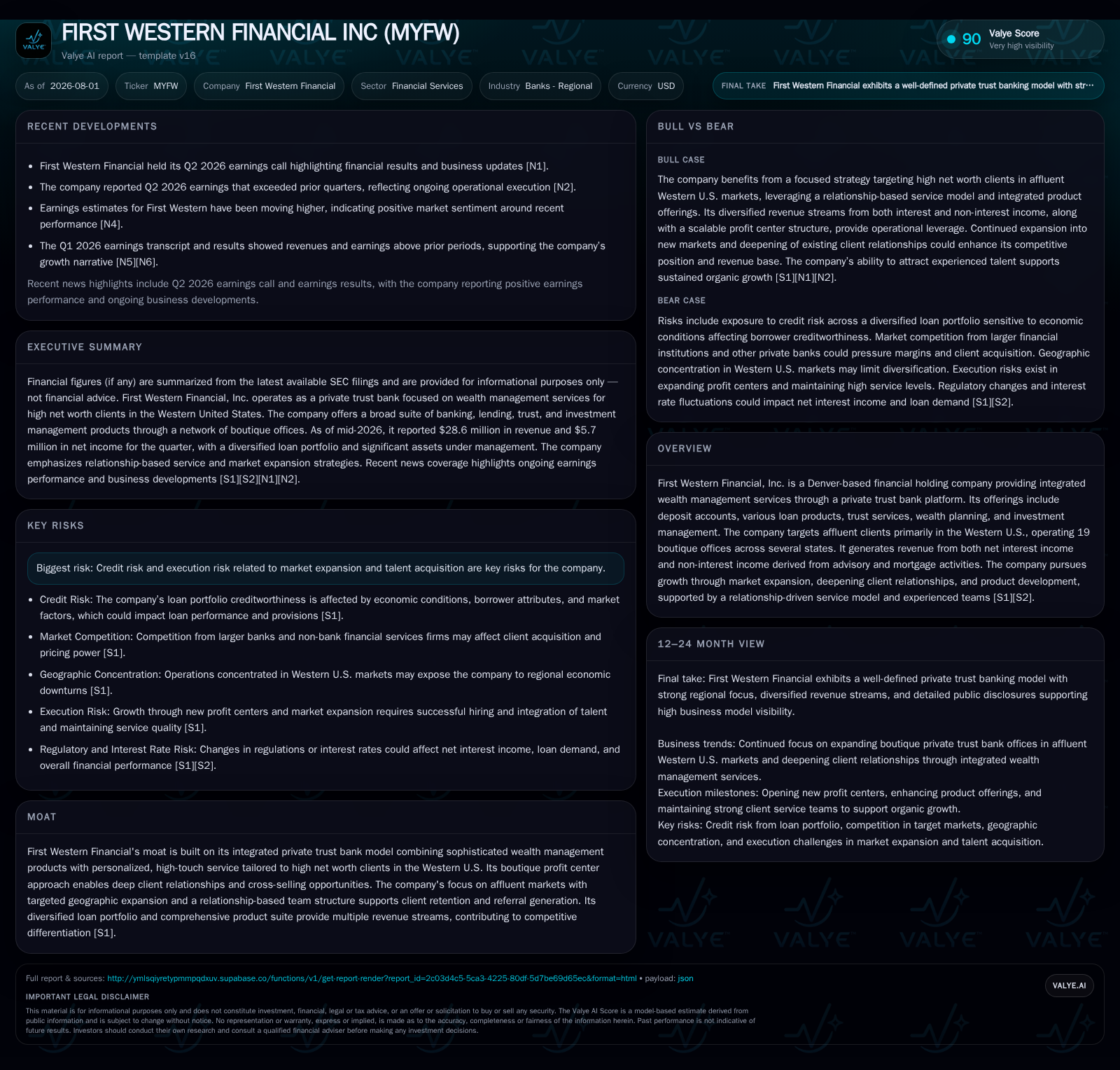
First Western Financial, Inc. continues to leverage its differentiated private trust bank model targeting high net worth clients across key Western U.S. states. The second quarter of 2026 saw stable loan portfolio quality and balanced revenue streams from net interest income and non-interest wealth management fees. Its relationship-driven boutique office approach supports client retention and cross-selling while regional economic conditions influence lending growth opportunities. Key risks remain credit concentration in select states and execution challenges tied to geographic expansion and talent acquisition.
Recent Operating Update: Q2 2026 Context
First Western Financial’s latest quarterly filing dated July 31, 2026 highlights sustained execution of its integrated private trust bank platform that serves affluent individuals primarily in the Western United States through a network of 19 boutique offices [S2]. Complemented by investor presentation materials filed shortly before the quarter end [S3][S17], the company reaffirms its strategy of relationship-driven wealth management combined with traditional banking products including loans and deposits. No material changes to risk factors were reported compared to the previous annual filing [S1], reinforcing operational continuity.
Q2 results broadly align with prior guidance commentary emphasizing steady loan portfolio performance without signs of pronounced credit deterioration or provision volatility [N1][N2]. This suggests underlying demand for affluent-targeted lending and fee-based advisory services remains resilient within its geographic footprint.
Business Model Overview
First Western Financial operates as a financial holding company headquartered in Denver, Colorado. It distinguishes itself in the regional banking space through its integrated private trust bank business model. This encompasses traditional deposit-taking and lending activities augmented by a robust suite of wealth management and fiduciary services delivered via dedicated trust officers and investment professionals [S1].
The company targets entrepreneurs, professionals, high net worth individuals (targeting those with over $1 million in liquid net worth), their businesses, and philanthropic entities primarily in growing affluent metropolitan areas across Colorado, Arizona, Wyoming, Montana, California, and neighboring Western states [S1][S15]. The localized boutique office structure enables personalized attention fostering deep client relationships—a critical differentiator versus more commoditized bank offerings or pure-play wealth managers.
Revenue generation is twofold: net interest income derived from a diverse loan portfolio primarily consisting of commercial real estate loans secured by first liens along with commercial and consumer loans; plus non-interest income derived mostly from fiduciary trust services, investment advisory fees on assets under management (AUM), and mortgage origination plus secondary market sales that follow conforming underwriting standards largely aligned with Fannie Mae/Freddie Mac guidelines [S1][S6][S18]. Net interest income represented approximately 78% of total income before non-interest expense while non-interest income was about 27% during the latest annual cycle [S1].
Loan underwriting emphasizes collateral quality combined with the borrower’s cash flow for repayment capacity [S14][S25][S28]. Commercial real estate loans (both owner-occupied and non-owner occupied) constitute roughly one-third of total loans backed by appraisals maintaining conservative loan-to-value ratios typically maxing around 75-80% depending on property type. The borrower's broader financial profile is also assessed due to potential cross-collateralization including business assets or personal guarantees where applicable
Deposit gathering strategies prioritize core retail and commercial deposit accounts supported by treasury management services reinforcing client stickiness.
Industry Structure & Competitive Position
Within the regional banking industry focused on Western U.S. states, First Western occupies a niche at the intersection of private banking trust firms and community/regional banks. Competitors can range from traditional regional banks like Zions Bancorporation or Western Alliance Bancorporation that offer broad commercial banking alongside some advisory capabilities to private-focused institutions such as First Republic Bank emphasizing wealth management synergy.
First Western’s competitive moat derives from its integrated service model combining sophisticated wealth planning products—trusts, estate services—with direct lending capabilities serving the same affluent client base. This bundled approach enables cross-selling higher-margin fee-generating advisory products anchored in long-term client relationships rather than transactional interactions alone.
While this integration creates differentiation within its chosen markets against larger players potentially lacking local officing or deeper trust service specialization, it also subjects the company to concentration risk due to regional economic dependencies predominantly spanning six states which represent 83% of its loan exposure [S15].
Growth Drivers
Organic expansion constitutes the primary growth vector via:
- Expanding wallet share within existing wealthy households through deeper engagement across advisory services (trusts, investment management) alongside tailored lending solutions.
- Strategic opening or scaling of boutique offices in high-growth metro areas demonstrating clustered affluent demographics.
- Scaling mortgage origination capabilities targeting conforming single-family home loans suitable for secondary market sales—leveraging internal processing efficiencies coupled with cross-referrals from trust clients seeking residential financing.
Additionally, buoyed by IPO-derived capital access post-2018 listing efforts have been outlined towards considered acquisitions of smaller banks or advisory firms that complement geographic or product line gaps reinforcing market share gains over time [S1][N4]
Technological investments aim to enhance client experience through improved online/mobile access while maintaining cybersecurity safeguards under executive risk oversight frameworks—a critical enabling tool for sustained growth among sophisticated clientele increasingly valuing digital responsiveness alongside personal touchpoints [S1][S19].
Risks & Constraints
Credit risk concentrates within the commercial real estate sector alongside select industries served by commercial loans. Though underwriting standards remain disciplined via conservative LTV ratios and guarantor assessments supported by centralized credit policy frameworks and independent loan reviews, geographic concentration in states sensitive to economic cycles carries inherent risk should adverse local macro conditions emerge [S14][S26].
Competition remains acute both from larger regional/national banks leveraging scale efficiencies potentially pressuring pricing on deposits or loans as well as fintech platforms encroaching into wealth management or mortgage origination channels.
Execution risk accompanies future planned market expansions or acquisitions compounded by challenges attracting qualified professionals amid tight labor markets—a known constraint for specialized private banking models requiring skilled fiduciaries and advisers alongside seasoned lenders.[S1]
Lastly regulatory compliance cost burdens continue given evolving cybersecurity mandates overseen regularly by senior leadership and board audit committees; failure here could expose operational disruption or fines though none currently threaten materially per disclosures [S19]. Equity distributions including dividends must also align prudently with capital reserve levels mandated under Basel III regulations enforced by Federal Reserve oversight confirming well-capitalized status at present [S21][S23].
What to Watch Next
Key indicators include:
- Quarterly trends in credit quality markers such as non-performing loans ratio or provision coverage revealing stress points within geographically concentrated portfolios.
- Growth trajectory of assets under management (AUM) reflecting advisory success amidst potential market volatility.
- Deposit base evolution signaling funding stability especially balances between core retail deposits versus brokered sources.
- Development of mortgage origination volume supporting non-interest income diversification.
- Progress on boutique office expansions or acquisition announcements providing insight into execution capability.
- Regulatory examination outcomes concerning cybersecurity resilience or capital adequacy monitoring governing capital return policies.
Management commentary during earnings calls surrounding margin outlook given interest rate shifts will also provide forward-looking operational cues relevant for assessing net interest margin sustainability amid macroeconomic tightening cycles observed industry-wide.
Financial Profile Discussion
In summary, First Western exhibits a financial profile consistent with mid-sized regional banks focused on affluent segments: manageable asset quality risk exposure offset by strong capital positioning fueled by prudent operational controls supporting sustained franchise value creation over time contingent on execution discipline in expanding both customer base and product depth.
This analysis synthesizes public SEC disclosures up to Q2 2026 combined with sector framing characteristic of regional banks specializing in private trust services without making forward-looking projections or investment research views.
Disclaimer: This is research-only, informational analysis and not investment advice. It may include AI-generated interpretation and general industry context. Always verify important details using primary sources.

Comments