
Northrim BanCorp Advances Growth Amid Pending Merger and Diverse Lending Portfolio
Northrim BanCorp's 2026 Q2 results highlight strong core franchise performance and a transformative merger agreement shaping near-term strategy.
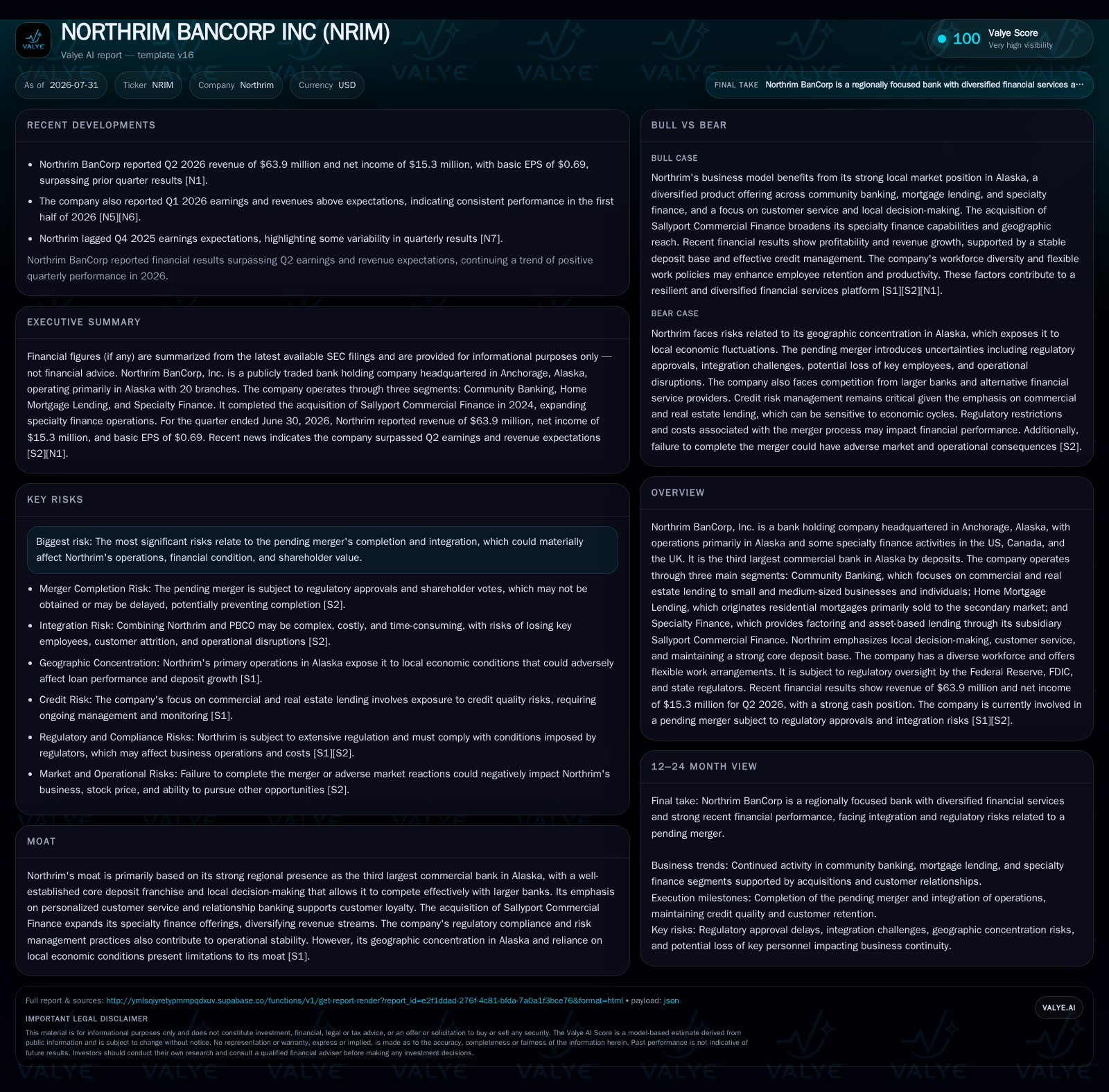
Northrim BanCorp, Alaska’s third largest deposit-holder, reported better-than-expected Q2 2026 earnings supported by robust community banking and specialty finance operations. The company entered a definitive merger agreement with PBCO Financial, pending regulatory and shareholder approvals, marking a pivotal growth inflection. Northrim’s focus on local decision-making, diversified lending through its Sallyport Commercial Finance unit, and disciplined credit risk management underpin its competitive moat. Key risks include merger completion uncertainties and concentration in Alaskan markets. Monitoring deposit trends, loan growth dynamics, and integration progress will be critical in the coming quarters.
Recent Operating Update
Northrim BanCorp’s latest quarterly filing for Q2 2026 reveals a positive operating environment highlighted by revenue and earnings surpassing market expectations [N1][S2]. This performance underscores the stability of its core deposit base in Alaska coupled with healthy loan demand across its community banking portfolio. The company continues to leverage local decision-making autonomy to maintain close customer relationships in its footprint.
A major development anchoring the near-term outlook is Northrim’s July 22, 2026 announcement of a merger agreement with PBCO Financial Corporation, an Oregon-based institution [S3]. The transaction awaits customary shareholder votes and regulatory approvals from multiple authorities including the Federal Reserve and FDIC. Completion of this merger could transform Northrim’s scale and market reach but introduces integration execution risk.
Business Model Overview
Beyond traditional banking, Northrim expanded into specialty finance through acquiring Sallyport Commercial Finance (SCF) effective October 2024. SCF offers factoring and asset-based lending solutions that cater to businesses underserved by conventional bank lending in the US, Canada, and the UK [S1]. This diversification mitigates some geographic concentration risks faced in the Alaska-centric community banking operations while providing fee-based income enhancing overall financial resilience.
The home mortgage segment primarily originates single-family residential loans that are commonly sold to the secondary market, reducing interest rate sensitivity on held assets but creating reliance on mortgage origination volumes which are cyclical in nature [S1]
Industry Structure and Competitive Position
Regional banks like Northrim typically compete based on relationship depth, local market knowledge, pricing flexibility afforded by strong core deposits, and service levels. Northrim emphasizes localized underwriting decisions enabling responsiveness to Alaskan economic conditions which tend to be distinct due to resource-driven sectors.
Peers within geographic or segment reference sets include Western Alliance Bancorporation (WAL), Zions Bancorporation (ZION), Plumas Bancorp (PLBC), as well as specialized players like Sallyport itself exemplifying niche specialty finance firms. Compared to larger multi-state regional banks that enjoy broader diversification benefits, Northrim’s concentrated footprint constrains scale economies but enhances community ties.
The addition of Sallyport strengthens Northrim’s competitive positioning by broadening its product offerings into alternative working capital finance — a growing niche addressing small/medium business cash flow needs often unmet by traditional lenders. This bolsters non-interest income streams that can improve overall efficiency ratios compared to pure-play community banks.
Growth Drivers
Several strategic drivers underpin Northrim's growth trajectory:
- Local Economic Activity: Economic conditions in Alaska remain pivotal; energy sector developments directly influence loan demand from commercial clients.
- Core Deposit Expansion: Maintaining loyal retail depositors is crucial for funding stability at low cost; strong core deposit growth supports higher lending capacity without expensive wholesale funding.
- Specialty Finance Diversification: Leveraging Sallyport’s national footprint for factoring/asset-backed lending extends Northrim’s addressable market substantially beyond Alaska.
- Mortgage Origination Activity: Active participation in residential mortgage origination tied to housing market conditions fuels fee income but depends on refinancing cycles.
- Merger Synergies: Pending merger with PBCO aims at scaling capabilities geographically into Oregon while capturing operational efficiencies across combined platforms.
- Technology Adoption: Improving digital capabilities for customer experience enhances retention and potentially reduces operating expenses over time.
Tracking upstream signals like backlog in specialty finance bookings or pipeline for mortgage originations will provide early visibility into sustained growth versus cyclical fluctuations.
Risks and Watchpoints
The primary risk cluster revolves around successful completion of the announced PBCO merger:
- Regulatory Approvals: Multiple agencies must clear the deal without onerous conditions delaying or diminishing synergies [S2][S3].
- Shareholder Consent: Both companies require votes approving merger terms which carry inherent uncertainty.
- Integration Execution: Merging systems, cultures, and compliance frameworks while retaining key talent poses operational risks that could disrupt client service or increase costs temporarily.
Additionally, Northrim faces persistent geographic concentration risk given most community banking revenues derive from Alaska's unique economy. A downturn in resource industries or natural disasters could elevate credit risk metrics such as non-performing assets or provisions for loan losses.
Interest rate volatility also impacts net interest margin; although mortgage sales mitigate some duration exposure on held loans, changes affect funding costs particularly when competing for deposits amidst national peers.
Competition remains multifaceted including regional/national banks offering broad product suites plus fintech entrants challenging traditional lending segments like specialty finance or consumer products.
What to Watch Next
In the coming quarters investors should focus closely on:
- Merger Progress: Updates on regulatory filings including SEC registration statements (Form S-4) expected post-July 2026 detailing transaction structure plus anticipated timing milestones [S3].
- Deposit Trends: Core deposit growth rates revealing sustained funding advantage or early signs of competitive pressure impacting liquidity costs.
- Loan Portfolio Dynamics: Changes in loan-to-deposit ratios indicating capacity utilization versus conservative underwriting post-Sallyport acquisition expansion.
- Net Interest Margin Stability: Effects from interest rate environment shifts interacting with deposit beta sensitivities influencing margin compression or expansion.
- Credit Quality Metrics: Movement in non-performing asset ratios or provision expenses signaling early stress or continued portfolio health amid macroeconomic conditions.
- Non-interest Income Contribution: Tracking specialty finance segment revenue growth or mortgage originations which provide diversification away from pure net interest income dependency.
- Efficiency Ratio Trajectory: Cost controls relative to revenue generation illuminating operational leverage potential ahead of full merger integration benefits realization.
Monitoring management commentary during quarterly earnings calls for color on these KPIs alongside any emerging regulatory feedback concerning the merger will be critical for assessing ongoing execution quality.
Financial Profile Discussion
Capital ratios have historically aligned comfortably above regulatory minima enabling buffer against economic shocks while supporting organic loan growth plus strategic investments such as technology upgrades or branch network maintenance.[S1]
Efficiency ratios benefit from streamlined operations achieved through limited branch footprint (20 branches across Alaska) paired with scalable digital channels enhancing customer access while controlling expenses relative to evolving revenue streams [S1]
In sum, Northrim blends steady financial fundamentals rooted in conservative balance sheet policies with measured revenue diversification efforts aiming to offset geographic concentration constraints inherent in its business model.
Disclaimer: This is research-only, informational analysis and not investment advice. It may include AI-generated interpretation and general industry context. Always verify important details using primary sources.

Comments