
Steven Madden Advances Multi-Channel Growth with Brand and Supply Chain Agility
Q2 2026 results reveal Steven Madden's strategic execution in multi-channel sales, brand portfolio expansion, and supply chain flexibility underpinning margin resilience.
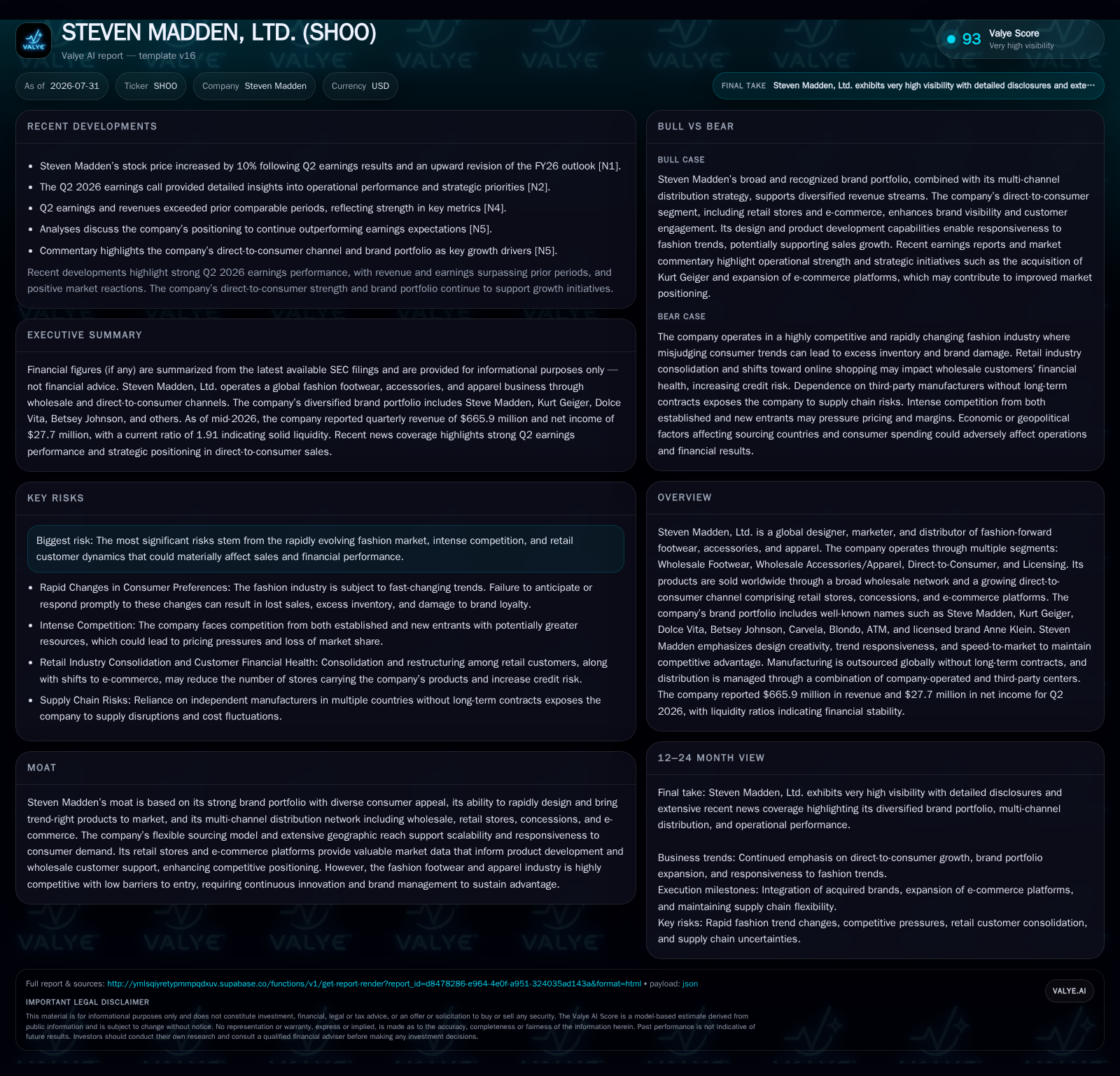
Steven Madden, Ltd. reported strong Q2 2026 financial results driven by balanced growth in direct-to-consumer (DTC) channels and wholesale footwear orders, resulting in a guidance raise for FY26 [S2][N1]. The company's diverse brand portfolio—including Steve Madden, Kurt Geiger, and Anne Klein—and its outsourced manufacturing model without long-term contracts continue to enable swift response to fashion trends and inventory control [S1]. E-commerce penetration gains and licensing agreements further support top-line growth while challenges remain around fashion volatility and wholesale customer health. Liquidity remains solid with a current ratio near 1.9x and moderate net debt [F1][S2].
Q2 Operating Momentum Supports Raising FY26 Expectations
sales growth in retail alongside stable or growing wholesale order volume over the coming quarters.
Consistent Multi-Channel Sales Evolution Bolsters Margin Resilience
Steven Madden’s business model comprises multiple segments: Wholesale Footwear (40.9% of 2025 revenue), Wholesale Accessories/Apparel, Direct-to-Consumer (retail stores, concessions, e-commerce), and Licensing [S1]. The company’s ability to integrate these channels strategically allows it to capture diverse consumer segments across geographic markets while optimizing margins. Wholesale accounts for a significant portion but faces industry pressures from retail consolidation and changing shopping behaviors. Conversely, growth in DTC—especially via digital platforms—enables higher average selling prices, improved product sell-through rates, and richer consumer insights that refine inventory management [S1]. For instance, e-commerce penetration has been steadily increasing, adding valuable data inputs that assist wholesale customers with timely order placement and reduce markdown allowances due to better forecasting.
This integration of channel data exemplifies how Steven Madden leverages its multi-channel distribution network as a competitive differentiator. Gross margins have held relatively firm despite inflationary pressures partly because the company can adjust pricing strategies quickly across brands. Compared to peers like Deckers Outdoor or Wolverine World Wide who also balance wholesale and DTC, Steven Madden's focus on speed-to-market through flexible product development cycles is critical to sustaining this performance.
Distinct Brand Portfolio Drives Flexible Consumer Appeal Across Markets
The company’s brand portfolio spans from widely recognized mass-market names like Steve Madden to acquired premium labels such as Kurt Geiger (UK-based) and more niche brands like Carvela acquired in May 2025 through MATL acquisition [S1]. This breadth enables Steven Madden to address diverse stylistic preferences and price bands globally—from affordable fashion-forward footwear to elevated basics apparel via the ATM brand acquired recently [S1]. Licensed brands such as Anne Klein add an American classics heritage element with stable licensing fees supporting recurring revenues.
Such brand diversification reduces dependency on any single demographic or geography while allowing cross-brand promotional strategies that enhance customer lifetime value. The strategy aligns well with the industry's need for rapid trend responsiveness; consumers seeking affordability or premium positioning can find tailored offerings within the company’s stable. Longer term, the integration effectiveness of Kurt Geiger remains crucial as international markets represent meaningful opportunities amidst varying regulatory environments.
Supply Chain Flexibility Mitigates Risks While Accelerating Speed-to-Market
Steven Madden operates a global outsourced manufacturing model sourcing products from countries including China, Vietnam, Mexico, Italy, and others without binding long-term supply contracts [S1]. This approach provides significant operational flexibility—critical in a fashion industry dictated by rapidly evolving consumer tastes where overproduction risks heavy markdowns. It permits shifting production volumes dynamically in response to sell-through rates detected via company-operated retail stores and e-commerce platforms.
However, this flexibility exposes the company to supply chain disruptions such as shipping delays or raw material shortages prevalent currently worldwide. The reliance on third-party logistics centers distributed primarily across California, New Jersey, Texas (USA), Canada, Mexico, Europe, UK, etc., creates a complex distribution web requiring robust inventory management systems [S19]. Close monitoring of vendor compliance with social responsibility standards reflects an awareness of reputational risk tied to manufacturing practices.
Outsourcing also controls fixed costs but demands continuous supplier relationship management—failure could lead to product delivery delays impacting seasonal collections critical to trend relevance. Inventory turnover rates will be an important KPI to watch going forward as an indicator of supply chain responsiveness combined with market demand alignment.
Growth Catalysts: E-Commerce Penetration and Licensing Partnerships
The accelerated growth of Steven Madden’s e-commerce platforms is a key incremental driver that complements physical stores and concessions worldwide [S1]. Digital sales provide scalability advantages including reduced overhead compared to brick-and-mortar retail while opening access to geographically dispersed consumers. Higher marketing spend efficiency on digital channels coupled with advanced data analytics enhances personalized marketing efforts facilitating higher conversion rates.
Licensing arrangements likewise contribute steady revenue streams less sensitive to direct operational risks. For example, Anne Klein footwear licensing rights cover multiple territories including North America and Israel extending market reach without capital investment burden on the company’s part [S1]. An expanding pipeline of licensed brand partnerships could amplify cross-selling opportunities leveraging Steven Madden’s established design and distribution capabilities.
Overall positive momentum in these areas confirms both organic growth prospects via omnichannel engagement enhancements plus inorganic diversification benefits through acquisitions like Carvela strengthening premium offerings.
Watchpoints: Fashion Volatility, Wholesale Customer Health, and Inventory Management
Steeply changing fashion trends inherently pose risks around inventory obsolescence. A failure to anticipate preferences or execute speed-to-market deliveries accurately may force increased markdown allowances damaging margins [S20]. Wholesale customers undergoing consolidation or financial distress may reduce order volumes or delay payments amplifying credit risk exposure given no extensive buyer concentration safeguards reported explicitly [S1][S20].
Monitoring comparable sales across wholesale accounts versus internal DTC performance will be vital early indicators of channel health. Inventory turnover ratios alongside markdown percentages should be scrutinized for signs of overstocking or misaligned assortments. The company’s extensive use of third-party logistics requires vigilance against fulfillment inefficiencies that could erode customer satisfaction.
Competitive pressures remain intense across specialty footwear brands; thus maintaining innovation momentum is essential for sustaining market share gains.
Upcoming Milestones: Monitoring Store Expansion, Product Launches, and Guidance Updates
Investors should observe the pace at which Steven Madden expands its retail store base organically amid evolving consumer shopping patterns favoring experiential retail versus purely online purchase preferences [S3]. New product launch reception will provide insight into design team effectiveness in reinforcing trend responsiveness while preventing excess inventory accumulation.
Subsequent quarterly filings may refine FY26 guidance reflecting shifts in macroeconomic conditions or consumer discretionary spending patterns impacting discretionary purchases typical for fashion footwear and accessories segments [S3]. Tracking marketing spend efficiency metrics alongside same-store sales growth figures will aid in assessing ongoing demand sustainability.
Financial Profile Discussion: Liquidity Position and Profitability Drivers
As of June 30, 2026, Steven Madden held approximately $112 million in cash and equivalents against about $125 million total debt translating into modest net debt levels around $12 million—a manageable leverage stance supporting operational flexibility amid current economic volatility [F1]. The current ratio stands at a healthy ~1.91 indicating good short-term liquidity coverage relative to current liabilities totaling roughly $488 million compared with current assets near $930 million providing ample working capital cushion at quarter-end [F1].
These factors collectively support modest free cash flow generation capacity necessary for funding selective acquisitions like Kurt Geiger or Carvela additions alongside disciplined returns such as dividends consistently declared every quarter since at least early 2025 confirming shareholder rebate stability within capital allocation priorities documented publicly [S18][S25][N2]
All analysis above is derived exclusively from publicly filed SEC documents dated up to July 31, 2026 (), supplemented by recent credible news sources () citing relevant earnings releases or events without speculative projections or unverified disclosures. The information aims solely at understanding Steven Madden's business fundamentals within the competitive fashion footwear industry context; it does not constitute investment advice.
Disclaimer: This is research-only, informational analysis and not investment advice. It may include AI-generated interpretation and general industry context. Always verify important details using primary sources.

Comments