
Crane Co Accelerates Industrial Pivot Through Strategic Acquisitions and Aftermarket Focus
Crane Co's latest quarterly report reveals integration progress on key acquisitions, bolstering its diversified industrial portfolio towards higher-margin aerospace components and process flow technologies.
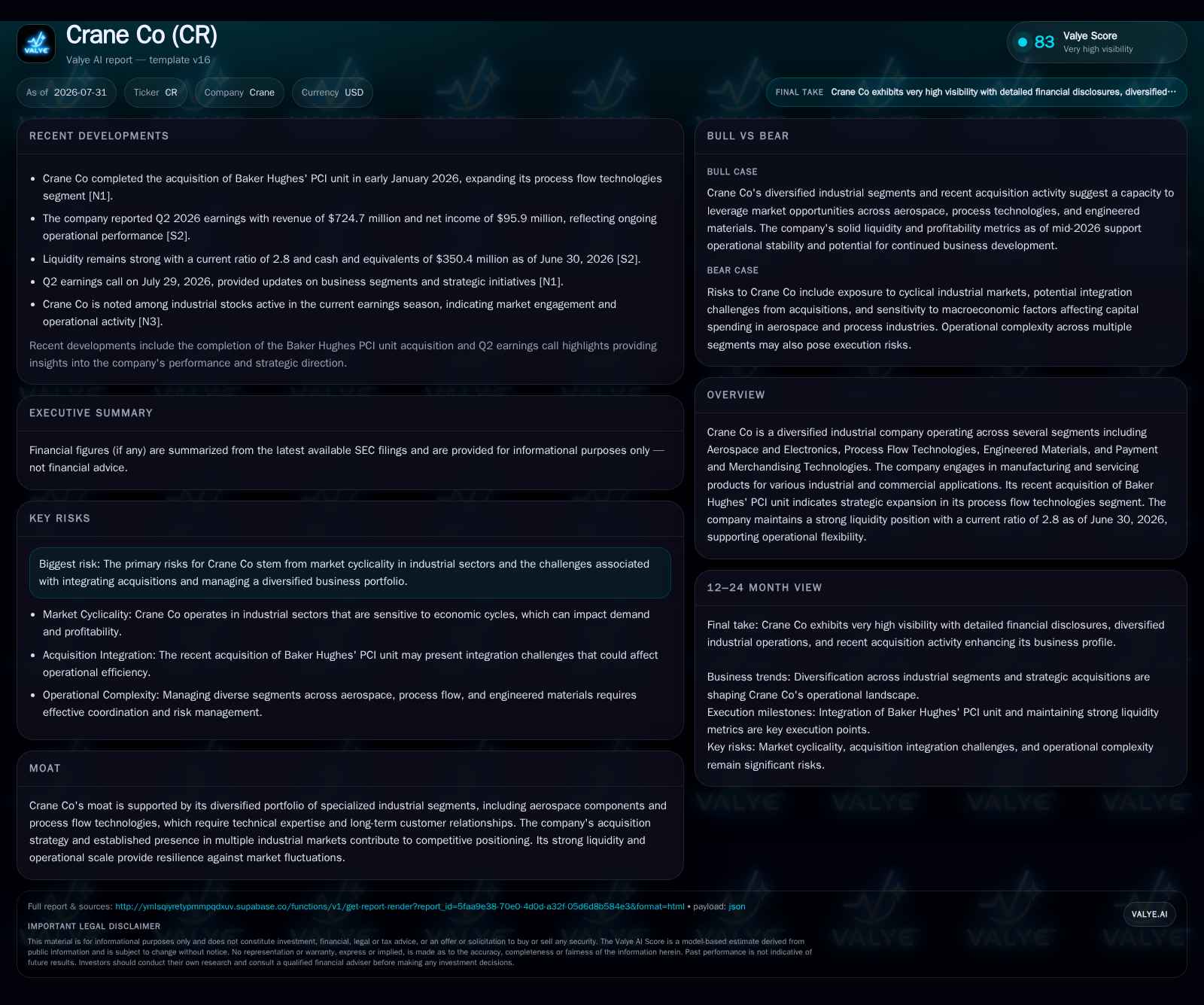
Crane Co's Q2 2026 filing highlights the successful assimilation of the Baker Hughes PCI unit and Optek acquisitions, reinforcing its Process Flow Technologies segment with advanced sensor capabilities. The company continues to shift its revenue mix in favor of stable aftermarket services alongside capital equipment sales in aerospace and industrial markets, supporting resilience amid sector cyclicality. Strong liquidity and operational scale underpin strategic flexibility as Crane navigates raw material inflation and acquisition-related execution risks.
Q2 Operational Trajectory Underlined by Acquisition Integration Momentum
Crane Co's latest quarterly 10-Q filing for Q2 ended June 30, 2026, underscores continued momentum in integrating recently acquired businesses pivotal to its strategic pivot in industrial manufacturing [S2], [S3]. Notably, the Baker Hughes Precision Sensors & Instrumentation (PCI) unit—encompassing Druck, Panametrics, and Reuter-Stokes—and Optek were onboarded from January 1, 2026. These acquisitions have materially enriched Crane’s Process Flow Technologies segment with sophisticated sensor-based technologies critical for aerospace, nuclear, biopharma, and pharmaceutical process control applications [S4].
This influx of advanced measurement capabilities is shifting the segment’s product mix towards higher-value proprietary technology and sensor integrations that enhance OEM partnerships. Early operating indicators reveal positive effects on order backlog quality and book-to-bill dynamics given growing demand for inline process control systems that combine optical sensing with automation solutions.
Customer retention rates remain resilient during this integration phase, reflecting Crane's operational excellence framework aimed at minimizing disruption while leveraging cross-selling opportunities across segments [S3]. Although margin contributions from the newly absorbed units are still being optimized, there is evidence of incremental operating leverage as synergies materialize through consolidated R&D efforts and streamlined supply chains
Diversified Industrial Portfolio: Revenue Drivers Across Aerospace, Process Flow, and Payments Segments
Crane operates principally through two reportable continuing segments: Aerospace & Advanced Technologies (AAT) and Process Flow Technologies (PFT), following divestiture of Engineered Materials in 2025 [S1]. The AAT segment manufactures critical aerospace components including pressure sensors for engine control systems, braking components for commercial aircraft and fighter jets, power conversion equipment for defense applications, and lubrication systems tailored for extreme environments [S1]. Approximately two-thirds of AAT sales derive from OEMs with the remainder from aftermarket parts—providing a recurring revenue base linked to maintenance, repair, and overhaul (MRO) cycles.
PFT encompasses a broad array of flow control products such as vacuum insulated piping systems used in cryogenic applications (notably hydrogen transport), industrial valves tailored to chemical processing environments, multi-stage lubrication pumps serving aerospace platforms via Vian Enterprises integration, as well as the newly acquired sensor-focused offerings [S1], [S6]. These products typically involve long lead times tied to capital expenditure (capex) projects in energy infrastructure or chemical manufacturing facilities.
Crane’s Payment & Merchandising Technologies segment was reclassified as discontinued operations post-separation in 2023; thus current revenues concentrate on diversified industrial customers primarily across aerospace/defense and process sectors [S1]. The combination of OEM original equipment sales alongside aftermarket service contracts anchored by long-term customer relationships enables Crane to balance growth volatility inherent in new equipment demand.
Aftermarket Services: A Growing Stable Revenue Foundation Against Cyclical Headwinds
Amid cyclicality typical of aerospace deliveries and industrial capex schedules, Crane’s strategic emphasis on augmenting aftermarket services provides a durable revenue buffer [N1], [S1]. Aftermarket sales represent approximately one-third of Aerospace segment revenues—with consistent customer retention driven by MRO requirements essential for aircraft operation safety and regulatory compliance.
The company invests selectively in R&D targeting lifecycle management solutions—sensor calibration services, software-enabled diagnostics, component refurbishment—to deepen these services’ value proposition. This stable revenue stream enables higher operating margins relative to initial equipment sales which can be lumpy due to fluctuating commercial aircraft build rates or energy project timelines.
Balancing equipment innovation with enhanced aftermarket engagement helps mitigate downturns linked to macroeconomic shocks or geopolitical tensions impacting defense budgets. Moreover, reliance on technically complex product lines with high switching costs supports pricing power within core markets.
Sector Dynamics: Pricing Power, Capacity Utilization, and Competitive Pressure in Industrial Hardware
Operating in a high-precision industrial manufacturing niche necessitates continuous supply chain vigilance—especially under recent raw material inflationary pressures affecting steel alloys, electronic components, and specialized fabrication inputs [S1], [N4]. Crane’s procurement strategy includes multiple-source raw material sourcing complemented by inventory management discipline maintaining favorable turnover metrics consistent with operational excellence principles.
Capacity utilization benefits from added manufacturing footprint through acquisitions expanding both geographic reach and production capabilities [S6]. By integrating companies like BAUM lined piping GmbH and Technifab Products—specialists in vacuum insulated pipe systems—the Process Flow Technologies segment enhances scale economies while addressing increasingly sophisticated customer specifications around cryogenic applications
Peer benchmarks such as IDEX Corporation experience similar market dynamics with flow control device innovation; meanwhile broader diversified industrial analogues like Stanley Black & Decker emphasize tooling breadth but without comparable high-specialty aero or sensor integration exposure—underscoring Crane’s distinct competitive angle driven by proprietary technology investments.
Unlocking Growth: Capex Cycles, Sensor Technology Innovation, and New Program Wins
Growth prospects hinge on secular tailwinds favoring infrastructure modernization efforts across energy transition plays alongside steady ramp-up of commercial aircraft deliveries worldwide [S1], [N1]. Capital expenditures by chemical manufacturers for safer handling systems incorporating sensor-based leak detection align well with Crane’s enhanced PFT capabilities post-acquisition.
Sensor technologies acquired bolster Crane’s ability to integrate real-time data analytics into flow control hardware—a differentiator increasingly demanded for regulatory compliance monitoring and process optimization. New program wins tied to next-generation military aircraft platforms also contribute stability given typically longer contract durations coupled with engineering collaboration requirements [S1].
Maintaining an R&D investment focus ensures product roadmap vitality while supporting incremental margin expansion through value-added tech integration rather than pure volume growth. These factors collectively point to a gradual evolution towards a revenue mix balancing capital equipment innovation with lifecycle-driven aftermarket relevancy.
Risks to Monitor: Cyclicality, Acquisition Execution Challenges, and Raw Material Inflation Impact
Management prudently outlines risks that include vulnerability to end-market fluctuations particularly in aerospace where shifts in commercial air traffic or defense appropriations could alter order pacing [S14]. The ongoing challenge is effective integration of acquired entities like the Druck brands without operational disruption or margin dilution—a complexity amplified by diverse regulatory frameworks across global markets.
Raw material cost volatility remains a watchpoint—while pricing mechanisms allow partial pass-through to customers, competitive pressures constrain full recovery potential. Supply chain disruptions could exacerbate lead time variability affecting customer delivery commitments.
Geopolitical tensions pose additional uncertainty especially given ~41% of revenues come from international operations exposing the company to currency fluctuation risk alongside trade policy shifts that may impact sourcing or market access terms [S1]. Continuous talent retention initiatives remain critical given specialized workforce needs inherent in high-tech manufacturing domains.
Financial Profile Discussion: Liquidity Cushion Supports Strategic Flexibility
Crane demonstrates solid financial footing with a current ratio of approximately 2.8 as of June 30, 2026—reflecting strong short-term asset coverage relative to liabilities supportive of operational agility amid economic variability [F1]. Cash & equivalents stood at $350 million while total reported debt was near $1.15 billion at year-end December 2025 translating into a net debt position around $798 million when adjusted for cash balances [F1].
This leverage profile affords capacity to finance acquisitive growth initiatives evidenced by recent substantial transactions without immediate distress risk. Free cash flow generation rooted in ongoing operations supports reinvestment into R&D pipelines along with prudent working capital management—integral when navigating raw material price cycles or funding incremental capacity expansions.
Maintaining conservative liquidity targets assists Crane in preserving credit flexibility which could become increasingly important should macroeconomic headwinds intensify or if large new program ramp-ups require upfront provisioning before revenue recognition milestones are achieved.
Disclaimer: This analysis is based solely on publicly available information from SEC filings dated through July 31, 2026; no insider insights or non-public data were used. It is offered purely for informational purposes without investment research view or advice.
Disclaimer: This is research-only, informational analysis and not investment advice. It may include AI-generated interpretation and general industry context. Always verify important details using primary sources.

Comments