
C.H. Robinson Leverages AI and Scale to Navigate Freight Brokerage Margins Amid Legal Risks
Q2 2026 results highlight pricing strength and Lean AI gains but spotlight growing contingent litigation exposure.
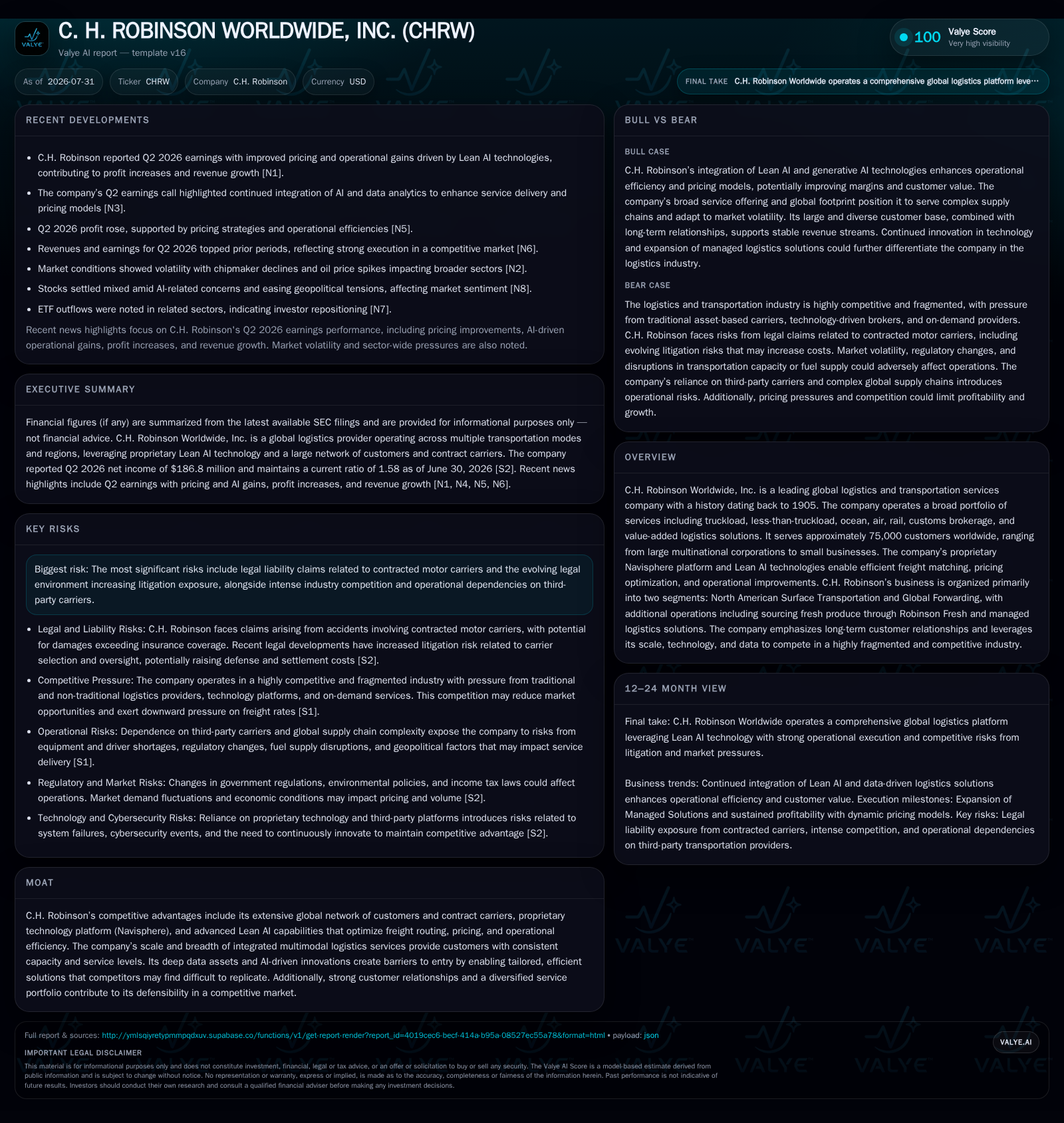
C.H. Robinson Worldwide, Inc. reported solid Q2 2026 results driven by pricing improvements and expanded use of Lean AI technology in freight brokerage and logistics management. The company continues to leverage its proprietary Navisphere platform and advanced data analytics to optimize freight matching across a large network of 75,000 customers and 450,000 contract carriers worldwide. Despite operational momentum, evolving legal risks from a recent $604 million jury advisory verdict concerning negligent carrier selection present a significant overhang, underscoring the challenge of liability in broker-carrier relationships. The company’s business model benefits from scale, multimodal service integration, and AI capabilities that support pricing power and volume growth, though cyclical demand, carrier capacity constraints, and working capital dynamics remain key performance drivers to watch.
Recent Operating Update
C.H. Robinson Worldwide delivered better-than-expected financial results for Q2 2026, propelled largely by pricing improvements and enhanced efficiencies from its Lean AI supply chain technologies [S2], [N1], [N4]. The company reported growth in adjusted gross profit margins driven by dynamic costing models integrating real-time market data to optimize carrier selection and customer pricing. These gains underscore the strategic importance of the firm's proprietary Navisphere platform as a technology backbone connecting an extensive network of approximately 75,000 global customers with over 450,000 contracted carriers across multiple transportation modes [S1], [S27]. Simultaneously, the firm announced leadership changes aimed at strengthening strategy execution around innovation and talent development to cement its competitive stance into the next decade [S16], indicating a proactive management approach during evolving market complexities.
However, significant legal risks crystallized briefly before the earnings announcement when a Dallas County Texas jury issued an advisory verdict holding C.H. Robinson potentially liable for $604 million related to allegations of negligent hiring of an independent motor carrier involved in an accident [S21]. Given the non-binding nature of this advisory verdict and the company's stated intent to appeal, this contingency introduces heightened uncertainty around future litigation expenses and insurance cost implications that may affect operating margins if unfavorable outcomes materialize. This development reflects broader sector-wide increasing scrutiny on broker responsibilities during shifting judicial interpretations allowing state-law negligence claims beyond federal preemption protections [S6], [S7].
Business Model Overview
C.H. Robinson operates primarily as a third-party logistics (3PL) provider functioning as an intermediary between shippers (customers) who require freight movement services and third-party carriers who physically transport goods without ownership of transport assets themselves [S1], [S27]. They monetize predominantly through fees derived from managing freight volumes: arranging shipments via truckload (TL), less-than-truckload (LTL), ocean, air, and rail modes but do not own trucks or warehouses directly.
Revenue is fundamentally volume-driven—higher numbers of shipments increase fee income—and rate-driven—a rise in pricing charged customers relative to payments made to carriers can expand adjusted gross profits. Contracted rates provide revenue stability but may limit upside during tightening capacity cycles if rates become uncompetitive; spot market exposure offers flexibility but also volatility in unit economics.
Value-added offerings such as customs brokerage, trade compliance, supply chain consulting (now under its Managed Solutions brand launched in late 2024), and sourcing fresh produce through Robinson Fresh diversify service lines while embedding customers deeper within their integrated multimodal ecosystem creating switching costs [S1], [S27]. Their technology portfolio focused on Lean AI represents a unique differentiator: data science algorithms optimize load matching to available carrier capacity while automating operational tasks that historically required manual intervention enhancing speed-to-market for customers and resource efficiency for carriers.
Industry Structure & Competitive Position
The global logistics services industry remains fragmented yet intensely competitive with firms ranging from asset-heavy carriers like J.B. Hunt or Schneider National to asset-light brokers such as XPO Logistics or Expeditors International. C.H. Robinson sits among premier global third-party logistics providers benefiting from substantial scale across distinct geographies due to their North American Surface Transportation (NAST) segment augmented by Global Forwarding operations for ocean/air freight plus value-added services which broaden their addressable market beyond basic brokerage.
Competitive advantages stem heavily from their proprietary technology platform (Navisphere) combined with a vast dataset accrued over decades enabling lean AI-driven efficiencies difficult for smaller or less technologically advanced peers to replicate reliably. This data advantage supports dynamic pricing strategies that capture market-based premiums when carrier scarcity occurs while maintaining service levels that underpin high customer retention rates—a critical KPI considering many large corporate shippers prioritize reliability alongside cost control when outsourcing their logistics functions.
Partner networks with hundreds of thousands of contracted motor carriers worldwide ensure access to needed capacity but also introduce operational complexity since these relationships are governed by short-term contracts subject to renewal risk or capacity variability due to industry-wide driver shortages or regulatory constraints affecting trucking availability.
Growth Drivers
Key growth contributors include ongoing globalization trends requiring complex multimodal solutions capable of spanning continents efficiently alongside increased outsourcing of logistics functions by shippers seeking cost-effective managed transportation providers (3PLs/4PLs). Digital transformation adoption in supply chain management accelerates demand for platforms combining human expertise with machine intelligence—the company's lean AI initiatives address this precisely.
Furthermore, newly introduced Managed Solutions consolidate consulting services with day-to-day transport management via integrated TMS technology meeting emerging client demand gaps for seamless end-to-end visibility and control over freight flows through a single vendor relationship rather than piecemeal providers [S1]. Expansion into emerging markets and leveraging increased e-commerce fulfillment needs also position C.H. Robinson advantageously for future volume uplift.
Risks & Constraints
Legal exposure related to broker liability represents a pronounced risk amplified by recent court decisions undermining federal preemption doctrines historically protective of brokers against state-level tort claims. These evolving legal interpretations expose C.H. Robinson to potentially costly lawsuits alleging negligent carrier vetting practices—a material liability given insurance coverage limitations detailed in filings [S6], [S7], [S21]. Such risks could increase defense costs materially or force more conservative operational protocols constraining agility.
Operational risks persist due to dependency on third-party carriers whose business failures or capacity shortages could disrupt service commitments impacting customer satisfaction or necessitating costly re-routing measures impacting margins. Economic cyclicality affects freight volumes profoundly; downturns may depress shipment counts reducing revenue while fixed/semifixed cost structures challenge margin preservation during volume contraction periods.
What To Watch Next
Crucial near-term indicators include updates on the status of ongoing litigation appeals which may set precedent affecting legal provisions or insurance expense forecasts going forward. Operationally tracking trends in contracted versus spot freight proportions will signal pricing sustainability or vulnerability amid fluctuating capacity conditions.
Adoption trajectory for Managed Solutions products alongside continual enhancements in Lean AI applications will provide insight into the durability of margin expansion—alongside penetration within existing customer bases which signals stickiness.
Macro factors such as fuel price fluctuations also warrant watching given their pass-through complexities within contractual arrangements influencing adjusted gross profit margins indirectly.
Financial Profile Discussion
As of June 30, 2026, C.H [F1]. Robinson's balance sheet reflects cash and cash equivalents totaling approximately $155 million against total debt near $1.69 billion resulting in net debt levels around $1.53 billion
Operating income reached nearly $795 million in calendar year 2025 illustrating the ongoing earnings potential anchored by scalable technology-driven efficiencies complemented by network effects deriving from broad multimodal offerings across geographies [F1]. Continued margin improvement depends on sustaining pricing power facilitated by AI capabilities balanced against cost inflation pressures including legal expense volatility tied to contingent liabilities.
This analysis is based solely on publicly available SEC filings as of the dates cited along with reputable news sources providing earnings-related commentary. It aims to provide an informed perspective grounded in current disclosed facts without expressing investment research views or forecasts about future performance.
Disclaimer: This is research-only, informational analysis and not investment advice. It may include AI-generated interpretation and general industry context. Always verify important details using primary sources.

Comments