
ACCO BRANDS Navigates Margin Pressure and Customer Concentration in Office Products Market
Q2 2026 shows revenue growth but operating income contraction, underscoring margin and competitive challenges.
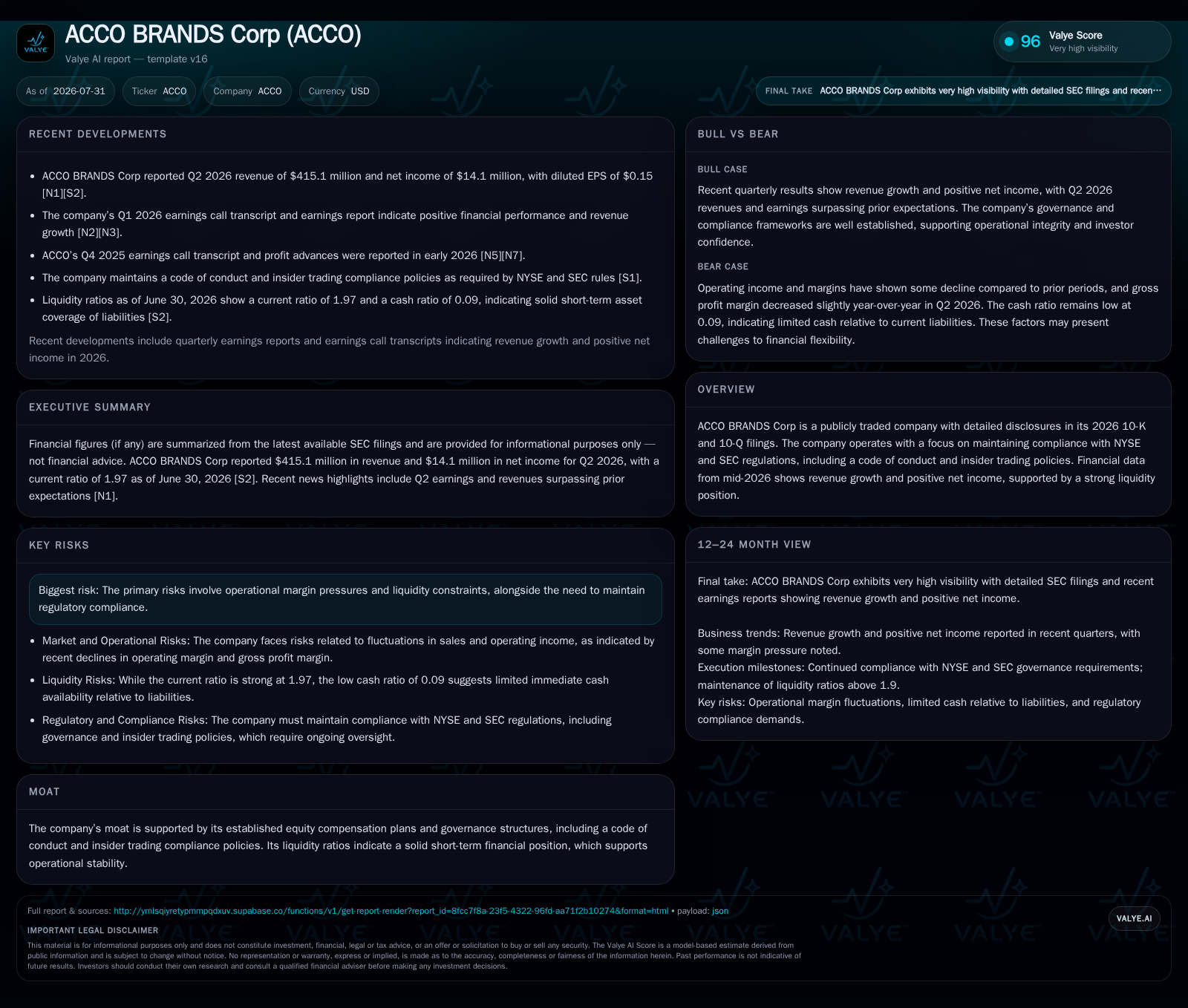
ACCO BRANDS reported Q2 2026 net sales growth of 5.1% to $415.1 million driven principally by price realization amidst a 2.3% decline in comparable sales [S2]. Operating income fell 8.2% due to higher SG&A expenses and margin compression, reflecting persistent competitive pressures from private label entrants and rising costs. The company’s diversified multi-channel distribution model serves mass retailers, e-commerce, and specialty customers across Americas and International segments [S1][S22]. Customer concentration risk remains material, with top ten customers accounting for a significant portion of revenue and strong bargaining power influencing terms and inventory policies [S1][S6]. Supply chain rationalization and product innovation efforts continue as key levers for future margin expansion. Financially, ACCO maintains a healthy current ratio of 1.97 but faces net leverage challenges given net debt near $779 million [F1].
Recent Operating Update
Despite revenue gains, operating income declined by $2.7 million (-8.2%) to $30.3 million with operating margin slipping to 7.3% from the prior year’s 8.4% [S2]. A significant driver of this contraction was an increase in selling, general and administrative expenses (SG&A) which rose by over $8 million (+10.4%), outpacing gross profit growth that was only +3.4%. Gross profit margin also retreated slightly to 32.3% from 32.9%, evidencing continued cost pressures likely tied to raw materials inflation, logistics costs, or competitive discounting/assortment shifts toward private label products within channels
Complementary insights released one day earlier confirm that these results surpass consensus earnings and revenue estimates but underscore underlying operational pressures faced by the company [N1][S3]
Business Model Specifics
ACCO operates as a manufacturer and marketer of branded consumer and business office products including note-taking supplies, technology accessories such as gaming headsets (PowerA), ergonomic seating (via Buro acquisition), planners (AT-A-GLANCE), workspace tools (Swingline), and dry erase boards (Quartet) among others [S1][S13]. Revenue derives primarily through wholesale relationships with large mass merchants (e.g., big box retailers), specialty store chains, e-commerce platforms like Amazon (both direct-to-consumer sales and through third-party listings), drug/grocery chains, warehouse clubs, independent dealers, wholesalers, contract stationers, as well as direct online sales via company-operated sites.
Pricing mechanisms depend on negotiated contracts incorporating volume discounts while balancing retailer demand for competitive pricing to manage inventory turns — a key KPI given seasonal demand patterns notably around back-to-school cycles which impact working capital needs profoundly [S1]
Approximately 40% of ACCO’s products are manufactured internally at owned facilities distributed worldwide while the remaining ~60% are sourced from third-party suppliers predominantly located in Asia’s lower-cost manufacturing hubs enabling cost flexibility but exposing the company to supply chain risks such as geopolitical disruptions or shipping constraints [S1]. This dual-manufacturing model provides operational agility but also complexity managing quality control and logistics costs.
Product innovation plays a strategic role; the company invests internally alongside technology partners to develop differentiated offerings that enhance brand value — crucial for maintaining edge against proliferating private label alternatives offered by large retail customers themselves importing directly from foreign suppliers at lower price points without brand premiums [S1]. Intellectual property protection through extensive global trademark registrations across major product lines further supports competitiveness.
Industry Structure & Competitive Position
The office products manufacturing industry is fragmented with competition spanning established branded players like Newell Brands or Staples’ private label arms alongside emerging importers offering low-cost goods targeting price-sensitive segments.
ACCO’s challenge lies in defending its branded portfolio through continuous innovation and supply chain efficiency improvements while navigating aggressive pricing pressure from private labels backed by large retail chains consolidating buying power — a trend well documented across the sector leading to margin squeezes industry-wide.
Customer concentration risk is notable: ACCO's top ten customers account for a substantial share of total net sales, concentrating negotiation leverage on these buyers who can impose terms such as reduced shelf space or increased private label penetration impacting gross profit adversely if not managed carefully [S6]. Large customers’ inventory optimization strategies sometimes result in order fluctuations requiring ACCO to maintain flexible manufacturing scheduling.
Multi-channel distribution remains essential; effective presence across brick-and-mortar retailers paired with robust e-commerce capabilities addresses evolving consumer purchasing habits post-pandemic where digital shopping continues gaining share.
Complementing traditional office supplies markets are high-growth adjacencies including gaming accessories and ergonomic office furniture segments where product innovation paired with technology integration can deliver sustainable differentiation versus commoditized office staples.
Growth Drivers
Key growth drivers for ACCO include continued investment in innovative product design—particularly integrating technology into office and gaming peripherals—as well as strategic expansion into adjacent categories like ergonomic seating evidenced by their acquisition of Buro Seating Limited Partnership enhancing regional presence in Australia/New Zealand markets [S16].
E-commerce expansion remains critical not only for capturing younger demographics but also enhancing margins due to direct-to-consumer economics bypassing wholesale discounts.
International geographic penetration provides diversification benefits with ACCO Brands International operations covering EMEA plus Asia-Pacific regions where rising business infrastructure spending fuels demand for branded workspace solutions [S13].
Seasonality linked to back-to-school cycles presents recurring annual revenue spikes aiding cash flow generation but requires astute inventory management aligned with production cycles to optimize working capital metrics such as inventory turnover ratio.
Foreign currency risk mitigation via forward contracts against primary currencies including Euro and British Pound helps stabilize reported earnings against volatility inherent in global sourcing models [S1].
Risks / Watchpoints / Constraints
Significant operational risks illustrate margin pressures from intensified private-label competition coupled with rising input costs (raw materials/logistics/labor) [S9][S6]. The dependency on large concentrated customers heightens credit exposure risk should any face insolvency or reduce purchase commitments abruptly impacting cash flow profiles negatively
Supply chain disruptions due to geopolitical tensions or logistics bottlenecks remain omnipresent hazards given significant offshore sourcing proportion.
Regulatory compliance related to trade tariffs/shipping constraints alongside intellectual property litigation potential requires ongoing vigilance.
Seasonal demand volatility necessitates responsive manufacturing scaling capabilities which if mismanaged may result in excess inventory write-downs or missed revenue opportunities during peak seasons.
Financial covenants tied to senior secured credit agreements limit potential aggressive capital allocation including dividends/share repurchases until leverage ratios improve materially beyond recent amendments accommodating higher consolidated leverage thresholds through end-2026 easing near-term liquidity pressures but imposing discipline on free cash flow usage [S4][S12]
What To Watch Next
Future milestones include evaluation of how successfully ACCO manages reinvestment into product innovation pipelines targeted at differentiated offerings that can reclaim margin growth lost under competitive pressure [S1]. Monitoring comparable sales trends relative to pricing actions will clarify whether volume declines persist structurally or reflect transient promotional timing effects.
Supply chain rationalization progress remains pivotal — achieving greater manufacturing facility utilization rates without sacrificing responsiveness will be key amid inflationary cost environments.
Earnings trajectory across upcoming quarters post-June 2026 will indicate stabilization (or further erosion) of operating margins especially as SG&A expense growth is scrutinized against EBITDA conversion returns; adjusted guidance updates at next earnings releases should provide directional clarity.
Watch international segment performance for geographic diversification impact particularly post-Buro acquisition integration effectiveness highlighting cross-selling capabilities within new ergonomic furniture categories.
Liquidity management will deserve attention through debt repayment pacing amid capital expenditure trends focusing on efficiencies vs growth investments; watch covenant compliance metrics closely amid any debt refinancing activity announcements.
Financial Profile Discussion
ACCO’s most recent balance sheet snapshot underscores solid short-term liquidity highlighted by a strong current ratio of approximately 1.97 calculated from current assets around $859 million against current liabilities near $435 million as of June 30, 2026 [F1]
Overall free cash flow generation continues positive but challenged by working capital oscillations tied mainly to inventory seasonality requiring dynamic management attention especially during retail demand peaks.
Disclaimer
This analysis is based solely on publicly available filings and information as of July 31, 2026. It does not constitute investment advice or research views regarding any securities mentioned herein.
Disclaimer: This is research-only, informational analysis and not investment advice. It may include AI-generated interpretation and general industry context. Always verify important details using primary sources.

Comments