
T. Rowe Price Advances Alternatives and Global Reach As Fee Pressures Persist
The latest quarterly filing highlights T. Rowe Price's strategic push into alternatives and international markets to offset ongoing fee compression and active management challenges.
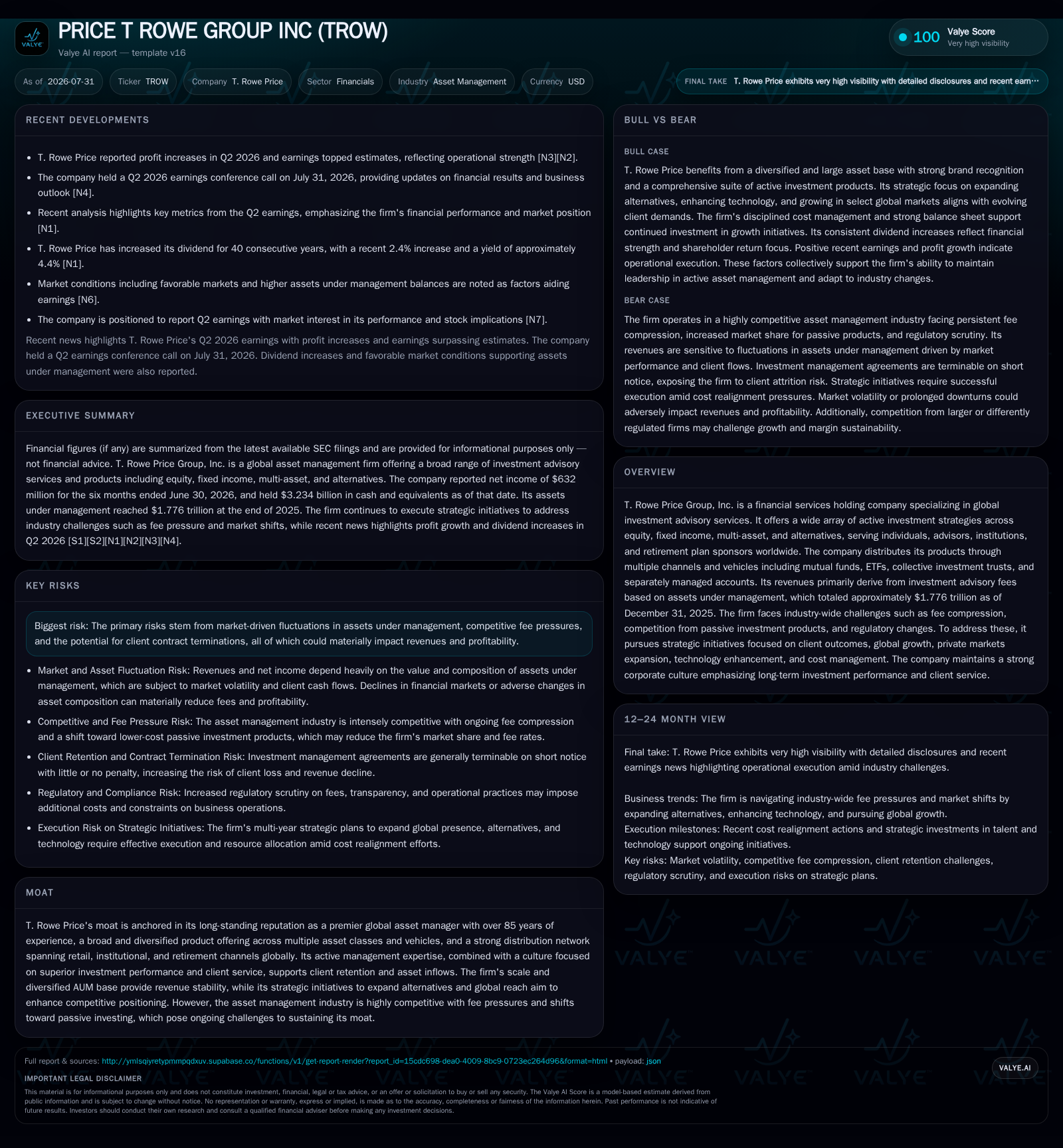
In its second quarter 2026 report, T. Rowe Price Group confronted persistent fee pressure and competitive headwinds in active investment management by accelerating expansion into alternative asset classes and targeting growth in select global markets. Despite volatility in assets under management driven by mixed net flows and market fluctuations, the firm’s diverse product mix across mutual funds, ETFs, and separately managed accounts sustains a resilient fee-based revenue model. Industry-wide challenges from passive investing trends and regulatory complexities remain significant but are met with renewed strategic initiatives focusing on client outcomes, distribution depth, and product innovation.
Q2 Operating Trends Reflect Active Management Headwinds and Alternative Growth Initiatives
T. Rowe Price reported second-quarter 2026 activities underscoring the interplay between market-driven valuation changes and client-driven asset flows shaping near-term revenue dynamics. While the overall assets under management experienced fluctuations due to net new flows varying across product categories as well as market appreciation or depreciation effects, the firm's revenue generation remained closely tied to these AUM movements [S2]. This environment spotlights the volatility inherent in active management revenue streams amid macroeconomic uncertainty.
Importantly, the company emphasized its growing allocation toward alternative investments as a strategic buffer against fee compression afflicting traditional equity and fixed income offerings. The alternatives segment includes private equity, business development companies, interval funds, and collateralized loan obligations — vehicles that generally command higher fees reflecting their complexity and illiquidity premiums. Expansion of these products into institutional mandates and retail channels aligns with T. Rowe Price’s multi-year focus on diversifying its asset base away from solely public active strategies [S3]. This tactical pivot signals recognition that sustainable fee yields will increasingly come from differentiated or less commoditized investment solutions.
Core Fee-Based Revenue Model Fueled by Diverse Investment Products Across Client Segments
The firm primarily earns revenues through investment advisory fees based on the market value of managed assets across equity, fixed income, multi-asset allocations, and alternative investment vehicles [S1]. These fees are charged via multiple product structures including U.S. mutual funds, ETFs offering passive-like accessibility within an active framework, collective investment trusts for retirement plans, subadvised vehicles, separately managed accounts often tailored for institutions or high-net-worth clients, plus affiliated private funds for alternatives exposure
This broad product palette enables T. Rowe Price to address varied client types: retail investors accessing mutual funds or ETFs via advisors; institutional investors managing large portfolios through separately managed accounts; retirement plan sponsors administering defined contribution plans utilizing collective trusts or recordkeeping services; and ultra-high-net-worth clients or specialized investors participating in private markets through fund structures.
Such client diversity fosters revenue stability because while some segments may face pressure or outflows during market stress (e.g., retail redemption), others like institutional mandates for alternatives tend to exhibit stickier capital given longer investment horizons [S1]. Moreover, fees vary by vehicle type—alternatives typically fetch higher rates than traditional index-like ETFs—enabling nuanced exposure to fee yield variations depending on evolving product mix
Industry Constraints: Fee Compression and Passive Competition Shape Strategic Responses
The asset management sector is contending with a pronounced shift from active strategies to passive investing modalities driven largely by investor demand for lower cost solutions amid average active manager performance struggles. Vanguard’s scale in index funds epitomizes this shift toward fee-sensitive products that challenge firms like T. Rowe Price who rely predominantly on active management fees [S1].
Consequently, fee compression remains a structural headwind as competitive pressures force downward adjustments in advisory fees or discounting practices across channels. Regulatory upheavals related to disclosure requirements, fiduciary standards for retirement accounts, or product transparency exert additional compliance cost burdens that can erode margins if not offset by scale or technology efficiencies.
In response, T. Rowe Price is innovating its pricing models and expanding into higher-margin private markets while enhancing client outcomes through better analytics and digital delivery — efforts focused both on defending existing client relationships and attracting assets where price sensitivity is less acute due to distinct investment characteristics [S1]. The firm’s broad suite of sponsored products and distribution capabilities helps mitigate pure commoditization risk by offering differentiated solutions across multiple investor needs.
Investment Performance Trends Drive Client Retention and Asset Flow Volatility
Central to sustaining advisory revenue is the firm’s ability to maintain competitive investment returns relative to peer benchmarks since performance directly influences investor willingness to commit capital or redeem shares. Subpar relative performance typically precipitates increased redemptions hurting AUM balances in both retail mutual funds and institutional mandates alike.
T. Rowe Price disclosed that volatile equity markets during Q2 impacted fund-level results variably but underscored continued focus on rigorous fundamental research intended to preserve capital during downturns while capturing growth opportunities over time. Performance consistency is pivotal given evolving investor scrutiny heightened by passive alternatives promising benchmark-matching without active fees [S1], [N1].
Retention metrics remain a useful barometer for engagement quality alongside net new flows data reflecting acquisition success or share shifts among competitors. Maintaining strong client loyalty amid pronounced market swings will be essential for smoothing revenue volatility inherent in asset-based fee models.
Expanding Alternatives and Global Reach as Key Proxies for Sustained AUM Growth Potential
Management reiterated ambitions to expand globally beyond entrenched U.S.-centric operations by focusing selectively on markets demonstrating meaningful wealth accumulation prospects where brand recognition combined with tailored partnership approaches permits organic growth acceleration [S3]. Growing international footprint involves investment in marketing infrastructure, local regulatory expertise, customized product launches aligned with regional preferences, plus hiring specialists conversant with those geographies.
Equally critical is scaling alternatives offerings where low penetration relative to traditional assets leaves considerable runway for growth especially from institutional investors seeking return diversification amid low-rate environments globally. Private equity funds of funds, real assets vehicles, interval funds accessible through retail channels represent conduits enabling broader client access while unlocking higher-margin revenue streams resistant to standard fee compression pressures common in liquid public strategies [S1], [N2].
This dual focus converges into a practical hedge against secular declines in conventional active mandates by tapping nascent demand trends supported by demographic evolution of retirement savings alongside global wealth expansion.
Emerging Risk Profile: Market Turbulence, Regulatory Costs, and Capacity Limitations
The firm’s risk disclosures highlight sensitivity of revenue streams to external factors including financial market downturns which reduce portfolio valuations thus shrinking advisory fees proportionally; periods of elevated redemptions triggered by investor sentiment; geopolitical instability introducing currency or policy volatility; plus long-term shifts toward passive investing lowering aggregate fee yields despite stable or growing AUM levels overall [S1]
Regulatory frameworks continue tightening globally requiring incremental investments in compliance infrastructure increasing operating expenses which could compress margins unless balanced by efficiency gains elsewhere.
Capacity constraints imposed when certain flagship strategies reach size thresholds prevent new inflows forcing capital reallocation potentially away from flagship funds attracting premium fees towards newer or alternative products that may have different margin profiles impacting consolidated profitability metrics over time.
These risks establish critical watchpoints emphasizing need for adaptive business model agility combining product innovation with disciplined cost control.
What to Watch Next: Asset Flow Guidance, Investment Results, Distribution Execution Milestones
Following Q2 disclosures stakeholders should monitor subsequent quarterly updates focusing on net new asset flow trends particularly whether momentum sustains positive gross inflows into targeted growth verticals such as alternatives or international units balanced against any residual redemptions in core equity/fixed income mandates. Additionally tracking comparative fund-level performance relative to relevant benchmarks offers insight into probable maintenance of investor confidence influencing retention rates.
Distribution channel productivity metrics including sales force effectiveness within retirement platforms or wealth advisor networks serve as intermediate indicators of pipeline health underpinning future asset gathering potential. For example, digital engagement enhancements coupled with specialist competency expansions could reveal early traction points validating strategic shifts signaled during the latest earnings calls [N3], [S2], [S3].
Financial Profile Discussion: Latest Profitability, Liquidity Posture, And Capital Management
Capital allocation philosophies have traditionally balanced shareholder returns via dividends—bolstered by more than four decades of consecutive increases—with reinvestment into technology platforms and strategic acquisitions aimed at fortifying alternative capabilities and distribution reach consistent with stated multi-year initiatives detailed previously [S1]. This prudent financial stewardship supports durable competitiveness amid evolving industry dynamics without excessive dependence on external financing sources ensuring flexibility against cyclical headwinds.
This analysis draws upon recent SEC filings dated July 31, 2026 ([S2], [S3]) complemented by prior annual disclosures ([S1]) along with corroborative market commentary ([N1], [N2], [N3]), reflecting a comprehensive view of T. Rowe Price Group’s current operating stance within ongoing structural changes shaping global asset management landscapes.
Disclaimer: This report is for informational purposes only and does not constitute investment advice or research views regarding any securities discussed herein.
Disclaimer: This is research-only, informational analysis and not investment advice. It may include AI-generated interpretation and general industry context. Always verify important details using primary sources.

Comments