
Nobility Homes Delivers Mixed Q2 Results with Declining Sales but Strong Balance Sheet
Q2 2026 shows lower net sales linked to softened demand and supply chain delays, offset by solid profitability and liquidity.
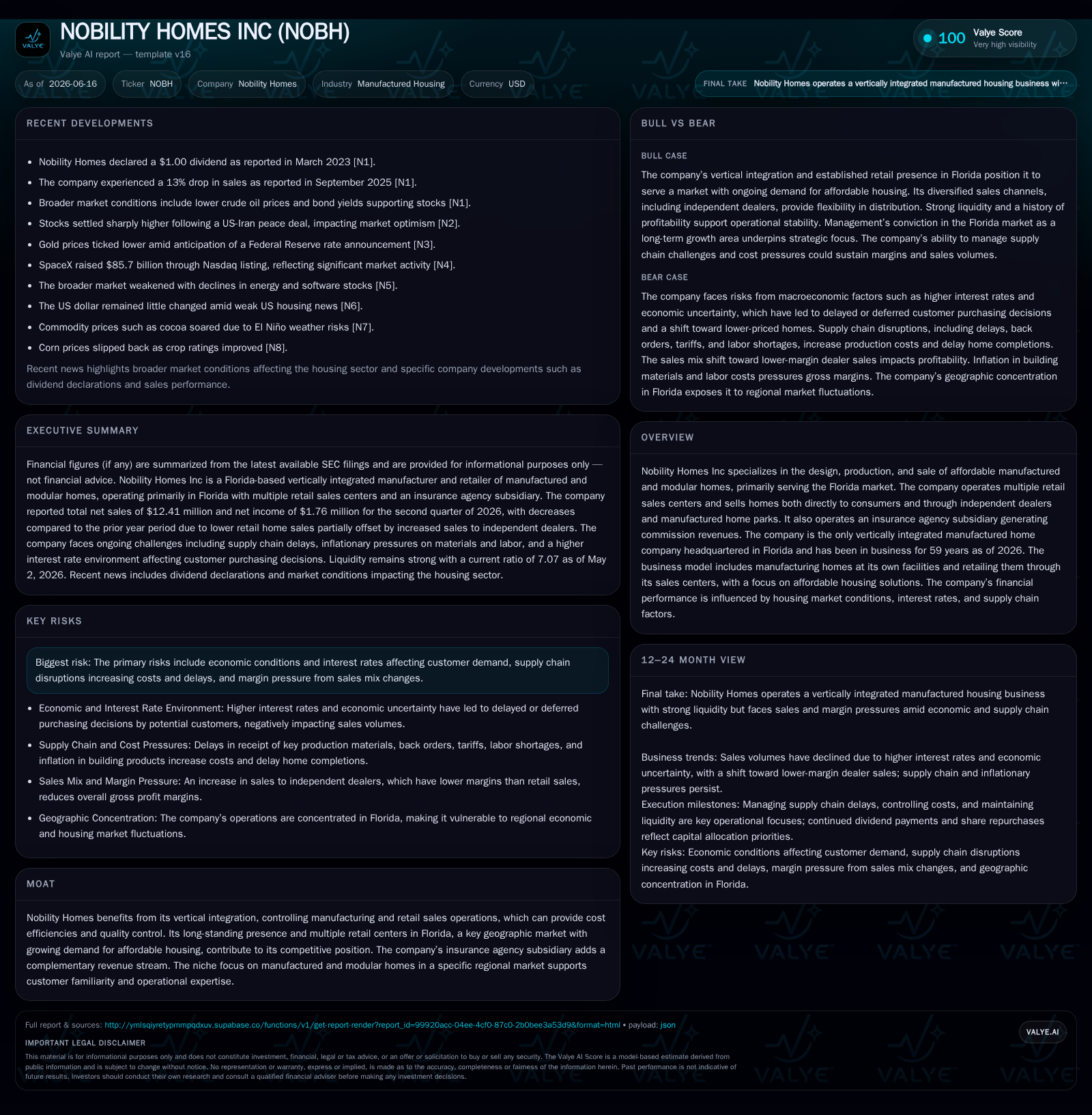
Nobility Homes reported Q2 2026 net sales of $12.4 million, down from $14.8 million in the prior-year quarter, reflecting continued challenges from elevated interest rates and supply chain disruptions impacting its Florida-centric manufactured home business. Despite weaker top-line results, the company preserved a healthy operating margin supported by vertical integration and a diversified sales mix including retail centers and independent dealers. Its insurance agency subsidiary adds a steady complementary revenue source. The balance sheet remains robust with a high current ratio and strong working capital, positioning Nobility to navigate ongoing market headwinds in affordable factory-built housing.
Q2 Operating Update: Sales Declines Amid Persistent Industry Headwinds
Management highlights ongoing market softness caused primarily by elevated interest rates dampening buyer affordability and confidence alongside continued supply chain disruptions. These disruptions involve critical materials such as forest products, vinyl siding, and PVC piping — all inflating input costs and complicating manufacturing schedules amid lingering labor shortages [S2][S3]. Despite these conditions, Nobility Homes managed its cost base prudently resulting in enablement of positive operating income.
Business Model Overview: Vertical Integration Driving Efficiency and Market Reach
Nobility Homes serves primarily the Florida market with factory-built affordable housing solutions composed of manufactured homes and modular homes [S1]. The company is uniquely positioned as the only vertically integrated manufacturer headquartered within Florida providing end-to-end control over production at its manufacturing facilities combined with distribution through several company-owned retail sales centers along with an established network of independent dealers and manufactured home parks.
This integration supports tighter quality standards and cost disciplines especially critical under volatile material prices and labor constraints that challenge many sector peers. Retail center sales typically deliver superior margins relative to wholesale to dealers given direct customer engagement reduces layers of margin dilution [S1][S2]. However, channel mix has shifted increasing exposure to dealer volumes amid market headwinds resulting in some margin pressure
Additionally, Nobility benefits from an insurance agency subsidiary generating agent commissions that contribute a complementary revenue stream diversifying dependence on home manufacturing operations alone. This segment leverages customer touchpoints post-sale supporting higher customer retention and incremental earnings streams.
Industry Structure: Florida's Affordable Housing Dynamic and Competitive Set
The manufactured housing industry consists mainly of regional players like Nobility focused on providing affordable factory-built housing alternatives to traditional site-built homes, which tend to have higher construction costs and longer delivery cycles. Florida as Nobility’s core geographic market continues to exhibit demographic tailwinds including population growth and migration patterns favoring demand for lower-priced housing solutions accessible through manufactured homes.
However, this market experiences cyclical fluctuations tied closely to funding availability influenced by mortgage interest rates and macroeconomic conditions impacting consumer confidence. Supply chain disruptions—whether material shortages or labor deficits—add operational complexity across the value chain affecting manufacturing capacity utilization which is crucial for timely product delivery in competitive markets.
Peers such as Clayton Homes exemplify large vertically integrated competitors offering similar factory-built home models but with broader national footprint; smaller niche regional players stack up against Nobility’s localized expertise in Florida.
Growth Drivers: Expanding Dealer Network, Financing Conditions, and Innovation
Looking ahead, Nobility’s ability to grow hinges on broadening its independent dealer network footprint enhancing wholesale volume contribution without eroding overall profitability excessively. Continued improvements in financing accessibility for buyers are essential given the sensitivity of demand to interest rate fluctuations; more favorable terms would mitigate payment burdens making manufactured homes more attractive financially.
Product innovation including expanding customization options can create differentiation helping maintain pricing power amid pricing pressures characteristic of commoditized affordable housing segments. Complementary revenue lines such as insurance commissions may also grow incrementally offering diversification benefits beyond cyclical housing sales.
Improving manufacturing efficiencies—raising factory capacity utilization above its current level—remains a critical lever for margin enhancement given fixed overheads intrinsic to factory-built housing operations.
Risks and Constraints: Interest Rates, Supply Chain Pressures, and Market Cyclicality
Key risks confronting Nobility include further adverse shifts in macroeconomic conditions raising borrowing costs or reducing mortgage availability deterring prospective buyers' commitment plans. Supply chain volatility could escalate raw material prices or prolong manufacturing lead times constraining order fulfillment thus impacting customer satisfaction.
Margin compression arises from a changing sales mix toward lower-margin channels or necessity-driven price concessions in highly competitive local markets where traditional site-built options compete aggressively on aesthetics or financing terms [S1,S2]
Regulatory changes or environmental events could disrupt operations either directly via facility shutdowns or indirectly through cost inflation (e.g., fuel prices impacting logistics). The reliance on the Florida regional economy also concentrates geographic risk exposure.
What to Watch Next: Order Backlog, Capacity Utilization, Consumer Financing Trends
Monitoring Nobility’s order backlog levels will provide early signals regarding demand trajectory shifts especially across its retail centers versus dealer channels. Improvement in manufacturing plant capacity utilization through stable supply chains or operational enhancements will be pivotal for restoring scale economies.
Additionally, management commentary around changes in local financing conditions—including mortgage rates for manufactured homes—and any updates on insurance business performance could signal evolving profitability levers beyond core home volumes.[S2]
Watching for strategic expansions in dealer relationships or product mix changes will also indicate how Nobility adapts proactively amid evolving sector dynamics.
Financial Summary: Profitability Sustained Despite Sales Erosion
Net income dropped commensurately yielding $1.76 million compared to about $2.29 million last year as higher dealer sales moderated margins [S2]. Current liquidity remains strong with cash & equivalents near $9.86 million pushing the current ratio above 7x — underscoring comfortable short-term financial flexibility without debt burden [F1][S2].
Working capital stayed robust at over $42 million providing ample buffer for inventory holding including new home stock controlled internally avoiding third-party floorplan financing expense [S2]. Recent share repurchase activity illustrates capital allocation discipline amidst cautious growth pacing.
This analysis uses information derived primarily from Nobility Homes’ latest quarterly SEC filing dated June 16, 2026 (Form 10-Q) complemented by the annual filing (10-K) dated January 30, 2026 along with relevant industry context based on standard manufactured housing industry knowledge frameworks.
No investment advice or price outlook is provided here; this strictly aims to assess the company’s recent operating performance alongside structural drivers influencing future prospects within Florida’s affordable factory-built housing sector.
Disclaimer: This is research-only, informational analysis and not investment advice. It may include AI-generated interpretation and general industry context. Always verify important details using primary sources.

Comments