
Southern Copper Advances Integrated Production Amid Geopolitical and Cost Pressures
Strong Q2 results reflect robust metal pricing and ongoing capital projects despite volume challenges and geopolitical risks.
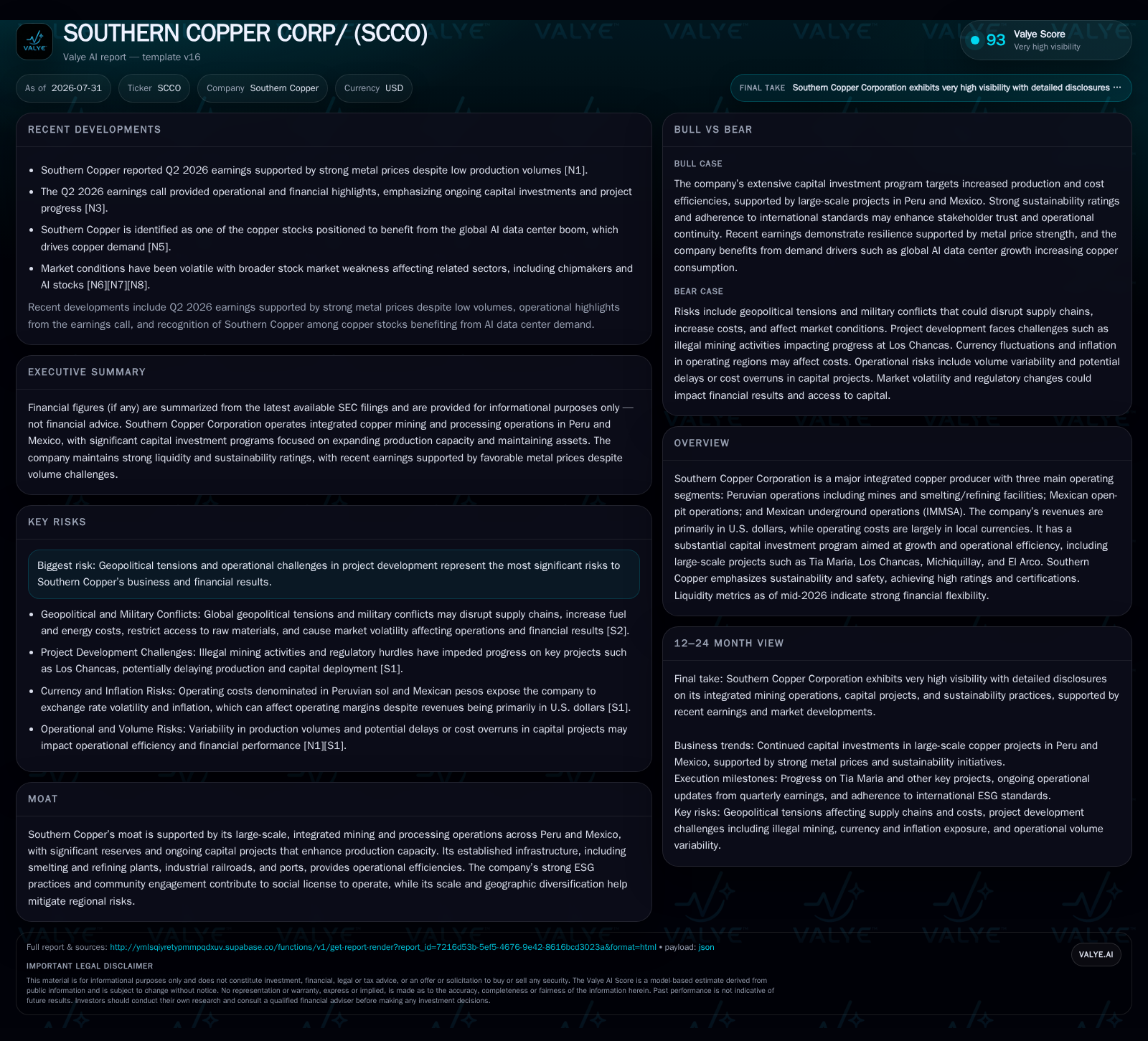
Southern Copper Corporation's latest quarter highlights the resilience of its integrated copper mining and refining operations, with earnings positively supported by elevated metal prices despite softer sales volumes. The company's strategic focus on major capital investments, including expansion projects in Peru and Mexico, underpins its growth trajectory and operational efficiencies. However, macro-level uncertainties such as geopolitical tensions, currency fluctuations, and regulatory complexities in key jurisdictions pose material risks that could affect future performance. Southern Copper's financial position remains strong, benefitting from solid liquidity and disciplined capital allocation.
Recent Operating Update: Q2 2026 Highlights
Southern Copper’s second-quarter earnings announcement for the period ended June 30, 2026 demonstrated the company’s ability to generate robust profitability during fluctuating operational volumes. While sales volumes were softer than prior periods, particularly for copper which saw a decline affecting overall throughput metrics, strong metal prices buoyed revenue results [S3]; [N1]. The board authorized a quarterly cash dividend of $1.10 per share alongside a stock dividend payable in late August 2026 [S3]. This dividend policy signals management's confidence in steady cash flow generation supported by commodity price strength.
The company’s three distinct operating segments—Peruvian open-pit operations (including Toquepala and Cuajone mines plus smelting/refining infrastructure), Mexican open-pit operations (La Caridad and Buenavista mines plus processing), and the IMMSA unit consisting of Mexican underground mines—all contributed variably to total output confronting unique country-specific cost structures, regulatory frameworks, and labor arrangements [S1]; [S16]. This segmentation aligns with industry practice given differing political climates and operational dynamics.
Business Model Specifics: Integrated Mining to Refining
Southern Copper operates a vertically integrated business model encompassing extraction through to cathode production via smelting and refining facilities located near its mining sites. This integration enables control over product quality — copper cathodes primarily — which are then sold to global customers largely denominated in U.S. dollars [S1]. Besides copper, by-products include molybdenum, zinc, silver, and small quantities of gold primarily concentrated within the IMMSA segment.
Revenue is driven by metal sales volume multiplied by the realized average metal price. These metrics are sensitive to ore grade variability, mining recovery rates, production disruptions, and global metal price cycles. Costs comprise local labor (largely unionized workforces subject to collective agreements), energy inputs influenced by fuel pricing volatility exacerbated by geopolitical events, materials including heavy equipment parts, and sustaining capital expenditures critical for maintaining production capacity [S1]; [S13].
Capital-intensive investment programs aim at expanding mine life and boosting production efficiency; notable projects are Tia Maria and Los Chancas in Peru plus Michiquillay recently accelerated alongside El Arco’s development in Mexico [S1]. These projects represent potential volume growth levers contingent on successful execution.
Industry Structure and Competitive Position
Within the broader copper mining industry—characterized by cyclical commodity prices and significant entry barriers linked to capital intensity—Southern Copper ranks among integrated producers managing mines with sizable reserves coupled with smelting/refining capabilities akin to peers like Freeport-McMoRan or Antofagasta plc (though direct peer comparisons require cautious interpretation without exact data).
Geographic diversification across Peru and Mexico helps mitigate regional political risk yet introduces complexity due to differing regulatory environments: stricter environmental rules apply in Peru compared to Mexico impacting compliance costs as well as labor negotiation frameworks [S16]; [S27]. The company’s control over logistic assets such as industrial railroads strengthens export reliability—a competitive advantage given limited shipping infrastructure alternatives.
Strong ESG compliance underpins Southern Copper’s social license to operate with high safety ratings reinforcing workforce stability—a critical factor given past sector challenges related to labor unrest or environmental concerns.
Growth Drivers
Several structural drivers underpin potential growth:
- Global copper demand is poised for long-term ascent driven by electrification trends (electric vehicles, renewable energy infrastructure) necessitating higher copper consumption.
- Ongoing capital expenditure investments targeting substantial production uplift from large-scale projects enhance medium-term capacity.
- Technological improvements at existing facilities could improve ore recovery rates and reduce unit costs.
- Exploration initiatives focused on reserve replacement help sustain mine life—a key KPI indicating long-term viability.
- Favorable pricing environments triggered by constrained supply chains or investment cycles can significantly boost margin profiles.
These growth vectors interplay critically with execution success at project stages—delays or cost overruns could limit expected benefit delivery [S1].
Risks and Watchpoints
Geopolitical instability remains a foremost concern highlighted in the most recent filings: ongoing conflicts involving Israel/Iran and Eastern Europe introduce the risk of supply chain interruptions affecting critical fuel or raw material deliveries essential for mining operations [S2]. Such conditions can inflate operating expenses through higher energy costs or logistics bottlenecks while also creating pronounced volatility in metal prices.
Trade policy uncertainties complicate planning—recent enactment of tariffs on semi-finished copper products by the U.S. as of mid-2025 may influence export flows or pricing strategies [S15]; [S23]. Currency fluctuations between the U.S. dollar (the functional currency) versus Peruvian sol or Mexican peso affect cost bases; although this is partially mitigated since revenues are dollar-denominated while many operating expenses occur locally [S1].
Operational risks include labor negotiations especially given union presence representing over half of Peruvian employees under multi-year collective bargaining extensions signed through early 2027 mitigating short-term strike risks but necessitating monitoring [S13]; [S27]. Environmental litigation linked to historical incidents persists but is not currently material financially according to company disclosures [S13]; legal proceedings remain active.
Long-term project execution risk remains notable; delays or budget overruns on flagship expansions could hinder capacity gains critical for sustaining growth amid rising global demand pressure.
What to Watch Next
Key milestones will revolve around progress reports on Tia Maria, Los Chancas mining expansions along with Michiquillay development—the pace of capital spending relative to budgets will signal execution robustness during 2026–27 [S1]. Monitoring ore grade trends and recovery efficiency metrics can provide early indications of operational health.
Metal price trajectories will remain a pivotal variable; as Southern Copper’s earnings sensitivity analysis reveals meaningful net income swings even for incremental price changes ($0.10/lb in copper impacts net income by approximately $120 million) [S1]. Currency exchange rate movements warrant watching given their margin implications.
Financially-related markers such as quarterly dividend declarations supplemented by stock dividends reflect confidence in sustainability of free cash flow generation; any deviations here might indicate stress points. Investor sentiment tied to geopolitical shifts or trade policy updates could lead to valuation adjustments.
Financial Profile Discussion
As of June 30, 2026, Southern Copper reported liquid assets totaling roughly $5.67 billion in cash and equivalents providing ample liquidity headroom against total debt around $6.85 billion recorded year-end 2025—resulting in a modest net debt level near $1.19 billion indicating conservative leverage for an industry heavyweight with sizeable asset base [F1]
The current ratio stood impressively at over 5x driven by approximately $10.79 billion current assets versus $2.13 billion current liabilities underscoring short-term liquidity strength suiting ongoing capex demands [F1]
Capital expenditures ran above $1 billion annually representing continued investment emphasis alongside disciplined working capital management ensuring robust free cash flow available for dividends—demonstrated recently by declared quarterly payouts approximating $3.23 per share inclusive of stock dividends signaling shareholder return prioritization balanced against reinvestment needs [S3]; [S4].
In sum, Southern Copper’s financial profile denotes strategic balance between aggressive growth investment funded through solid cash generation while maintaining conservative debt levels typical among integrated copper miners managing cyclical commodity exposures conservatively.
This analysis synthesizes publicly available SEC filings through mid-2026 alongside market commentary without providing investment advice. readers may want to monitor comprehensive factors including commodity markets volatility before forming conclusions regarding Southern Copper Corporation.
Disclaimer: This is research-only, informational analysis and not investment advice. It may include AI-generated interpretation and general industry context. Always verify important details using primary sources.

Comments