
OneWater Marine Faces Seasonal Headwinds but Strengthens Retail and Service Integration
Q3 results reflect typical seasonality challenges in marine retail, with expanding dealer network and aftermarket services supporting revenue resilience.
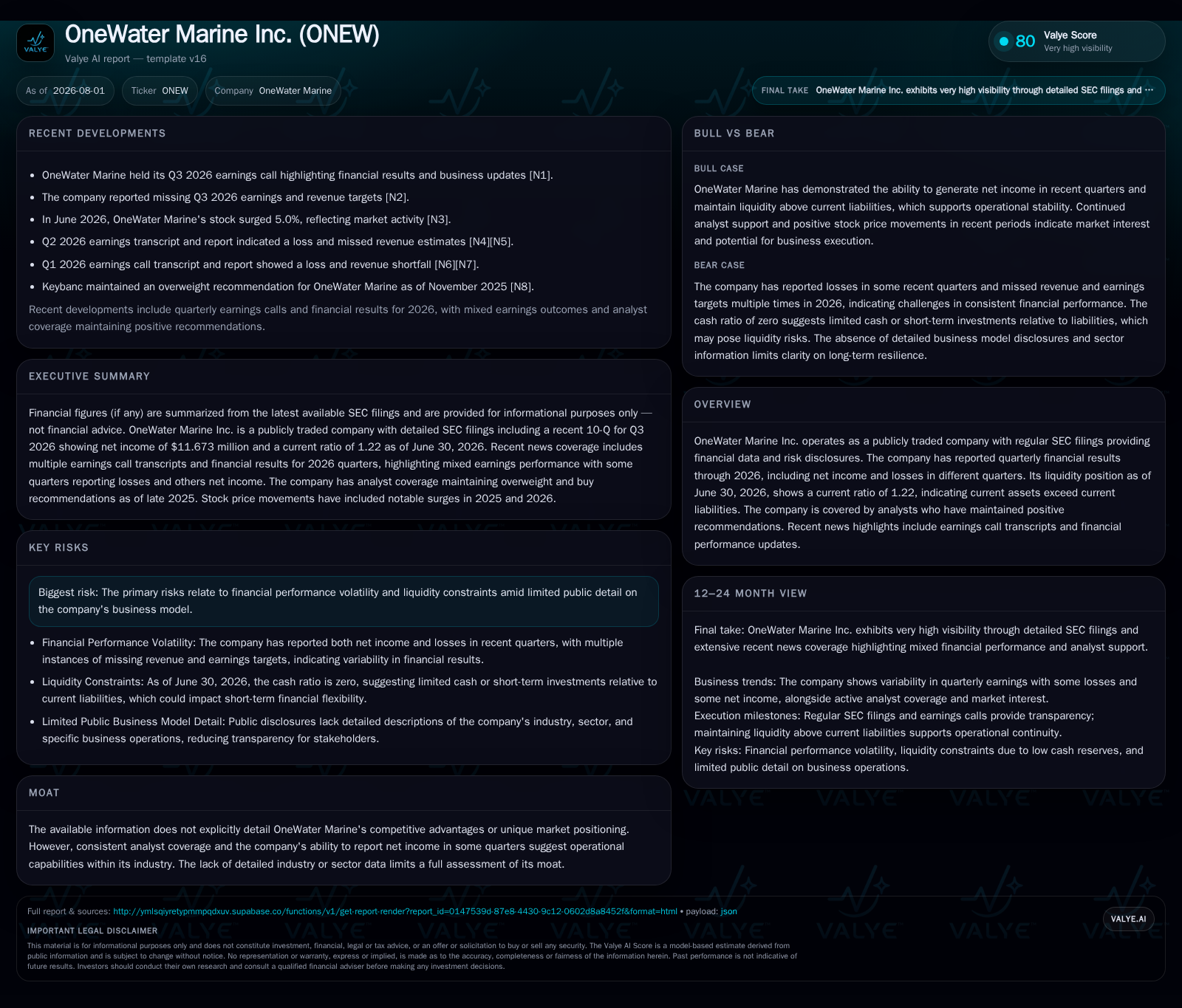
OneWater Marine’s Q3 2026 results showed pressure from seasonal declines in unit sales and margin compression, consistent with discretionary spending volatility in marine recreational vehicle retail. Despite missing revenue and earnings expectations, the company is advancing its dealer network expansion and increasing aftermarket service revenues, which together provide some stability amid new boat demand softness. Financing penetration remains an important lever for sustaining sales in this capital-intensive, cyclical sector. Liquidity at a current ratio of 1.22 supports ongoing operations but leverage near $350 million warrants attention given the business model’s working capital needs.
Q3 Operating Metrics Highlight Seasonality Pressures on Sales and Margins
OneWater Marine’s fiscal third quarter ended June 30, 2026, exposed the persistent seasonality inherent in marine recreational vehicle retail. The company reported a decline in unit sales volume that fell short of consensus estimates [S2][N2]. This volume contraction directly impacted top-line growth since boat sales remain the primary revenue generator. The direct correlation between seasonality—typically lower demand outside peak summer—and quarterly performance crystallizes here as a key volatility factor.
Gross profit margins showed compression relative to prior quarters, attributed partly to price concessions to move inventory amid subdued demand and elevated carrying costs tied to slower inventory turnover [S2]. Such margin pressure underscores the sensitivity of OneWater’s profitability to both pricing dynamics and effective inventory management during off-peak periods. Consistent with industry norms, this pattern reflects broader season-dependent consumer buying behavior influenced by discretionary spending cycles.
OneWater’s Revenue Mix: Assessing New vs. Used Boats and Financing Influence
The company’s business model combines new boat sales, used boat sales, marine financing solutions, and after-sale service offerings [S1]. While new boat sales typically command higher average selling prices (ASP), used boats complement volume particularly when economic uncertainty leads buyers toward more affordable options. Although Q3 operating disclosures do not delineate precise ASP shifts by segment [S2], stable ASP trends are crucial for gross margin maintenance given the fixed-cost structure embedded in dealership operations.
Marine financing penetration serves as a critical enabler for closing sales in this discretionary category. By extending credit solutions directly or through partners, OneWater facilitates customer purchases that might otherwise be deferred due to upfront cost barriers [S1]. Financing penetration rates thus correlate strongly with unit sales momentum—higher penetration eases affordability pressures but introduces credit risk that requires prudent management.
Dealer Network Expansion Enhances Market Reach While Challenging Inventory Control
Consistent with its growth strategy detailed in prior filings [S1], OneWater is actively expanding its dealer footprint across multiple states to increase market penetration. The latest quarter furthered this expansion with additional dealership openings or acquisitions [S2], enhancing geographic coverage and brand exposure metrics.
However, scaling dealer network breadth inherently raises operational complexity around inventory allocation and turnover. More dispersed locations heighten working capital demands as boats must be stocked across sites anticipating localized demand variability tied to lake/reservoir access or weather conditions. Managing dealer incentives effectively while controlling unsold inventory risks is a balancing act critical for preserving margin integrity.
Aftermarket Services Bolster Earnings Resilience amid Discretionary Spend Fluctuations
Service and parts revenue streams play an increasingly pivotal role in buffering the earnings cycle against volatile new boat sales [S1][S2]. In Q3 2026, aftermarket services demonstrated relatively stable growth rates even as boat unit sales softened [N1]. This steadiness stems from maintenance contracts, repair appointments, accessory sales, and warranty service execution, which exhibit less sensitivity to seasonal purchasing patterns.
Higher-margin service activities contribute positively to gross profit percentage because labor and parts carry better margins than new boat wholesale pricing [S2]. Furthermore, aftermarket engagement fosters improved customer retention rates through recurring touchpoints—an essential differentiation factor often leveraged by leading peers like MarineMax who integrate servicing seamlessly into their value proposition.
Industry Competitive Benchmarks: Position Versus Leading Marine Retailers
Seasonality-driven quarterly volatility is standard across publicly traded peers; thus OneWater’s Q3 dips follow sector-wide patterns rather than company-specific competitive failings. Its continued investment in service capability development aligns strategically with successful peer practices observed within marine retail focused on balancing cyclicality effects.
Growth Drivers: Financing Accessibility, Market Penetration, and Service Penetration Gains
Outlook drivers for OneWater hinge largely on consumer disposable income trends which influence leisure spending propensity on recreational boating [S1][S2]. Dealer network expansion remains another organic growth vector; incremental locations augment sales funnel breadth geographically while enabling deeper brand presence. Complementary aftermarket service extension promotes higher wallet share per customer across ownership lifecycles thus improving lifetime value metrics.
Demographic tailwinds towards outdoor recreation adoption further underpin medium-term demand outlooks supported by innovation cycles introducing feature-rich marine products attractive to evolving consumer preferences.
Risks to Monitor: Seasonality, Economic Sensitivity, Supply Chain Constraints, Liquidity Risks
Principal risks documented include economic downturns dampening discretionary spend capacity—a clear threat illustrated by quarterly volume swings correlated with macro consumer sentiment adjustments [S4][S13][S14]. Seasonality amplifies this exposure by compressing peak selling windows into shorter periods requiring tight operational cadence.
Supply chain disruptions affecting new boat delivery timelines can further constrain available inventory or force costly expedite orders impacting gross margin realization. Interest rate shifts influence marine financing demand elasticity with sharp rises potentially curbing credit-fueled purchases.
Liquidity constraints emerge as key watchpoints given the capital intensity of stocking extensive boat inventories coupled with working capital tied up in parts and servicing infrastructure.
'What to Watch': Upcoming Earnings Guidance, Dealer Network Developments, Customer Retention Trends
Investors should focus on upcoming quarterly earnings reports revealing whether Q3 softness was purely seasonal or indicative of structural softness in buyer demand [N1][N4]. Progress on dealer network openings will signal ongoing commitment to expanding geographic reach versus overextending operational bandwidth.
Shifts in customer retention metrics impacting service revenue continuity will serve as early indicators of aftermarket income sustainability amidst fluctuating new boat volumes—key for smoothing income streams during downstream cyclical troughs.
Management commentary around macroeconomic environment navigation especially regarding financing terms adjustment strategies offers additional clarity on tactical responsiveness plans.
Financial Profile Discussion: Leveraging Liquidity Amid Capital Intensity
As of June 30, 2026, OneWater Marine maintains a current ratio of approximately 1.22 indicating current assets exceed current liabilities by a moderate margin—sufficient for near-term liquidity support given operating cash flow cycles typical of marine retail [F1]. Total debt stood near $352 million reflecting substantial leverage consistent with capital-intensive vehicle inventory models requiring significant upfront working capital deployment [F1].
This liquidity profile provides some cushion for operating fluctuations; however, sustained margin pressures combined with seasonal revenue dips place emphasis on efficient balance sheet management going forward. Monitoring debt servicing capability alongside cash conversion timelines will be crucial given the thin margin environment exacerbated during off-peak quarters.
This analysis is based solely on publicly available SEC filings and market sources without investment research views.
Disclaimer: This is research-only, informational analysis and not investment advice. It may include AI-generated interpretation and general industry context. Always verify important details using primary sources.

Comments