
First Business Financial Strengthens SBA Lending and Manages CRE Risk Amid Liquidity Challenges
Q2 2026 results highlight solid earnings and ongoing focus on commercial real estate loan portfolio concentration, SBA lending, and liquidity management.
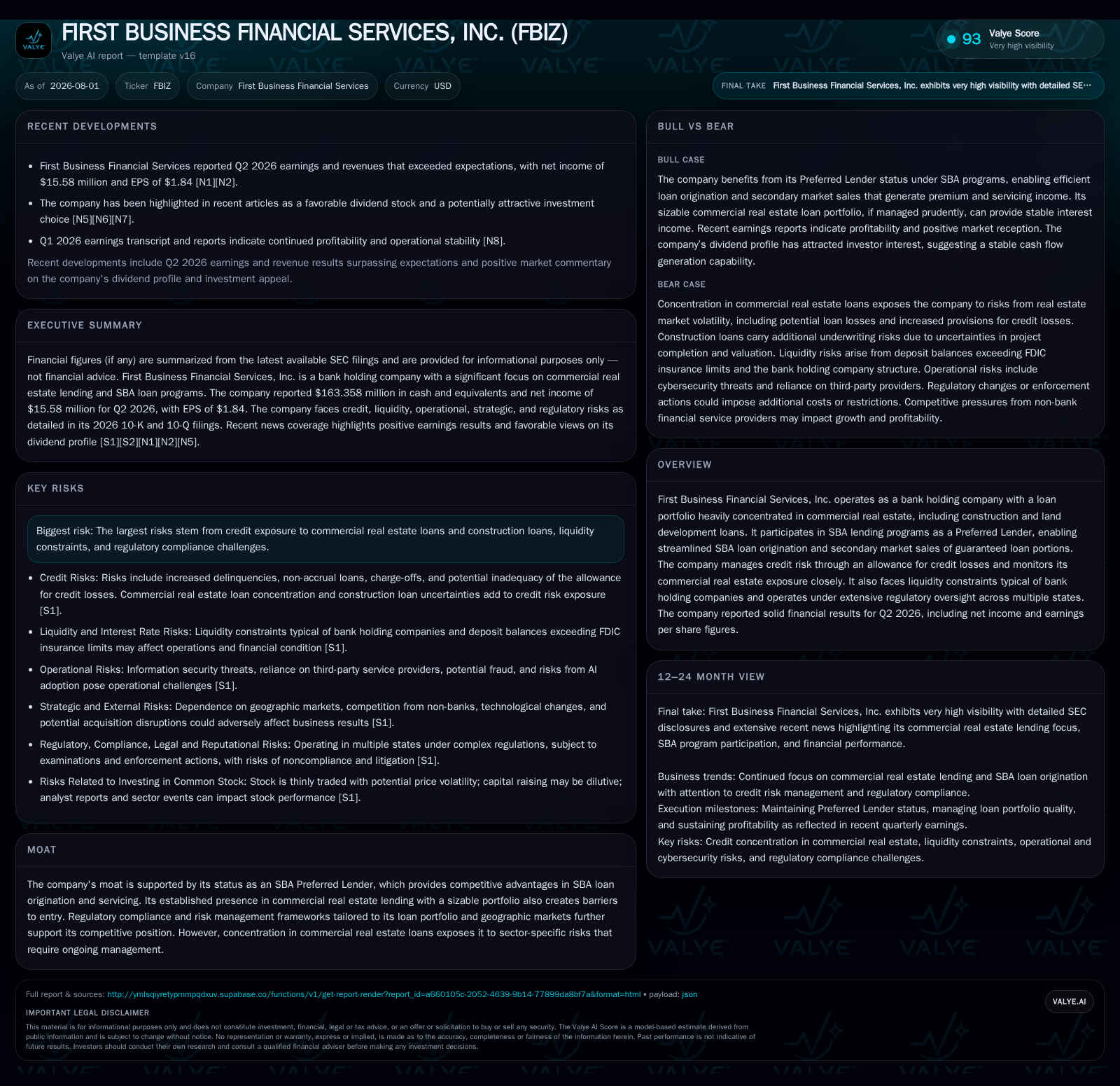
First Business Financial Services, Inc. reported strong Q2 2026 financial results driven by its SBA Preferred Lender status and a concentrated commercial real estate loan portfolio. The firm’s revenue relies heavily on net interest income from commercial real estate, construction, and land development loans, complemented by SBA-backed loan origination fees and secondary market sales of guaranteed loan portions. Despite favorable earnings performance, the company faces risks primarily from credit concentration in real estate loans and liquidity constraints typical of regional bank holding companies. Regulatory oversight across multiple states imposes operational discipline, while key growth avenues include expanded SBA lending programs, construction activity recovery, and enhanced servicing capabilities.
Recent Operating Developments
First Business Financial Services reported its Q2 2026 earnings with net income surpassing market expectations, supported by steady earnings per share figures as noted in the July filings [S2][N1]. The company's announcement also included updated declarations on dividend payments reflecting confidence in recurring earnings streams [S3]. This quarterly update confirms that the company continues to leverage its established positions within commercial real estate lending and SBA-backed loan origination to sustain financial performance.
Business Model Analysis
First Business operates as a bank holding company specializing primarily in commercial lending with a notably concentrated portfolio in commercial real estate (CRE) loans encompassing construction and land development projects [S1]. These loans generate most of the company's net interest income—derived from interest paid by borrowers on this segmented portfolio—as well as fee income associated with SBA loan origination and secondary market activities.
The company's status as an SBA Preferred Lender is strategically crucial. This designation facilitates expedited SBA loan approval processes enabling First Business to compete effectively for small business financing [S1]. Such status not only boosts origination volumes but also allows the institution to sell guaranteed portions of these loans on secondary markets—a mechanism that diversifies revenue via fees while mitigating credit risk by transferring parts of the borrower risk exposure to investors
Credit risk management is a central pillar because commercial real estate loans inherently carry cyclical risks tied to property market valuations and project completion uncertainties. Construction and land development loans are particularly sensitive given their reliance on future cost/value estimates, which can vary materially over time. To counteract potential loss scenarios, First Business maintains an allowance for credit losses calibrated to anticipated impairment levels within its portfolio. The allowance’s adequacy is critical since underestimated provisions could lead to sudden earnings hits if defaults rise [S1]. Monitoring non-performing assets remains an essential operational KPI.
Liquidity risk is another dimension tightly managed due to structural limitations faced by bank holding companies like First Business [S1]. The company’s deposit base includes balances exceeding FDIC insurance coverage limits which elevates potential withdrawal risks during periods of stress. Maintaining sufficient liquid assets alongside regulatory-mandated liquidity coverage ratios forms part of the company's defensive approach against operational disruptions
Regulatory compliance requirements across its multi-state presence further shape operational capabilities. These regulatory frameworks mandate capital adequacy standards (e.g., Tier 1 capital ratio), comprehensive risk oversight programs, periodic examinations, and robust internal controls—all of which constrain certain growth initiatives but enhance franchise durability.
Industry Structure and Competitive Position
Within regional banking focused on commercial lending, First Business aligns closely with peers such as Eagle Bancorp Montana and Civista Bancshares that similarly integrate SBA Preferred Lender programs with concentrated CRE portfolios. These peer banks also balance reliance on net interest margins derived from specialized commercial loans alongside fee-based income from government-backed programs.
The competitive moat for First Business stems largely from SBA Preferred Lender status offering faster approval cycles compared to lenders without this designation. This status engenders stronger relationships within small business communities seeking timely capital solutions backed by government guarantees. Furthermore, extensive experience managing CRE credit nuances anchors the company’s ability to prudently underwrite these riskier segments.
Nevertheless, concentration in CRE introduces vulnerability relative to more diversified peers that also serve consumer or retail banking segments. Large swings in real estate markets or construction slowdowns could disproportionately affect First Business’s credit profile. Additionally, emerging operational risks around cybersecurity or AI integration reflect growing challenges industry-wide.
Growth Drivers
Key growth avenues for First Business reside in expanded participation in SBA lending programs—given governmental emphasis on supporting small businesses—and recovering demand for CRE development reflecting macroeconomic conditions favoring property investments. The capacity to originate loans that can be sold on secondary markets enables scalable growth without proportionally increasing balance sheet risk.
Enhancements in digital underwriting tools could also improve efficiency ratios and reduce servicing costs over time—addressing long-term profit margin expansion goals. Geographic expansion into underserved regional markets presents incremental opportunity but requires careful assessment given regulatory variability.
Deposit base growth remains vital as it underpins lending capacity; stable or increasing deposits provide fuel for incremental loan originations without necessitating expensive wholesale funding sources.
Risks and Watchpoints
The foremost risk lies in credit exposure concentrations within CRE loans—any deterioration here can trigger elevated non-performing assets affecting profitability and capital buffers [S1]. Accuracy of construction cost estimates impacts loss severity if projects do not complete on budget or timeline.
Liquidity constraints echo typical challenges among regional bank holding companies reliant primarily on core deposits but susceptible to outflows during market disruptions or underwriting volatility in CRE sectors.
Regulatory compliance risk is ongoing; non-adherence could result in penalties or restrictions affecting business operations.[S1] Operational vulnerabilities include cybersecurity breaches potentially causing financial loss or reputational harm; dependence on third-party vendors amplifies such risk vectors.
Finally, fluctuations in interest rates influence net interest margin dynamics—the firm must efficiently manage asset-liability mismatches amid volatile rate environments.
What to Watch Next
Investors should monitor upcoming quarterly disclosures focusing on:
- Loan growth rate shifts particularly within CRE categories,
- Changes in allowance for credit losses reflecting evolving credit quality assumptions,
- Non-performing loan ratio trends signaling asset quality pressures,
- Volume of SBA loan originations indicating continued capitalizing on Preferred Lender benefits,
- Secondary market sales activity influencing liquidity profiles,
- Deposit base developments impacting funding capacity,
- Net interest margin trajectory as a barometer of lending profitability,
- Efficiency ratio changes revealing operating leverage impacts,
- Regulatory updates affecting capital requirements or operational flexibility.
Earnings releases combined with MD&A commentary post Q3 will be pivotal checkpoints to assess how sustained macroeconomic conditions affect both loan demand and credit risk metrics.
Financial Profile Discussion
As of June 30, 2026, First Business held $163 million in cash and equivalents underpinning its liquidity position [F1]. Capital adequacy ratios maintained at required regulatory thresholds support balance sheet resilience though detailed Q2 capital disclosures would clarify trending positions more precisely. Overall financial health reflects prudent management balancing growth ambitions against inherent commercial real estate cyclical exposures alongside stable core deposit funding fundamentals.
This analysis synthesizes SEC disclosures through July 31, 2026 alongside recent public information without extrapolating beyond verified evidentiary boundaries or providing investment research views.
Disclaimer: This is research-only, informational analysis and not investment advice. It may include AI-generated interpretation and general industry context. Always verify important details using primary sources.

Comments