
Quaker Chemical Leverages Technical Service and Global Reach Amid Cyclical Demand Challenges
Quaker Chemical’s Q2 2026 results show resilience in specialty chemicals despite industrial sector cyclical pressures and raw material volatility.
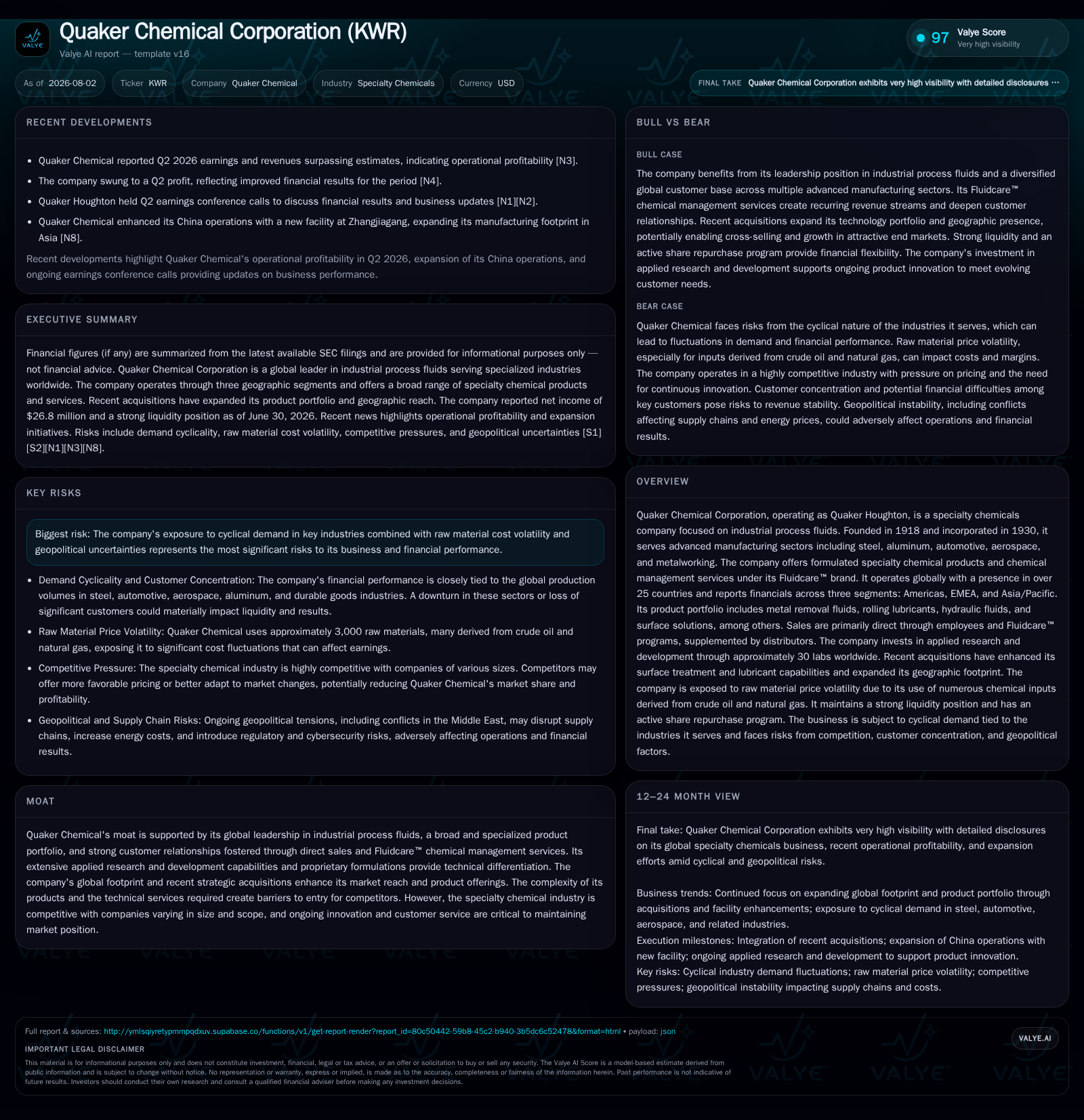
Quaker Chemical Corporation, a global leader in industrial process fluids, reported steady operational performance in Q2 2026 amid continuing volatility in end-market production volumes and raw material costs. The company’s business model centers on highly formulated specialty chemicals combined with Fluidcare™ chemical management services, fostering durable customer relationships across steel, automotive, aerospace, and metalworking sectors. While industry cyclicality and geopolitical headwinds remain risks, recent acquisitions and R&D investment underpin its competitive edge and geographic expansion. Continued execution on innovation and service programs will be essential to maintain margin stability and growth momentum.
Recent Operating Update
In its latest quarterly filing dated July 30, 2026, Quaker Chemical reiterated that its earnings reflect the inherent link between its revenue growth and the production throughput of industrial manufacturing customers across steel, automotive, aerospace, aluminum, and metalworking sectors [S2][N1]. The second quarter showed resilience with revenues surpassing estimates despite persistent headwinds from cyclical demand softness. Margin pressure continues due to raw material cost inflation particularly from oil-derived inputs used in many formulations. However, the company’s disciplined pricing strategies coupled with Fluidcare™ program expansion have helped stabilize operating performance [N3][S2].
Geopolitical developments in the Middle East have introduced additional challenges such as supply chain disruptions via critical maritime routes like the Strait of Hormuz. These events have increased logistics costs and energy price volatility affecting operating expenses globally [S2]. Quaker acknowledged the uncertainty stemming from potential sanctions expansions which could limit business interactions in certain regions. Cybersecurity risks are also heightened in this environment reinforcing the need for robust IT safeguards [S2].
Business Model
Quaker Chemical’s core business revolves around developing and supplying highly formulated specialty chemical products designed to optimize industrial process fluids critical in manufacturing advanced metals and components. Its principal customers are large manufacturers operating at relatively few but high-volume sites—especially in steel and aluminum—while metalworking customers tend to be more numerous but smaller locations [S1]
Revenue generation combines direct product sales through seasoned technical sales employees visiting customer plants regularly to tailor chemical solutions with integrated Fluidcare™ chemical management services [S1]. These programs embed chemicals supply within site operations coupled with ongoing technical service—including training, process troubleshooting, and waste management—helping drive high retention rates. Such chemical management contracts often involve managing third-party products where Quaker acts as either principal or agent depending on negotiated terms impacting revenue recognition methods
This hybrid product-service model creates switching costs for customers due to the technical complexity of fluid formulations adapted precisely to specific manufacturing processes (such as metal removal fluids or rolling lubricants). The broad product portfolio—metal removal fluids representing about 19% of sales with rolling lubricants at roughly 18%, hydraulic fluids at 12%, and surface solutions recently growing above 10%—offers cross-selling opportunities that enhance account penetration [S1]
Strong applied research & development investment supports continuous innovation needed to keep pace with evolving customer requirements driven by emerging manufacturing materials (e.g., lighter-weight alloys) and tightening environmental regulations. Quaker operates about thirty R&D labs worldwide focused on applied technology improvements rather than basic science; this practical angle supports agile new product rollouts which are vital given limited patent protection relying instead on proprietary formulations combined with technical know-how [S24][S1].
Industry Structure & Competitive Position
The specialty chemicals sector focused on industrial process fluids is characterized by fragmentation but also high barriers to entry created by product complexity and embedded service models. Competitors range from other formulated specialty chemical producers (like Element Solutions Inc.) to providers focused more narrowly on niche chemistries or regional distribution players.
Pricing competition is intense given volatile raw material costs primarily linked to petrochemical derivatives such as mineral oils and surfactants combined with competition from substitutes or novel processes being adopted by customers [S1][S8]. Success depends heavily on differentiation through innovation pipelines and quality of technical service delivered on site
Quaker stands out due to its established global footprint spanning over 25 countries with balanced segment presence across Americas, EMEA, and Asia/Pacific allowing geographic diversification mitigating localized downturns or geopolitical disruptions [S5]. The company's recent acquisitions—such as Dipsol Chemicals (Japan), Natech Ltd. (UK), and CSI (South Africa)—have strategically expanded its technology base in surface treatment chemicals as well as regional market access enhancing cross-selling synergies [S7][S24].
Ongoing investments in compliance infrastructure respond proactively to complex regulatory environments governing hazardous substances usage worldwide (including REACH in Europe and TSCA in the U.S.), crucial since these regulations can impact cost structure or restrict product usage thus affecting competitive positioning [S13][S14].
Growth Drivers
Key long-term growth drivers include rising manufacturing process complexity demanding specialized chemical solutions offering operational efficiencies or environmental compliance benefits. The expansion of Fluidcare™ integrated chemical management programs will likely foster stickier customer relationships yielding recurring revenue streams less susceptible to spot sales volatility.
Emerging markets' industrial production growth offers attractive opportunities given rapid infrastructure development driving higher demand for metals processing supported by tailored local formulations. Quaker’s enhanced presence in Asia Pacific positions it well here.
Acquisitions remain pivotal for inorganic growth contributing new chemistries (surface treatment) aligned with expanding end-market segments like automotive coatings or electronics that require superior finishing capabilities. Simultaneously, stringent environmental rules globally boost demand for next-gen eco-friendly specialty fluids.
Investment in R&D ensures product pipeline robustness enabling Quaker to address shifts like increasing electrification in automotive industry impacting legacy fluid requirements—a potential structural risk it aims to mitigate via innovative solutions adapting to new materials or processes.
Risks & Watchpoints
The company remains exposed to cyclical downturns inherent in steel, automotive production volumes impacting sales volume directly—a factor exacerbated by regional geopolitical uncertainties which can interrupt supplies or increase costs non-linearly.
Raw material price volatility constitutes a major risk influencing gross margins; Quaker’s ability to pass through price rises without losing competitiveness will be critical under sustained commodity inflation.
Competitive pressure from both diversified global players with deeper pockets or nimble niche formulators capable of rapid innovation could erode market share absent continued emphasis on differentiation through service excellence.
Currency fluctuations affect international segment profitability significantly given Quaker’s broad geographic scope; hedging effectiveness will therefore be an important financial metric.
Operational continuity risks including regulatory compliance failures or environmental liabilities might impose unexpected costs or constrain capacity expansions.
What To Watch Next
- Q3 operational updates for trajectory confirmation post-Q2 raw material cost pressures.
- Adoption rates of Fluidcare™ services as a leading indicator of contract renewals and customer retention.
- Progress integrating recent acquisitions fully into global commercial platforms.
- New product launches reflecting applied R&D outputs addressing emerging manufacturing trends.
- Geopolitical developments impacting supply chains especially tied to Middle East tensions.
- Currency impact disclosures aligned with fluctuating macroeconomic conditions.
- Monitoring working capital efficiency metrics tied to global inventory management amid supply uncertainties.
Financial Profile Discussion
As of June 30, 2026, Quaker Chemical maintained a healthy liquidity buffer evidenced by cash & equivalents totaling approximately $155 million alongside current assets near $991 million versus current liabilities around $403 million—yielding a robust current ratio of about 2.46 which supports operating flexibility in volatile environments [F1]. While total debt stood near $835 million as per late 2025 figures resulting in net debt around $680 million after cash offsets indicates leverage remains substantial reflecting financing for recent strategic acquisitions [F1]. The company utilizes interest rate swaps partially offsetting variable-rate exposure but remains susceptible to rising interest costs which may pressure net income if not managed effectively over coming quarters [S4][S22]. Monitoring operating margin evolution relative to raw material cost swings will be key alongside free cash flow generation capability amidst increased capital expenditures for compliance and acquisition integration initiatives.
This analysis is informational only and intended for internal use without constituting investment advice or research views regarding securities trading.
Disclaimer: This is research-only, informational analysis and not investment advice. It may include AI-generated interpretation and general industry context. Always verify important details using primary sources.

Comments