
Canadian Pacific Kansas City Navigates Currency Headwinds Amid Operational Growth in Q2 2026
Q2 results show operational volume gains offset by currency impacts and ongoing integration costs.
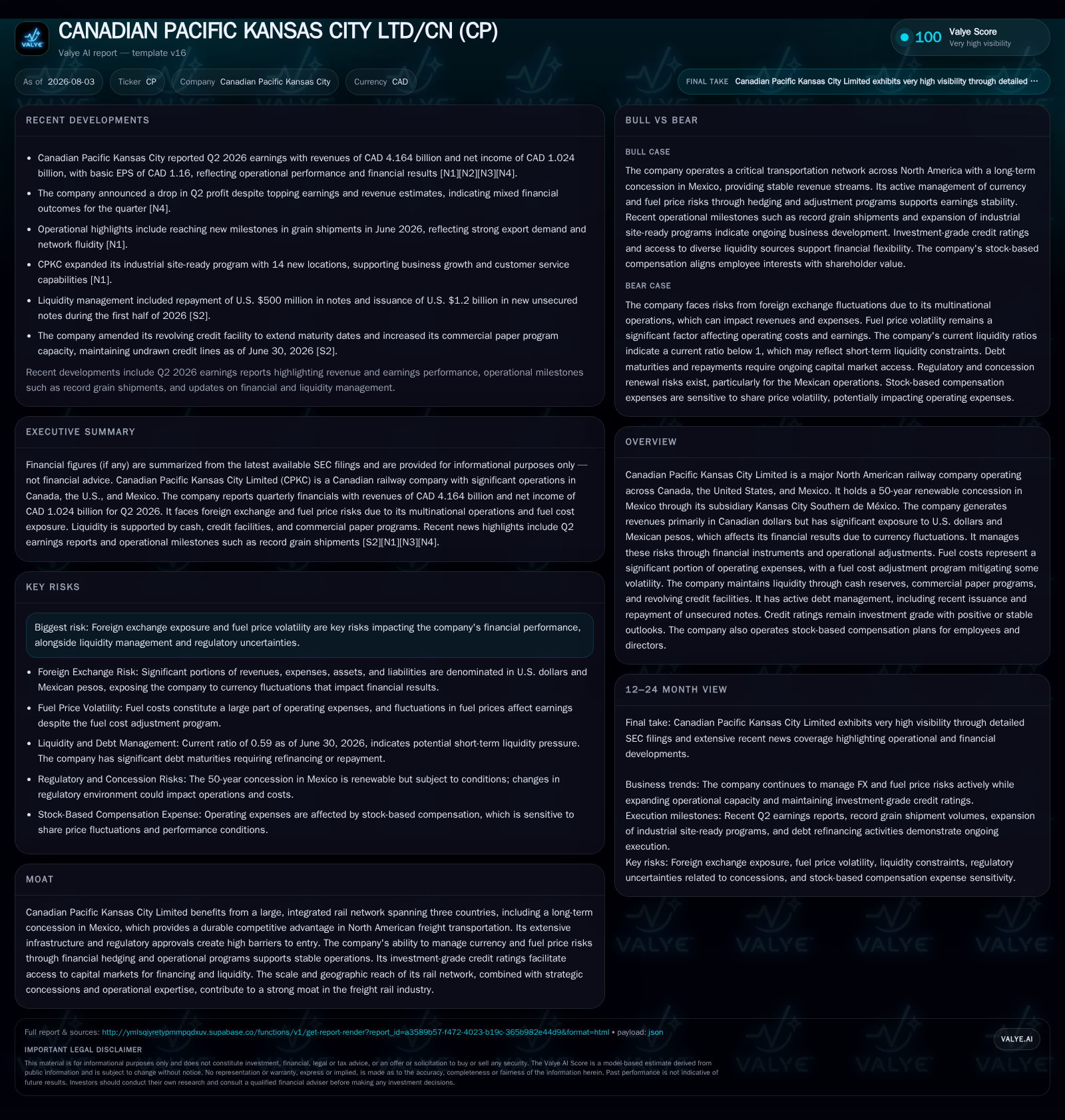
Canadian Pacific Kansas City Limited (CPKC) reported a 6% increase in gross ton-miles in Q2 2026 driven by stronger shipments of grain, energy, chemicals, and metals. However, currency fluctuations, particularly the weakening Canadian dollar versus the U.S. dollar and strengthening Mexican peso, suppressed revenue growth and affected expenses. Fuel efficiency improved through enhanced locomotive productivity, contributing to operational cost control. The company continues to manage acquisition-related expenses tied to integrating Kansas City Southern, while maintaining solid liquidity supported by investment-grade credit ratings. Monitoring FX volatility and progress on network integration remains critical.
Recent Operating Update
Canadian Pacific Kansas City Limited’s latest quarterly filing for Q2 ended June 30, 2026 reveals a clear dual narrative of operational growth offset somewhat by adverse currency movements. Gross ton-miles—a key industry KPI measuring freight volume weighted by distance—increased by 6% versus the prior year period to approximately 107.6 billion GTMs [S2]. This volume expansion was led by higher shipments in grain, energy-related products including crude oil, chemicals and plastics, as well as metals and consumer products. Meanwhile, coal volumes declined slightly.
Train miles grew by only 4%, lagging volume increases due to a reported improvement in average train weight by about 1%. This suggests enhanced efficiency of rail operations with heavier trains moving over fewer miles—an important driver for cost leverage in the capital-intensive rail freight business [S2]. Concurrently, locomotive fuel efficiency improved by roughly 4%, dropping fuel consumption per thousand GTMs from 1.034 gallons to 0.992 gallons year-over-year. This gain reflects better asset utilization and supports lower operating costs given fuel’s significant share of expenses [S2].
Yet, these operational positives were juxtaposed against currency headwinds. In the first half of 2026 compared to the same period in 2025, fluctuations primarily involving the Canadian dollar weakening against the U.S. dollar and the Mexican peso strengthening relative to the Canadian dollar reduced total revenues by $61 million CAD while trimming total operating expenses by $7 million CAD [S2]. The multi-currency exposure is inherent given CPKC’s trilateral North American footprint spanning Canada, the U.S., and Mexico through its subsidiary concession Kansas City Southern de México.
The company manages this FX risk using forward contracts and financial hedges alongside operational realignments; however, reported earnings remain sensitive to exchange rate moves that affect translation of revenues incurred largely in USD and MXN back into reporting currency CAD [S2]. On an annualized basis, management quantifies that each one-cent change in CAD/USD impacts revenues by about $79 million CAD positively or negatively with correlated movements in expenses and interest costs [S2]. Similar but smaller-scale exposures exist for MXN/CAD.
Acquisition-related costs stemming from the April 2023 merger with Kansas City Southern persist as an EPS headwind—$36 million were charged in H1 2026 related mostly to integration efforts including legal fees, IT system migration, restructuring incentives, and synergy initiatives [S8]. These are excluded from core adjusted operating metrics aiming at portraying ongoing operational profitability independently from merger effects
Importantly, liquidity looks secure with $366 million CAD held as cash equivalents complemented by an expanded commercial paper program now allowing additional borrowings up to USD/CAD $2.2 billion combined [S2]. Revolving credit facilities remain undrawn but available as backup funding sources.
Credit ratings affirm the company's balance-sheet strength: Standard & Poor's maintains BBB+ rating with positive outlook while Moody's rates Baa1 stable for senior unsecured debt instruments associated with normal financing needs [S2]
Business Model Specifics
Canadian Pacific Kansas City's business centers on providing freight rail transport across an extensive integrated network covering Canada, the U.S., and Mexico. Its revenue derives primarily from hauling customer freight measured by volume-distance metrics such as gross ton-miles (GTMs) or revenue ton-miles (RTMs). Customers span heavy industries including agriculture (grain), energy (oil & gas), chemicals, metals & minerals sectors plus consumer product flows.
Monetization hinges on contractual freight rates that factor usage intensity—such as train weights—and route distances executed over CPKC's infrastructure assets comprising tracks, locomotives, rolling stock cars plus terminals.
Operational efficiency is critical given the sector’s capital-intensive nature requiring continuous capital expenditure for maintenance and network expansion alongside variable costs like fuel which fluctuate widely. CPKC uses a fuel cost adjustment program partly indexing revenues against volatile diesel prices.
The addition of KCS broadened CPKC’s concession rights into Mexico with a renewable 50-year agreement granting unique cross-border reach linking the three countries into a seamless rail corridor. This raises barriers against new entrants who face regulatory hurdles plus massive upfront investments in track building.
Train productivity gains—through heavier trains managed over optimized train miles—drive low incremental cost growth while currency hedging strategies mitigate FX risks inherent in multi-national operations with revenues/costs denominated in multiple currencies [S2][S8].
Industry Structure & Competitive Positioning
Within North America’s Class I freight railroads landscape—which includes peers like Canadian National Railway (CNI), Union Pacific Corporation (UNP), Norfolk Southern Corporation (NSC), CSX Corporation (CSX), and formerly independent Kansas City Southern (KSU)—CPKC stands out due to its tri-country scale incorporating Mexico through its KCS acquisition.
The integrated rail network forms a high-moat business characterized by:
- Significant capital intensity requiring long planning horizons for capacity expansion,
- High regulatory oversight especially relating to cross-border trade,
- Customer stickiness due to specialized logistics capabilities,
- Limited substitution except costly road trucking alternatives affecting certain segments,
- Strategic network positions enabling access to ports and industrial hubs.
CPKC’s ability to deploy interoperable services across three countries enhances value creation through supply chain simplification amid growing North American trade flows.
Its operating ratio—a profitability gauge measuring operating expenses relative to revenues—is closely watched among peers; continued improvement signals effective cost control benefiting margins in an industry where fixed infrastructure costs dominate.
Growth Drivers
Several factors underpin potential sustained growth:
- Economic activity expansions driving demand for bulk commodities transported by rail such as grain exports or industrial raw materials.
- Intermodal traffic gains facilitated by improvements connecting rail networks with ports supporting containerized cargo enhancing throughput capacity.
- Technology-enabled productivity enhancements including advanced scheduling tools improving network utilization.
- Regulatory encouragement for shifting freight from road to greener rail alternatives incentivizes modal shift.
- Successful integration of KCS assets enabling synergies in reduced overheads and optimized routing advantages across borders.
KPIs aligned with growth include rising gross ton-miles reflecting volume gains; increasing average train weight signifying better asset loading; improved fuel efficiency reducing unit costs; culminating in lower operating ratios evidencing margin progress [S2]
Risks & Watchpoints
Key risks remain:
- Foreign exchange volatility directly impacts reported financials given material revenues/costs in USD/MXN converted into CAD reporting currency potentially compressing margins unexpectedly.
- Fuel price swings present cost uncertainty despite partial adjustment mechanisms.
- Integration execution risks related to ongoing KCS systems merger could disrupt operations or delay synergy realization affecting earnings clarity.
- Regulatory environment uncertainties around concessions may alter long-term operational permissions or cost structures.
- Competitive pressure from trucking routes offers flexibility though at higher unit costs possibly constraining pricing power in some markets.
- Labor relations issues or acute supply chain disruptions could impair service reliability impacting customer retention metrics.
- Capital allocation balancing maintenance of extensive physical infrastructure against pursuing growth investments must be managed prudently for sustainable returns.
Tracking these factors via FX movement analyses, fuel price trends, merger milestones such as technology platform consolidation timelines, concession updates from Mexican authorities will provide advance signals on risk trajectory [S1][S8].
What To Watch Next
Looking ahead:
- Quarterly updates on volume progression measured by GTMs will indicate demand momentum following commodities cycle shifts or trade policy changes.
- Announcements regarding completion stages of KCS business integration including system harmonization or organizational restructuring will clarify merger-related cost trajectories impacting EPS sustainability.
- Currency market developments influencing translation effects alongside hedging program adjustments will bear materially on reported financial outcomes.
- Progress towards modest improvements/reductions in operating ratios reflecting margin discipline will confirm structural cost efficiencies beyond transient factors.
- Capital expenditure disclosures focusing on enhancement projects promoting network capacity or intermodal terminal upgrades may signal expansion intent supporting medium-term growth targets.
- Dividend declarations—as evidenced recently by a quarterly payout declared July 29 payable October—demonstrate confidence in underlying cash generation stability [S3][N3][N10]
Financial Profile Discussion
On the balance sheet front at June 30, 2026 CPKC held cash & equivalents totaling CAD $366 million providing comfortable immediate liquidity buffers alongside a commercial paper program and revolving credit facility rated investment grade (BBB+ positive S&P; Baa1 Moody's) [F1][S2]. Despite current liabilities exceeding current assets resulting in a current ratio below one at approximately 0.59—a typical working capital profile for mature railroad operators—the company’s strong cash flows support ongoing obligations without strain [F1].
Net debt remains substantial reflecting the KCS acquisition consolidation, with the latest available figure near USD $14.3 billion as of December 31, 2025 [F1]. The company continues active debt management focused on refinancing maturities efficiently amid stable interest rate environments [S2].
Overall financial positioning appears prudent with conservative liquidity buffers coupled with credible investment grade status facilitating affordable access to capital markets for future financing or opportunistic strategic investments needed to sustain competitive positioning across North American rail transportation corridors.
Disclaimer: This is research-only, informational analysis and not investment advice. It may include AI-generated interpretation and general industry context. Always verify important details using primary sources.

Comments