
NextDecade Advances Rio Grande LNG Construction Amid Capital-Intensive Debt Burden
NextDecade progresses on its Texas LNG export project with significant financing and construction milestones, while facing leveraged balance-sheet and regulatory risks.
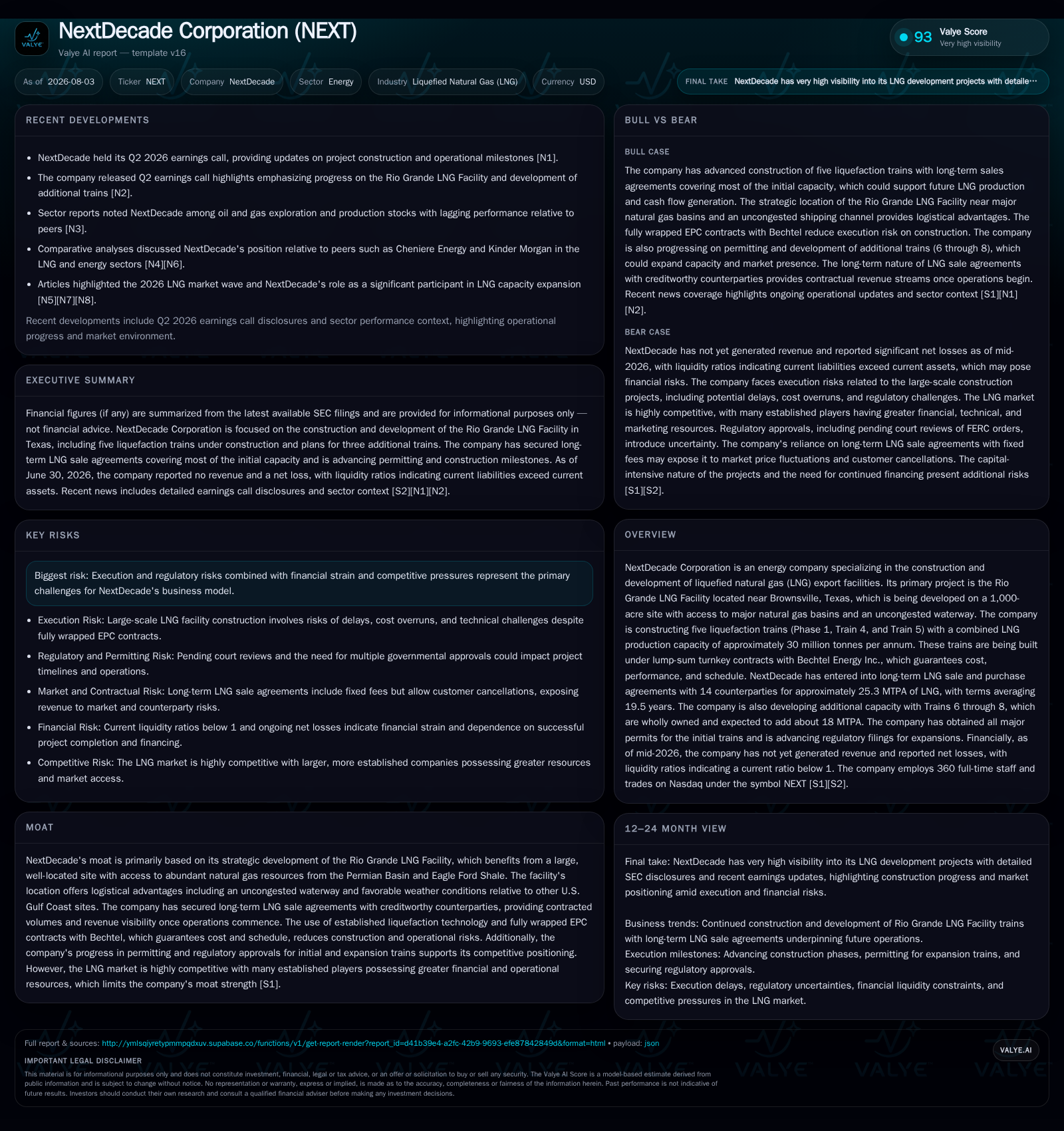
NextDecade Corporation continues building its Rio Grande LNG Facility, comprising five liquefaction trains with a total capacity around 30 MTPA. The company has secured lump-sum turnkey EPC contracts with Bechtel to mitigate cost and schedule risks. Financing expanded in July 2026 with $3.5 billion in senior secured notes supporting ongoing construction. However, NextDecade operates under high leverage combined with a weak current ratio, creating refinancing and liquidity challenges typical of capital-intensive LNG infrastructure developers. Long-term LNG sale agreements underpin revenue visibility upon operations start, though execution and regulatory risks endure.
Recent Operating Update
NextDecade reported in its Q2 2026 Form 10-Q that construction is ongoing for the first five liquefaction trains at its Rio Grande LNG Facility near Brownsville, Texas, targeting a combined production capacity around 30 million tonnes per annum (MTPA) [S2]. Engineering, procurement, and construction (EPC) contracts for Phases 1, Train 4, and Train 5 are fully wrapped lump-sum turnkey agreements with Bechtel Energy Inc., providing guarantees on cost and schedule performance. This approach mitigates some traditional project execution risks common in LNG infrastructure development. The company completed a substantial bond offering on July 2, 2026, issuing $3.5 billion in senior secured notes across four tranches with maturities extending to 2041 [S3]. This advances Rio Grande’s project financing but also elevates NextDecade’s sizeable long-term leverage.
This quarter revealed no operating revenue as the facility is still under construction without commercial operations initiated. NextDecade's liquidity position shows $83.7 million in cash but total debt around $10.3 billion as of June-end 2026, generating a low current ratio of roughly 0.37 reflecting working capital constraints [F1]. There were no material changes to previously stated risk factors [S2].
Business Model Overview
NextDecade functions primarily as a developer and future operator of midstream liquefied natural gas facilities focused on exporting natural gas sourced mainly from prolific U.S. basins such as the Permian Basin and Eagle Ford Shale [S1]. Its key asset is the Rio Grande LNG Facility sited along the Brownsville Ship Channel—a strategic location characterized by an uncongested waterway conducive to vessel loading logistics and favorable weather relative to other Gulf Coast sites.
The company generates value through the design, construction, and eventually operation of liquefaction trains that convert pipeline natural gas into LNG for export under long-term sales and purchase agreements (SPAs). Monetization depends heavily on contracted volumes (about 25.3 MTPA under SPAs averaging nearly two decades in length) that underpin revenue stability once operations commence [S1]. Incorporating experienced EPC contractors on fixed-price contracts reduces exposure to cost overruns during construction.
Additional revenue streams may emerge from carbon capture and storage (CCS) projects which NextDecade is exploring at Rio Grande to offset emissions and potentially monetize carbon credits—a growing concern in fossil fuel infrastructure sectors [S1]. Liquefaction technology employed involves advanced processes licensed from Honeywell to enhance efficiency.
Industry Structure and Competitive Environment
The LNG export industry involves large-scale capital projects with long development horizons subject to significant regulatory scrutiny across federal, state, and local levels [S7]. Companies compete principally based on site advantages including feedstock access, shipping logistics, technology efficiency, financing capability, contract portfolio strength, and execution record.
NextDecade sits among a set of U.S.-based exporters like Cheniere Energy—market leader with multiple operational terminals—and Sempra Energy which owns diverse energy assets including LNG infrastructure. These peers benefit from operational cash flow generation improving their credit profiles unlike NextDecade which remains pre-revenue amid construction delays typical for new entrants.
The sector faces cyclical commodity price risk affecting spot market prices but off-take contracts help attenuate volume/demand variability. Regulatory changes pose material uncertainties especially environmental permitting and legal challenges by opponents concerned about ecological impacts or climate-related issues [S5]. Counterparty credit quality of SPA customers also influences perception of contracted revenue backlog solidity.
Growth Drivers
Key growth drivers include accelerating global demand for cleaner-burning natural gas especially in Asia-Pacific and Europe as countries transition away from coal power generation. NextDecade’s expansion vision contemplates adding three additional liquefaction trains beyond the initial five (Trains 6–8), indicating scalable site capacity potential backed by an ample footprint totaling approximately 1,000 acres [S1]
Long-term SPAs locked in with multinational energy companies provide assured demand support mitigating volume risk post-commissioning [S1]. Enhanced liquefaction technology adoption could improve production yields thereby enhancing margin prospects when operational.
The planned CCS initiatives align with evolving ESG expectations potentially unlocking new financing avenues linked to sustainability-linked loans or green bonds while addressing increasing regulatory emissions limits [S1].
Risks and Watchpoints
Execution risk remains elevated given the complexity of completing multi-train LNG facilities subjected to potential delays associated with labor availability, supply-chain bottlenecks, weather events, or performance issues despite EPC guarantees [S4][S24]. Regulatory permitting challenges linger as ongoing appeals against FERC orders could impose delays or conditions increasing compliance costs [S7].
Operating cash flows won’t materialize until commissioning milestones pass plausibly in late decade timeframes implying persistent losses at present levels.
Market price volatility affects counterparty willingness to honor SPAs especially if commodity pricing weakens significantly or exporters lose competitive edge due to costs or location disadvantages vis-à-vis rivals like Cheniere who have earlier platform expansions completed now generating positive EBITDA.
ESG concerns expose NextDecade to reputational risks alongside emerging litigation linked to climate disclosures or alleged greenwashing which may increase operating restrictions or costs over time [S12][S13].
What To Watch Next
Critical milestones include progress updates on EPC contract adherence—especially Bechtel's management of Phase 1 through Train 5 schedules—and any announcements confirming final investment decisions (FID) or financing closure for forthcoming Trains 6–8 expansions [S1][N2]. Regulatory developments remain a barometer; watch for resolution or continuation of FERC order appeals impacting project timelines.
Liquidity improvements such as equity raises or further bond issuances would ease near-term funding risks while operational commissioning dates will clarify transition from capex phase to revenue-generating operations impacting cash flow prospects materially. Carbon capture project commercialization progress will also be relevant given potential impact on future growth pathways.
Monitoring SPA counterparty performance indicators or restructuring activity can signal demand stability while broader energy market dynamics including global LNG supply-demand balance shifts will influence pricing power going forward.
Financial Profile Discussion
As of June 30, 2026, NextDecade holds approximately $83.7 million in cash against total debt estimated near $10.3 billion resulting in net debt over $10 billion—a heavy leverage load reflective of capital-intensive project status typical among development-stage LNG exporters [F1]
The recent issuance of several senior secured notes totaling $3.5 billion expands maturity profile out to mid-century but raises fixed-charge burdens given interest rates ranging from approximately 5.25% to over 6% depending on maturity dates [S3]. The absence of revenues until plant commissioning amplifies dependency on external financing sources for continuing operations.
Despite losses reported historically—with operating income negative as recently as end-2025—the robust contracted volume backlog provides future revenue visibility conditional on successful commissioning down the road [F1][S1]. Investment in CCS systems may incrementally add capital expenditure needs before producing positive net operating results.
Ensuring adherence to EPC contract guarantees remains critical given the potential financial implications should Bechtel’s liabilities be triggered for delays or cost increases.
In summary, NextDecade’s financial profile typifies early-stage LNG infrastructure developers: deeply capital-intensive with limited near-term cash flow but supported by long-term contracted revenue streams potentially yielding strong operating margins post-completion if execution risks recede.
This analysis synthesizes NextDecade’s latest SEC disclosures contextualized within prevailing industry dynamics without predicting specific outcomes. It avoids speculative assertions unsupported by public evidence emphasizing rigorous interpretation of reported data relative to the competitive U.S. LNG export sector.
Disclaimer: This is research-only, informational analysis and not investment advice. It may include AI-generated interpretation and general industry context. Always verify important details using primary sources.

Comments