
Hippo Holdings Accelerates Portfolio Diversification While Controlling Underwriting Volatility
Hippo’s Q2 2026 results highlight its multi-carrier insurance platform growth, underwriting discipline enhancements, and risk management amid evolving market conditions.
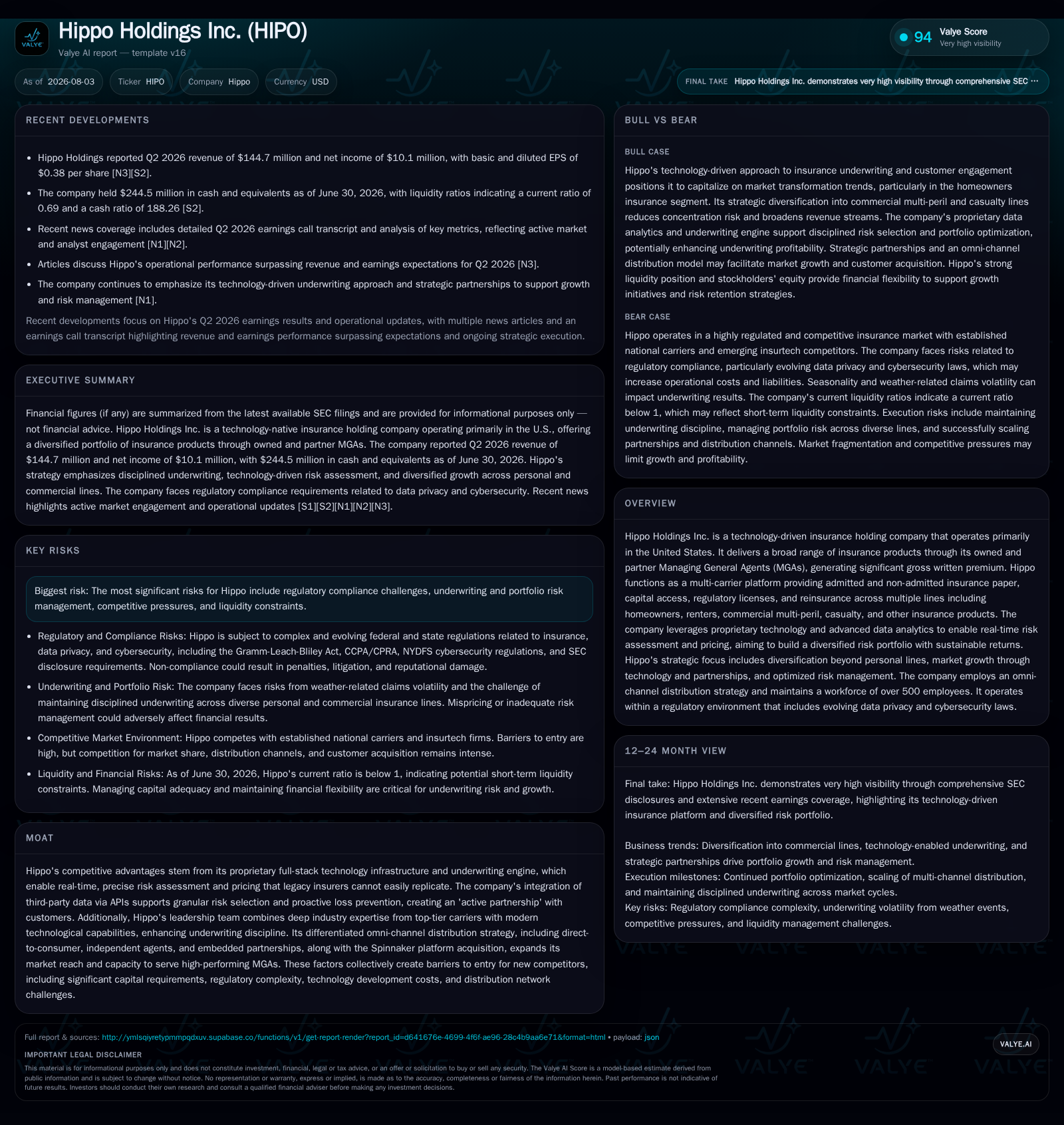
In Q2 2026, Hippo Holdings demonstrated continued gross written premium growth driven by a strategic expansion of its insurance lines and geographic footprint. The company advanced its underwriting discipline through data-driven risk segmentation and catastrophe modeling to manage loss ratio volatility. Hippo's multi-carrier platform model, combining admitted and non-admitted paper via owned and partner MGAs, supports stable fee income alongside selective underwriting participation. While competitive dynamics and regulatory complexity persist, the firm is positioning to capitalize on digital distribution trends and diversified product offerings. Financially, Hippo maintained solid capital reserves and cash liquidity as it balances growth with underwriting volatility control.
Q2 2026 Impact: Operating Trends Reflect Strategic Portfolio Broadening with Risk Controls
Hippo Holdings’ latest quarterly filing for Q2 2026 reveals that the company sustained meaningful growth in gross written premium (GWP), propelled by a deliberate expansion across diverse insurance lines including homeowners, renters, commercial multi-peril (CMP), and casualty coverage [S2][N3]. This diversification is a strategic response to past underwriting volatility that notably affected prior quarters due to severe weather-related catastrophes. Management underscored the benefits of continuous portfolio optimization supported by sophisticated financial and catastrophe modeling that have enabled more precise risk appetite calibration. Consequently, underwriting results show improving loss ratios as the company lifts prior nationwide pauses on homeowner HO3 new business while maintaining cautious risk segmentation [S2][S18].
This evolution matters because it signals a transition from reactive risk contraction to proactive portfolio management aiming for sustainable returns. The key confirmation marker will be observing whether improved loss ratios persist over subsequent quarters paired with steady or growing premium volumes — an indicator that Hippo can balance growth with underwriting discipline.
Platform Business Model Dynamics: Multi-Carrier Architecture Drives Fee Stability and Premium Mix Balance
As detailed in the annual filings and reiterated in recent disclosures, Hippo operates fundamentally as a multi-carrier platform providing insurance paper—both admitted and non-admitted—to owned and partner Managed General Agents (MGAs) across multiple product verticals [S1][S23]. This structure allows Hippo to generate revenue primarily through underwriting premium income while simultaneously earning stable fee income from carrier platform services. The complementary nature of fee revenue buffers operational volatility inherent in underwriting cycles.
The carrier role involves not only issuing policies but also managing regulatory licensing requirements, reinsurance arrangements, and capital deployment efficiently across personal lines like homeowners and renters plus commercial lines such as CMP and casualty [S1]. The ability to selectively retain risk participation within program portfolios enables Hippo to optimize capital utilization while managing exposure—a balance that creates resilient premium streams even amid competitive pricing environments or catastrophe impacts.
This model differentiates Hippo from digital-native insurtechs solely focused on direct consumer sales as well as legacy carriers that historically lack this flexible multi-carrier architecture tied tightly with emerging MGA channels.
Proprietary Technology Inflection: Data Analytics Enhance Underwriting Discipline and Market Responsiveness
Central to Hippo’s competitive edge is its proprietary full-stack technology infrastructure coupled with an advanced underwriting engine capable of real-time risk assessment and dynamic pricing adjustments [S1][S18]. Unlike legacy insurers constrained by dated actuarial processes, Hippo leverages extensive third-party data integrations via APIs to enable granular risk segmentation at quote inception. This enhances loss prevention efficacy by facilitating an active partnership approach with customers rather than a purely claims-reactive orientation.
Such technological capability underpins more precise catastrophe modeling which informs selective underwriting participation decisions reducing unwarranted volatility that previously mandated broad underwriting pauses. When benchmarked against peers like Lemonade Inc. or Root Insurance—both also leveraging technology for personal lines underwriting—Hippo’s multi-carrier platform approach combined with robust data analytics offers differentiated operational scalability [S18]. It can flex risk appetite across multiple MGAs rather than relying solely on proprietary distribution.
Industry Positioning: Multi-Carrier Platform Versus Insurtech Peers and Legacy Insurers
Hippo sits at a distinct nexus between legacy insurance carriers that are digitizing their operations (e.g., Progressive Corporation) and pure-play insurtech disruptors centered on consumer direct channels [S1]. Its omni-channel reach encompasses direct-to-consumer sales but crucially extends through independent agents and embedded partnerships powered by acquisition of platforms such as Spinnaker which broaden MGA engagement.
This layered distribution network increases switching costs for MGAs due to integrated licensing, reinsurance access, and scale economies available via Hippo’s platform—creating barriers difficult for new entrants lacking similar capabilities [S18]. Compared with digital-first peers focusing narrowly on personal lines homeowners or renters insurance via online quotes alone, Hippo's capacity in commercial multi-peril products adds diversification both top-line wise and from a risk-adjusted portfolio perspective.
Growth Drivers: Expanding Geographic Reach, Product Suite Innovation, and Distribution Channel Penetration
The company’s growth agenda hinges notably on geographic expansion into underserved U.S. markets coupled with product innovation targeting renters protections alongside small-to-medium commercial business lines such as CMP [N2][S1]. Digitally embedded insurance solutions represent an increasingly material avenue where partnerships embed coverage offers seamlessly within real estate transactions or home services ecosystems—enhancing customer acquisition efficiency beyond traditional marketing-heavy tactics.
Rising demand for proactive insurance models facilitated by predictive analytics aligns well with broader consumer preference shifts towards tailored coverage featuring transparent pricing grounded in real-time data analysis. Concurrent regulatory evolutions may also open new product lines or relaxed limits favoring flexible insurer program design—benefiting a carrier platform agile enough to adapt rapidly.
Risks and Headwinds: Regulatory Complexity, Catastrophe Exposure, Competitive Intensity, and Capital Constraints
Despite progress executing its strategy, Hippo faces entrenched challenges detailed in its extensive risk disclosures including strict multi-jurisdictional regulatory compliance burdens requiring continuous vigilance to avoid adverse enforcement actions or fines [S5][S15]. Catastrophe losses remain a principal source of underwriting earnings volatility given the unpredictability of severe weather patterns; effective catastrophe modeling does mitigate but does not eliminate this threat.
Competition derives both from established large carriers benefiting from scale brand recognition plus nimble insurtech entrants vying for digital-savvy consumers; sustaining differentiation requires constant technology investment alongside disciplined underwriting execution. Capital adequacy is monitored closely since mispriced risks or rapid premium growth could stress statutory surplus levels necessitating capital raises or reinsurance cost escalation [S5].
Striking the right balance between aggressive portfolio expansion versus conservative risk appetite remains a primary watchpoint.
Looking Ahead: Guidance Signals, KPI Milestones, and Execution Benchmarks to Monitor in Coming Quarters
Key performance indicators warranting scrutiny post-Q2 include policy retention rates especially following lifting of prior underwriting pauses on homeowner HO3 policies which historically impacted customer counts adversely [N1][N3]. Sustained improvement or stabilization of loss ratios across diversified business lines will validate effectiveness of updated catastrophe assumptions.
Further announcements regarding new MGA partnerships or geographic market entries will also serve as real-time indicators whether Hippo’s platform ecosystem scaling proceeds as intended. Monitoring expense ratio trends relative to revenue growth is critical given the effects of marketing spend timing differences intrinsic to insurance premium recognition models noted previously [S1]
Finally, any changes in reinsurance utilization or capital deployment strategies would be crucial signals around financial resilience management.
Financial Profile Discussion
Hippo held $244.5 million in cash and equivalents as of June 30, 2026 supporting operational liquidity amidst premium growth initiatives [F1]. The company’s current ratio stood at approximately 0.69 as of June 30, 2021, indicating working capital constraints typical for rapidly growing insurers investing upfront in acquisition costs recognized differently than premium earnings timing [F1].
The company reported net income of $57.7 million for full year 2025 reflecting initial profitability following years of net losses driven partly by prior catastrophe-related impairments. Future financial performance will hinge on steady net earned premium ramp-up combined with contained claims severity effecting improved combined ratios.
Disclaimer: This analysis is based exclusively on information publicly disclosed in SEC filings and verified news sources up to August 2026. It provides no investment advice but aims to deliver rigorous industry-focused insight into Hippo Holdings Inc.’s business operations, market positioning, growth dynamics, risks, and financial context.
Disclaimer: This is research-only, informational analysis and not investment advice. It may include AI-generated interpretation and general industry context. Always verify important details using primary sources.

Comments