
Titan International’s Segment Performance Reflects Tariff Risks and Portfolio Expansion
Q2 2026 results underscore volatility in agricultural and construction markets, offset by consumer segment growth and strategic acquisitions.
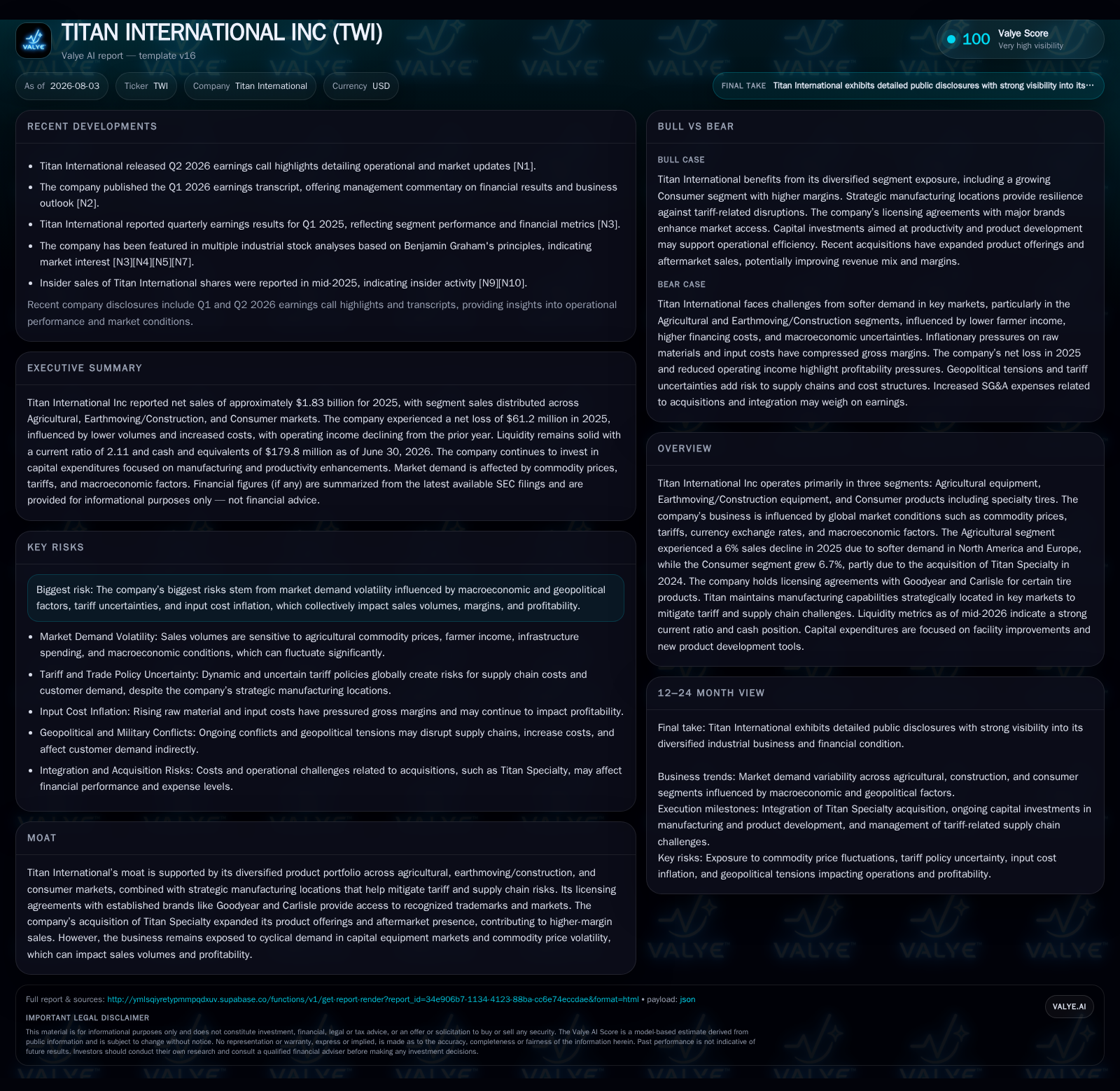
Titan International’s latest quarterly filings show continuing pressure on the agricultural and earthmoving/construction segments due to tariff uncertainties and softer OEM demand. However, the consumer products segment, bolstered by the 2024 Titan Specialty acquisition, exhibits healthy revenue and margin expansion driven by high-margin aftermarket sales. The company’s geographically diversified manufacturing footprint and licensing agreements with Goodyear and Carlisle remain key competitive advantages amid volatile commodity prices and tariff policy dynamics. Capital expenditure focus on facility improvements aims to enhance operational efficiency, while liquidity metrics remain solid, supporting near-term investment needs.
Recent Operating Update
The earthmoving/construction business is experiencing an uptick in OEM demand supported by strong mining capital budgets fueled by high mineral commodity prices, translating into modest incremental volume improvement [S1]. Despite this positive momentum, the segment remains vulnerable to variable infrastructure spending levels and ongoing tariff exposure.
Meanwhile, the consumer products division recorded a 6.7% increase in net sales in 2025 compared to the prior year [S1]. This growth stems substantially from the accretive impact of Titan Specialty (formerly Carlstar), acquired in early 2024. The acquisition expanded Titan’s geographic footprint and product portfolio across specialty tires serving powersports, outdoor power equipment, and trailer markets. The segment also benefits from strong aftermarket parts revenue that carries higher margins than OEM sales.
Business Model Analysis
Titan International operates as an integrated manufacturer specializing in wheels, tires, and undercarriage components primarily for off-highway vehicles used across three segments: agriculture, earthmoving/construction equipment, and consumer specialty products [S1]. The model combines original equipment manufacturer (OEM) direct sales with extensive aftermarket parts distribution channels — a dual-revenue approach that cushions volatility inherent in capital equipment cycles.
The company derives significant advantage from its manufacturing footprint strategically placed within key markets to reduce exposure to tariffs and supply chain delays. This geographic diversification allows production to be closer to customers in regions such as North America and Europe where tariff reciprocity impacts trade costs [S1]. Additionally, licensing agreements with globally recognized brands Goodyear and Carlisle enable Titan to leverage established trademarks while expanding product offerings without incurring full R&D expenses associated with new proprietary tire development.
Revenue dynamics are influenced by sales volumes segmented by end markets: agricultural equipment units tend to fluctuate with commodity prices and farmer income; construction volumes track infrastructure appropriations; consumer specialty lines vary based on consumer discretionary spending patterns. Average selling prices (ASP) adjust based on input cost inflation — especially steel for wheels and rubber for tires — as well as end-market pricing power. Aftermarket parts sales growth stands out as a critical KPI due to their higher margin profile relative to OEM units.
Industry Structure and Competitive Position
Titan operates within an industrial equipment manufacturing value chain that demands capital-intensive assets alongside skilled labor inputs to deliver durable goods such as wheels and tires tailored to specific vehicle applications. Peers include broad-scope players like Caterpillar (construction/agriculture heavy machinery) and AGCO (agricultural machinery) on the hardware side; Bridgestone parallels emerge on tire manufacturing. Within specialty tires specifically served by Titan Specialty brands ITP and Marastar, competition includes legacy brands supported through licensing agreements.
The company's diversified portfolio reduces concentration risk compared to pure-play agricultural or construction equipment makers exclusively dependent on cyclical commodity cycles. Furthermore, its ongoing integration of aftermarket services provides more resilient cash flow streams that are less sensitive to OEM capital spend downturns.
Geographic diversification of manufacturing mitigates risks from tariff policy shocks witnessed globally over recent years. For example, Titan's ability to manufacture within Europe offsets US-imposed tariffs on imports from Asia or vice versa, maintaining competitive pricing while protecting margins [S1]
Growth Drivers
Several factors underpin Titan’s growth trajectory:
- Infrastructure spending boosts demand for earthmoving/construction products. Anticipated GDP growths across served countries support longer-term volume increases [S1].
- Commodity price stability or gains elevate farmers' disposable incomes facilitating replacement cycles for agricultural fleets.
- Population growth coupled with dietary shifts toward protein drives structural increases in farm output demands creating sustainable replacement demand for ag equipment [S1].
- The recently acquired Titan Specialty business extends reach into growing specialty tire markets including powersports segments benefiting from outdoor lifestyle trends.
- Expansion of aftermarket parts sales represents a critical margin enhancer providing recurring revenues outside OEM order cycles.
- Capital expenditures focusing on facility modernization improve capacity utilization rates and reduce lead times enhancing customer responsiveness [S4].
Tracking KPIs such as order backlogs per segment, capacity utilization rates at manufacturing sites, average selling price trends adjusted for raw material pass-throughs will signal execution effectiveness against these drivers.
Risks / Watchpoints / Constraints
Titan faces several notable risks:
- The cyclical nature of end markets heavily influenced by volatile commodity prices directly impacts agricultural capital spending plans.
- Tariff policy unpredictability continues driving cost uncertainty; future tariffs or trade restrictions could compress margins despite geographic production mitigation strategies [S1], [S2].
- Inflationary pressures on raw materials such as steel alloys for wheels or synthetic/natural rubber for tires can erode gross margins if not rapidly passed through via pricing adjustments.
- Supply chain disruptions resulting from geopolitical tensions particularly around raw materials sourcing pose operational risks.
- Foreign currency exchange rate volatility adds complexity given Titan’s multinational operations.
- Competitor activity increased innovation or pricing changes from global or niche players could pressure market share or ASPs.
- Heavy capital expenditure requirements necessitate disciplined cash flow management; failure to invest efficiently could undermine competitiveness long term.
- Dependency on OEM clients’ capital budget cycles means sudden industry downturns cascade quickly through order pipelines affecting revenue visibility.
Monitoring forward bookings per segment alongside input cost trends will be essential near-term indicators of risk crystallization.
What to Watch Next
Investors should monitor:
- Quarterly segment revenue trajectories disaggregated between agriculture, construction/earthmoving, and consumer specialty products for early inflections post-Q2 2026 data [S2].
- Order backlog trends particularly from large ag equipment customers signaling demand recovery or further softenings.
- Price/mix evolution considering raw materials inflation pass-through success as reflected in gross margin movements per reporting period.
- Progress on planned capital expenditures focusing on efficiency gains as disclosed in future MD&A commentary [S4].
- Tariff policy developments globally given their outsized impact on competitive positioning particularly for export-dependent production facilities.
- Execution integration milestones related to the Titan Specialty acquisition impacting profitability expansion within consumer segments.
- Cash flow conversion ratios reflecting working capital management effectiveness amidst inventory build decisions supporting expected demand shifts.
Financial Profile Discussion
As of June 30, 2026, Titan International reported a solid liquidity position with cash & equivalents of approximately $179.8 million against current liabilities of $498.5 million resulting in a healthy current ratio of about 2.11 [F1], illustrating ample short-term coverage capacity. Total debt stood near $566.7 million at year-end 2025 with an estimated net debt position around $386.9 million after factoring cash holdings [F1], suggesting moderate leverage consistent with industry peers engaged in capital-intensive manufacturing activities.
Capital expenditures forecast between $50 million to $55 million for fiscal year 2026 reflect ongoing investments targeted at facility enhancements and tooling commitments aligning with new product development programs [S4]. Interest expense approximations at $36 million-$40 million annually indicate substantial debt servicing costs primarily related to fixed-rate senior secured notes maturing in 2028 [S4]. This level of financial obligation underscores the importance of steady operating cash generation especially given tightening end-market dynamics.
Disclosure: This analysis does not constitute investment advice but aims to provide an informed perspective based on currently available SEC filings dated up through July 30, 2026.
Disclaimer: This is research-only, informational analysis and not investment advice. It may include AI-generated interpretation and general industry context. Always verify important details using primary sources.

Comments