
NorthWestern Energy Advances Infrastructure and Navigates Regulatory Dynamics in Q2 2026
Recent quarterly results highlight NorthWestern Energy's ongoing infrastructure investments and stable regulated operations amid merger and regulatory considerations.
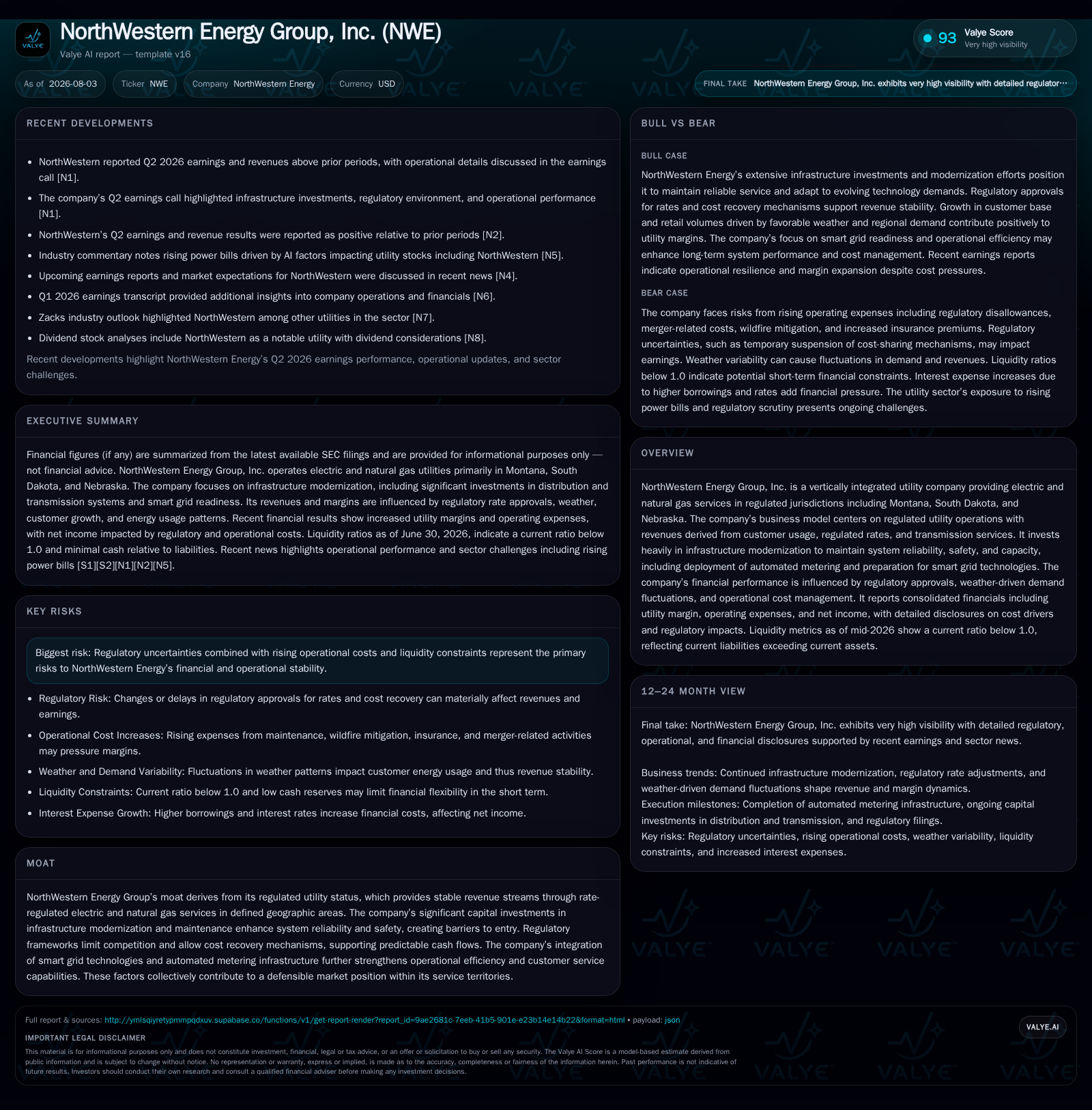
NorthWestern Energy reported solid Q2 2026 results reaffirming its 2026 earnings guidance while maintaining a heavy capital expenditure program focused on grid modernization. Its vertically integrated utility model, anchored in regulated electric and natural gas operations across Montana, South Dakota, Nebraska, and Yellowstone National Park, continues to benefit from regulatory frameworks that provide steady utility margin despite weather-driven demand variability. The company is progressing with a planned all-stock merger with Black Hills Corporation, targeting scale and operational synergies. Key challenges remain in rate case approvals and managing liquidity given substantial capital intensity and currently modest liquidity ratios.
Recent Operating Update: Q2 Performance Anchors Near-Term Outlook
NorthWestern Energy Group’s latest quarterly filing dated July 30, 2026, reveals a performance snapshot underpinning the company's reaffirmation of its full-year earnings guidance ranging from $3.68 to $3.83 per diluted share [S2][S3][N1][N2]. This update confirms operational stability amid ongoing investment cycles and regulatory progress while spotlighting the company’s capacity to manage supply cost pass-throughs inherent in its regulated utility model.
The Q2 results echo the sustained emphasis on infrastructure renewal—particularly automation across metering devices and grid components—with spend levels consistent with the annual forecast of around $683 million for capital expenditures primarily targeting distribution and transmission systems [S1]. These investments prepare NorthWestern’s service territories for smart grid applications while addressing aging infrastructure challenges.
Meanwhile, the significant merger agreement with Black Hills Corporation remains at the forefront of strategic developments. The planned all-stock merger aims at combining complementary regional footprints enhancing scale advantages and operational expertise in regulated energy delivery. Black Hills is identified as the accounting acquirer per ASC Topic 805 rules; this transaction will see NorthWestern shareholders receive shares of Black Hills common stock upon closing pending customary regulatory approvals [S1].
Business Model: Vertically Integrated Regulated Utility With Predictable Margins
NorthWestern operates as a vertically integrated provider delivering both electricity and natural gas mainly through two subsidiaries—NW Corp in Montana (including Yellowstone National Park) and NWE Public Service in South Dakota and Nebraska—servicing over 850,000 customers across these jurisdictions [S1]
Revenue generation follows traditional regulated utility mechanics: customers are billed based on tariffed rates approved by state public utility commissions that allow recovery of operating costs plus an authorized return on invested capital (ROIC). Key revenue components include supply volumes driven by customer usage (measured in MWh or therms), regulated rates that incorporate cost recovery mechanisms for fuel/purchased power expenses, and fixed charges associated with transmission and distribution services.
To isolate the core operating profitability excluding commodity price fluctuations—which are largely pass-through costs—the company uses "Utility Margin," a non-GAAP measure defined as operating revenues less fuel, purchased supply, and direct transmission expenses excluding depreciation [S1]. This metric offers insight into earnings powered by volume growth, rate changes, operational efficiencies, or load factor shifts.
Infrastructure modernization—exemplified by recent completion of automated metering infrastructure deployments starting from 2021—and ongoing investments targeted at improving system reliability represent foundational growth pillars enhancing customer experience while supporting approved rate base expansion [S1]. These tangible assets underpin future allowed returns under regulatory frameworks.
Industry Structure & Competitive Landscape
As a regulated electric and natural gas utility operating within specified geographic territories subject to state-level public utility commission oversight, NorthWestern faces limited direct competition due to protective regulatory constructs designed to ensure safe, reliable energy supplies at reasonable rates.
The company's peers encompass major vertically integrated utilities such as Duke Energy—offering both electric and gas services—NextEra Energy—concentrated on renewable-focused electricity—and Southern Company with comparable regional service models. Natural gas utilities like NiSource Inc. share similarities in gas service dynamics, while companies like Alliant Energy operate regionally under analogous rate-regulation regimes.
Comparison among these peers centers on scale of rate base under management, capacity to invest in grid modernization, customer density metrics influencing load profiles, regulatory track records including rate case outcomes influencing allowed ROEs, and exposure to weather-driven demand swings represented by degree day variability.
Growth Drivers
NorthWestern’s growth trajectory aligns closely with several structural themes:
- Customer Base Expansion: Incremental customer additions within existing territories contribute steadily to utility margin growth absent significant pricing moves.
- Usage Variability from Weather Patterns: Heating degree days drive natural gas consumption while cooling degree days push residential electricity use during hot summers; these metrics influence short-term volume fluctuations impacting margins notwithstanding rate stabilization mechanisms.
- Infrastructure Modernization: Capital investments directed toward upgrading legacy distribution/transmission equipment not only maintain reliability but also constitute qualifying rate base additions yielding incremental returns under regulatory approval.
- Regulatory Approvals: Outcome of future rate cases is critical; timely cost recovery episodes for acquisitions (e.g., Colstrip units acquired Jan 2026 without current rate collection) enhances cash flow visibility.
- Electrification Trends: Broader adoption of electric vehicles or electric heating fuels incremental demand upward trends over medium term.
- Operational Efficiency: Systematic O&M expense controls can improve net margins provided they align well with allowed recoveries under tariffs.
- Merger Synergies: Integration benefits from the Black Hills merger—expected after successful closing—offer potential for improved financial scale efficiencies.
Risks & Watchpoints
Despite inherent advantages of regulation-backed stability, several risks warrant monitoring:
- Regulatory Delays or Disallowances: Protracted or unfavorable decisions on rate reviews threaten timely cost recovery including major acquisitions’ operating expenses impacting earnings continuity.
- Operational Cost Inflation: While some O&M expenses exhibit stability across volume ranges, escalating labor or contractor costs could pressure near-term margins if not offset by rate adjustments.
- Liquidity Constraints Amid Capital Intensity: Current liquidity measures suggest tight working capital positioning with a current ratio of about 0.83 as cash balances on hand remain modest compared to looming liabilities; proactive refinancing efforts for short-term debt maturing in 2026 are underway [F1][S27].
- Weather Volatility: Unseasonable temperature patterns can either depress or spike demand unpredictably impacting measured utility margin trajectories despite pass-through protections.
- Merger Execution Risks: Regulatory or integration obstacles related to the pending Black Hills transaction could disrupt expected strategic benefits.
- Technological Shifts & Cybersecurity Threats: Adoption barriers related to smart grid technologies combined with increasing cyber threats present operational challenges common across industry peers.
- Environmental Regulation Compliance Costs: Evolving emissions standards or climate policies may necessitate further capital allocations or operational modifications affecting profitability.
What to Watch Next
Key milestones for investors tracking NorthWestern include:
- Progress on regulatory filings especially the forthcoming Montana rate case affecting Colstrip acquisition cost recovery timing [S1].
- Completion status of merger integration steps following shareholder and regulator approval processes expected post-announcement [S1].
- Capital expenditure execution against the planned $683 million budget allowing assessment of spending discipline versus project timelines underpinning future rate base growth.
- Quarterly updates on operational metrics tied to customer count changes, weather-driven sales volumes (degree days), load factors reflecting utilization shifts.
- Liquidity management updates focusing on refinancing activity around upcoming debt maturities including the $150 million Term Loan borrowed mid-2026 replacing prior revolving credit debt [S27].
- Earnings disclosures with attention to movements in operating margins excluding fuel cost volatility informing underlying efficiency trends.
Financial Profile Discussion
As reflected in NorthWestern’s mid-2026 balance sheet snapshot data as of June 30th, cash and equivalents stood at roughly $4.18 million against current liabilities totaling approximately $583 million resulting in a conservative current ratio around 0.83 which underscores tight near-term liquidity buffers typical for capital-intensive utilities reliant on working capital management strategies [F1]. Total debt remains substantial at above $3.28 billion adjusted for cash holdings as net debt reflecting long-duration financing structures consistent with industry norms [F1].
Dividend payout targets remain disciplined aiming for approximately 60–70% payout ratios relative to earnings per share ensuring sustainable capital return policies aligned with cash flow profiles [S12]
In conjunction with peer entities such as Duke Energy or Southern Company carrying similar leverage targets within the range of low-to-mid 50% debt-to-capital ratios, NorthWestern’s financial posture remains typical but warrants vigilant management given ongoing integration activities stemming from merger ambitions combined with increasing demands for smart grid investments requiring robust funding approaches.
The information presented reflects facts as reported through SEC filings up to July 30, 2026 [S2][S3] combined with market commentary dated August 3rd, 2026 [N1][N2], providing an integrated view without deriving forward-looking investment conclusions or research views.
Disclaimer: This is research-only, informational analysis and not investment advice. It may include AI-generated interpretation and general industry context. Always verify important details using primary sources.

Comments