
Meta's AI Investment Spurs Advertising Growth Amid Rising Costs and Regulatory Challenges
Meta Platforms delivers strong revenue growth powered by AI-enhanced advertising, while investing heavily in next-gen AI infrastructure and immersive technologies.
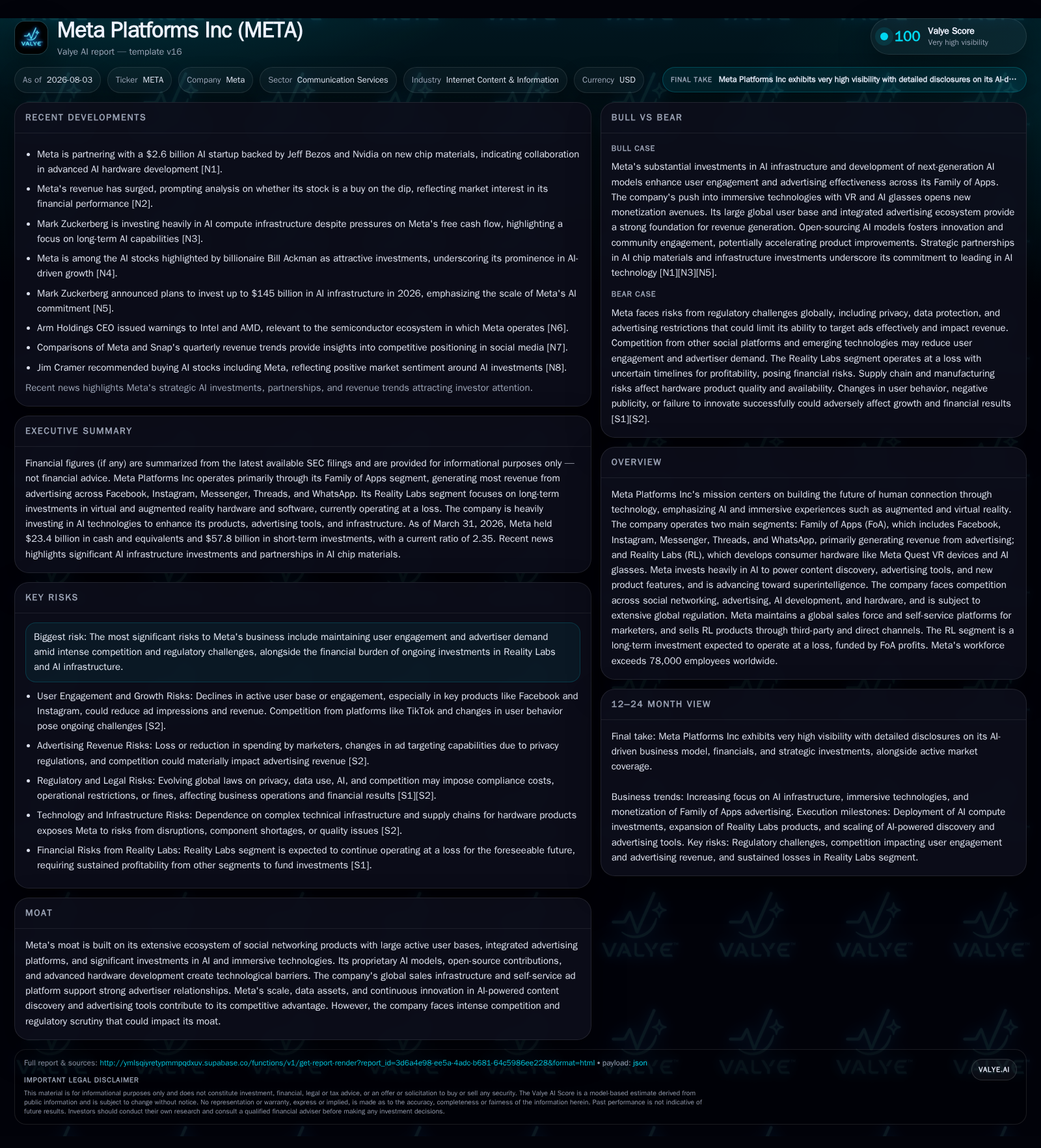
In Q2 2026, Meta Platforms reported a 28% year-over-year revenue increase to $60.8 billion, driven largely by the Family of Apps segment’s advertising strength across Facebook and Instagram. Despite robust top-line growth, operating income declined 8% due to accelerating expenses, including AI infrastructure costs and severance. Reality Labs showed modest revenue growth but remains a loss-making investment. Meta's business model continues to leverage massive user engagement combined with AI-powered ad targeting, but regulatory scrutiny and substantial capital expenditures—particularly the planned $130-145 billion spend on AI initiatives in 2026—pose ongoing challenges. Key metrics such as daily active users and ad impressions both grew, reflecting underlying platform resilience amid competitive pressure and regulatory risks.
Recent Operating Update
Meta Platforms’ second quarter of 2026 results highlight significant momentum in its core advertising business alongside expanding investments in AI infrastructure and Reality Labs hardware development. Total revenue reached $60.8 billion for Q2, up 28% from $47.5 billion in the same period last year [S2], underscoring robust advertiser demand despite prevailing economic uncertainties. This growth was mainly driven by the Family of Apps segment (FoA) which reported $60.4 billion revenue — a 28% rise fueled by a combination of higher ad impressions delivered (+14%) and improved average price per ad (+12%), indicating Meta's success in leveraging artificial intelligence (AI) to enhance ad targeting efficiency and pricing power [S9].
However, these top-line gains were offset by rising costs: consolidated costs and expenses increased sharply by 55% year-over-year to $42.0 billion. The expense growth was driven primarily by increased employee compensation (including severance related to a workforce reduction), larger infrastructure spending on data centers and technical capabilities, plus third-party AI token costs related to content delivery and development [S2]. As a consequence, operating income declined by about 8%, settling at approximately $18.8 billion versus $20.4 billion a year earlier, compressing operating margins from 43% down to 31%. This margin decline reflects Meta’s strategy prioritizing future growth via aggressive reinvestment in AI compute capacity and immersive technology platforms.
The Reality Labs (RL) segment—the division responsible for Meta Quest VR devices, AR glasses, software, and related content—continued its pattern of modest revenue growth paired with operating losses typical for nascent hardware-focused innovation units in tech companies. RL revenue rose about 16% year-over-year to $431 million; yet operating losses slightly widened as Meta maintained substantial R&D outlays and marketing efforts ahead of long-term scaling [S9]. This suggests RL remains a significant capital-intensive bet contributing only marginally to near-term profitability but aligned with Meta’s vision for the metaverse ecosystem.
Business Model Specifics
Meta monetizes its vast digital ecosystem primarily through advertising sales on its flagship social networking platforms—Facebook, Instagram—and messaging services like Messenger and WhatsApp—the core constituents of its Family of Apps segment. Revenue generation hinges on two key levers: volume (ad impressions delivered) driven by user engagement scale across billions of daily active users (DAP), and price (average price per ad unit), which is powered increasingly by sophisticated AI-optimized targeting algorithms enhancing advertiser ROI.
Advertisers pay based on impressions and clicks facilitated through Meta’s self-service platforms or direct sales teams globally. The company continues refining machine learning models that improve content relevancy research views (e.g., Feed ranking, Reels discovery) boosting time spent on apps—a critical engagement metric directly linked to more ad exposures.
In parallel, Reality Labs generates revenues through direct hardware sales plus associated software content subscriptions or purchases but incurs heavy upfront capital investment costs for product development cycles, supply chain logistics, global marketing campaigns, and emerging technologies integration like augmented reality (AR) glasses.
Meta’s ongoing shift toward embedding advanced generative AI models within both advertising systems and new consumer experiences typifies an industry-wide trend in internet content providers exploiting AI for differentiated value propositions — aiming ultimately for personal superintelligence capabilities embedded across all user touchpoints [S1].
Industry Structure and Competitive Position
Meta operates at the intersection of social media platform hosting, digital advertising sales brokerage, immersive hardware manufacturing, and machine-learning model development — a diversified yet synergistic footprint within the Internet Content & Information sector.
Within the social networking realm dominated by large-scale platforms, Meta commands one of the largest combined user bases globally (~3.6 billion daily active users as of Q2), substantially exceeding peers like Snap Inc., Twitter/X, or TikTok’s ownership under ByteDance when considering ownership of multiple leading apps [S9]. Its advantage is reinforced through integrated ad platforms that facilitate personalized targeting rooted in an expansive data asset collection.
Competition arises from both horizontal peers competing for advertiser budgets (e.g., Google/Alphabet’s YouTube + Search ads ecosystem) and vertical or emerging players innovating in AI-driven content discovery models or immersive experiences (e.g., Apple’s AR initiatives). Mobile OS providers (Apple iOS & Google Android) play pivotal roles affecting platform policies that can impact data access or privacy controls influencing advertising efficacy.
On technology infrastructure fronts, partnerships with chip makers like Nvidia as well as strategic investments into proprietary AI compute infrastructures signal Meta's attempt to control cost structures and maintain performance advantages over competitors increasingly reliant on public cloud providers.
Growth Drivers
Fundamental growth drivers include expanding global internet penetration supporting user base enlargement particularly in emerging markets where monetization rates are currently lower but improving. The pace of digital advertising budgets migrating from traditional media channels toward digital formats continues unabated; Meta is poised to capture this secular shift given leadership positioning.
The integration of advanced AI optimizes both user experience—via better content personalization—and advertiser outcomes through enhanced audience segmentation analytics enabling higher prices per impression without proportional increases in volume alone [S9]. In addition to scaling advertisements delivered (+14% YoY), improvements in average price per ad (+12%) confirm underlying pricing power tied closely to AI capabilities.
Immersive technologies represent a longer-term avenue where Reality Labs aims to create new revenue streams beyond two-dimensional social applications into virtual worlds encompassing gaming, commerce, education, social interaction via headsets or smart glasses currently being refined [S1]
Finally, expansion into e-commerce integrations within apps creates incremental monetization possibilities enabling advertisers direct conversion funnels reducing friction — enhancing overall advertiser ROI incentives.
Risks / Watchpoints / Growth Constraints
Regulatory scrutiny remains among the most significant headwinds facing Meta. Investigations spanning U.S., European Union (GDPR/DMA/DSA), UK Online Safety Act compliance demands ongoing resource allocation toward legal defenses and adapting product practices that may constrain data usage critical for precision advertising targeting [S4][S16]. The company also faces class-action litigation over privacy breaches including allegations related to facial recognition usage.
Economic cyclicality affecting advertiser spend budgets can introduce volatility—a risk amplified if regulatory frameworks diminish available data signals or impose stricter targeting restrictions reducing ad effectiveness [S7]. Additionally, dependency on mobile OS partners entails risk; changes imposed unilaterally could impair content moderation policies or user tracking approaches essential for measurement.
High capital intensity persists primarily due to aggressive infrastructure build-outs supporting AI workloads ($130–145B CAPEX planned for FY2026) raising cash flow pressure despite large cash reserves [S2]. Furthermore, Reality Labs’ profitability timeframe remains uncertain given competitive pressures from other consumer electronics players entering VR/AR markets alongside potential slow adoption curves.
What To Watch Next
Key milestones include quarterly tracking of Family daily active people growth rates supporting sustained ad impression volume trajectories; progression on AR/VR device sales figures reflecting Reality Labs’ path toward profitability; continued expansion of average price per ad underpinning pricing strategy effectiveness; quarterly updates on AI infrastructure spend balanced against margin trends; progress resolving major regulatory investigations—particularly related antitrust outcomes impacting acquisition strategies; shifts in headcount reflecting operational efficiency adjustments post recent downsizing announced May 2026; monitoring effective tax rate changes as global minimum tax laws evolve; signs progress toward new generative AI product integrations boosting engagement beyond standard feed formats.
Financial Profile Discussion
As of June 30, 2026 Meta held approximately $90.3 billion in cash equivalents and marketable securities against long-term debt burdens totaling nearly $83.7 billion — maintaining ample liquidity supported by robust free cash flows generated from operations [S2][F1]. Current ratio stood healthy at about 2.35x reflecting solid short-term asset coverage over liabilities [F1]. Net income for Q2 was reported at $15.85 billion with an effective tax rate around 16%, indicating a normalized taxation environment amid shifting international tax regimes [S9][S19]. Capital expenditures remain extraordinarily elevated driven by expansive investments into cloud capacity leases arranged over decades totaling hundreds of billions committed through multi-year agreements starting as early as late-2026 onward [S5].
This analysis leverages the latest SEC filings up through Q2 2026 supplemented by industry knowledge without extrapolating unverifiable assumptions. It illustrates Meta Platforms’ mix of solid advertising-driven revenue growth bolstered by transformative AI investments counterbalanced by margin pressure from reinvestments and complex regulatory environment risks inherent to digital platforms today.
Disclaimer: This is research-only, informational analysis and not investment advice. It may include AI-generated interpretation and general industry context. Always verify important details using primary sources.

Comments