
Dolby Laboratories Advances Licensing Strategy with Enhanced Performance Obligations Clarity
Dolby refines its revenue recognition approach for Atmos Cinema Processors, underscoring the strategic role of commissioning services in its licensing model.
In its Q3 2026 10-Q filing, Dolby Laboratories introduced a refined accounting treatment that treats commissioning services related to Dolby Atmos Cinema Processor installations as distinct performance obligations. This change adds transparency to revenue recognition and highlights the growing importance of service-related revenue streams alongside traditional intellectual property licensing. The company’s enduring moat is reinforced by its strong patent portfolio and brand presence, although risks from consumer spending fluctuations and royalty collection persist. Growth prospects are underpinned by rising adoption of immersive audio/video formats and expansion into new entertainment venues and emerging markets.
Q3 Update: Revenue Recognition Shift Highlights Commissioning Services as Distinct Performance Obligation
Dolby’s Q3 2026 10-Q filing detailed a significant evolution in its revenue recognition policy, where commissioning services associated with the sale of Dolby Atmos Cinema Processors are now treated as separate performance obligations. These commissioning services include critical venue design reviews specifying speaker placement and calibration trials ensuring optimal playback quality after hardware installation [S2]. By unbundling these services from product sales, Dolby provides enhanced granularity into how transaction prices are allocated among components including variable consideration factors such as discounts, rebates, or rights of return.
This accounting refinement reflects the increasing strategic weight that service-related offerings carry within Dolby’s overall licensing business. Though this change is not expected to materially impact consolidated financial statements immediately, it raises the need to monitor future filings for the uptake rate of these discrete services and their contribution to reported revenue and margins [S2]. Such clarity may also better align reported financials with operational realities given the bespoke nature of cinema installations requiring expert output beyond standard licensing.
Dolby’s Business Model: Leveraging Intellectual Property Across Multimedia Ecosystems with Licensing Precision
Dolby’s core business centers on monetizing proprietary IP encompassing patented audio codecs and advanced video processing technologies such as Dolby Atmos (immersive audio) and Dolby Vision (high dynamic range imaging). Its revenue framework is predominantly built on licensing fees and royalties paid by consumer electronics manufacturers, content creators, broadcasters, and cinema exhibitors who integrate these technologies into hardware or digital content platforms [S1][S2]
Beyond traditional licensing streams tied to device shipments or content distribution volumes, Dolby increasingly captures value through commissioned services tailored to complex product implementations—for instance, calibration and tuning of Atmos processors in cinemas now recognized as a distinct contractual obligation [S2][S1]. This hybrid monetization strategy combines recurring royalty streams with one-time service commissions, diversifying revenue levers while maintaining ties to core patented technologies
The contract terms often involve assessing variable pricing components—like rebates or returns—which require critical judgment in transaction price determinations under accounting standards. Such complexities underscore Dolby’s sophistication in interpreting performance obligations aligned with customer engagement nuances.
Competitive Moat Anchored in Patent Portfolio Strength and Brand-Driven Licensing Relationships
A central pillar of Dolby’s competitive advantage lies in its extensive patent portfolio protecting innovations spanning spatial sound generation, noise reduction algorithms, and proprietary image enhancement methods. This IP fortress creates high barriers to entry by deterring replication without licenses, reinforcing recurring royalty income from a broad licensee base across sectors.
Complementing patents is the market-recognized strength of the Dolby brand itself—a signal of quality trusted by content producers and device makers. Maintaining this brand equity requires continuous R&D investment; Dolby's spending on innovation serves not only product development but also fortifies its licensing moat against competing open standards or alternative proprietary technologies [S1][F1].
When contextualized against peers such as InterDigital, known for wireless multimedia patents, or Fraunhofer IIS with audio codec leadership, Dolby distinguishes itself through dual mastery in sound and visual IP licensing combined with selective service offerings linked to product deployment.
Industry Dynamics: Adoption Trends Amid Streaming Growth and Consumer Electronics Evolution
The wider industry backdrop features escalating demand for immersive audio-visual experiences fueled by the expansion of streaming platforms investing heavily in high-quality content delivery. Consumers increasingly prefer devices capable of reproducing rich spatial audio (Atmos) and vivid HDR imagery (Vision), embedding these proprietary formats into smartphones, TVs, home theaters, and newly proliferated mobile devices expands total addressable markets.
Dolby benefits from these structural tailwinds by integrating its technologies within next-generation consumer electronics sold worldwide. Broader industry trends also see technology licensors playing pivotal roles in standard setting which further accelerates market uptake—paralleling how Fraunhofer's MP3/AAC codecs transformed digital audio consumption [S1].
Growth Catalysts Fueled by New Entertainment Venues and Emerging Market Penetration
In addition to established licensing avenues, Dolby invests substantially in emerging growth vectors such as Dolby Cinema—a premium film exhibition format integrating cutting-edge sound/image with architectural enhancements. Although near-term revenues from these initiatives remain modest relative to legacy streams, they represent strategic footprint expansion that could unlock differentiated licensing deals with studios and global exhibitors over time [S1].
International expansion efforts particularly in Asia and Europe form another critical driver amid rising consumer electronics penetration within emerging middle classes. While operational risks exist including geopolitical or regulatory hurdles when entering diverse territories, successful scaling can augment both licensee diversity and royalty bases.
Partnerships extending into automotive infotainment systems or mobile communications signal additional channels for proprietary audio/video technology monetization beyond classic home entertainment or cinematic contexts.
Watchpoints: Royalty Collection Challenges, Customer Concentration, and Technology Obsolescence Risks
Despite strengths, Dolby faces notable risks primarily inherent to its reliance on licensing revenues subject to end-market cyclicality. Consumer discretionary weakness can suppress device sales leading licensees toward payment delinquencies or defaults that escalate write-offs [S1]. Moreover, downturns raise concerns about underreporting or unauthorized use of licensed technology which complicates accurate royalty collections.
Concentration risk should also be monitored carefully; large licensees represent a meaningful portion of total royalties granting them bargaining power that could pressure rates or contract terms. Additionally, fast-paced innovation cycles expose Dolby’s proprietary formats to displacement threats from emerging open-source solutions or competitive standards requiring continuous technological leadership.
Vigilant enforcement of IP rights remains fundamental yet potentially costly amid litigation dynamics evolving globally.
Financial Profile Discussion: Liquidity Buffer and Profitability Support Operational Flexibility
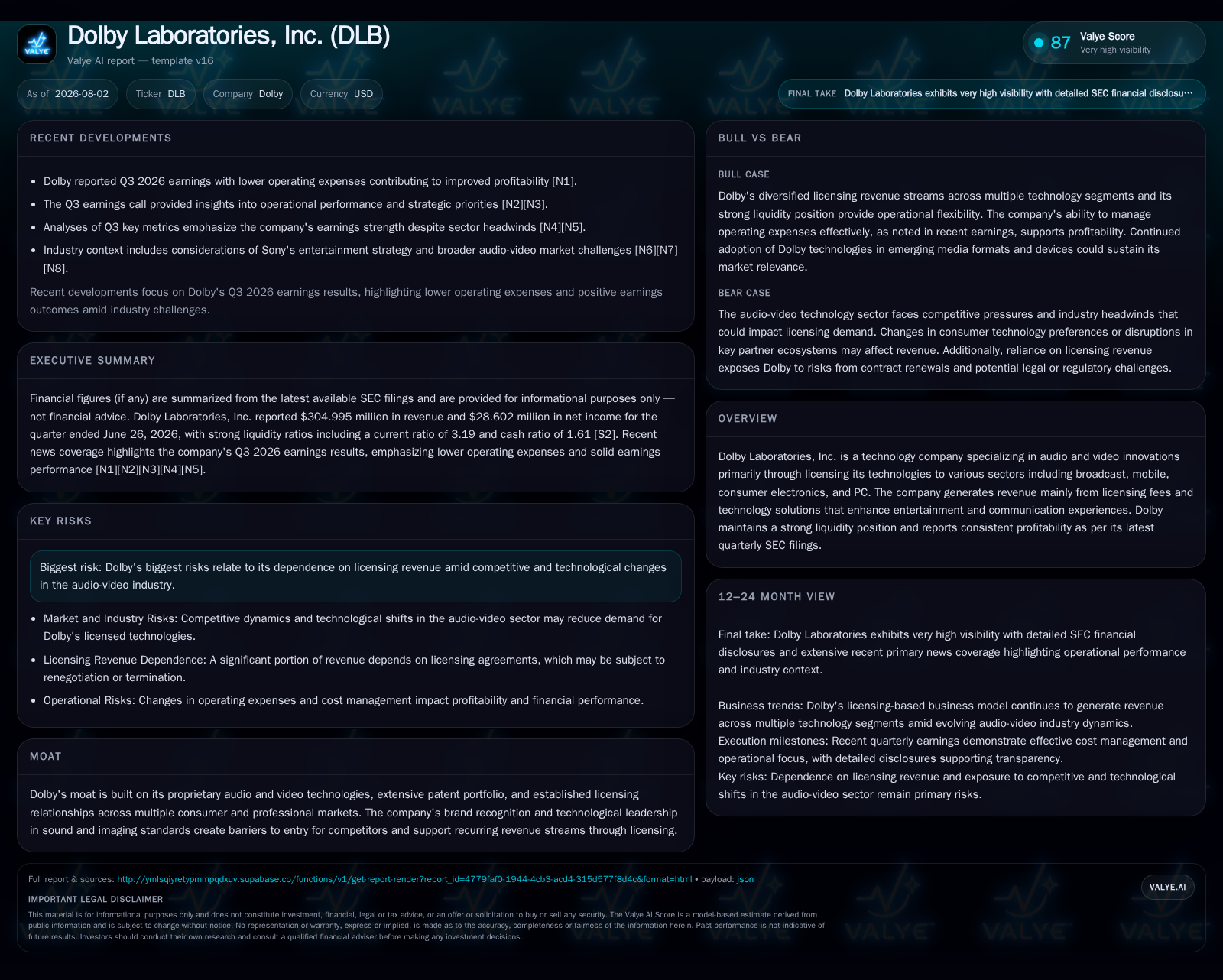
As of 2026-06-26, Dolby held $669 million in cash and equivalents with current assets totaling approximately $1.33 billion against current liabilities near $416 million, resulting in a current ratio of about 3.19x—indicating strong short-term liquidity and operational flexibility [F1]
These financial strengths provide management flexibility to absorb cyclical pressures on royalty flows while pursuing selective investments in innovation (R&D) and strategic initiatives like geographic expansion or new service offerings. Recent augmentations in stock repurchase authorization underscore confidence in sustainable cash flow generation despite macroeconomic uncertainties [S22]
This analysis synthesizes recent SEC disclosures emphasizing changes in revenue recognition practices alongside a deep review of Dolby Laboratories’ business model anchored by its intellectual property leadership. It evaluates emerging industry factors shaping demand for immersive multimedia experiences while highlighting financial robustness that supports execution resilience. Readers should note risks typical in IP-dependent technology licensors including royalty collection variability and competitive innovation threats require ongoing scrutiny.
This report is intended solely for informational purposes reflecting current disclosed evidence without advocacy for any investment decision.
Disclaimer: This is research-only, informational analysis and not investment advice. It may include AI-generated interpretation and general industry context. Always verify important details using primary sources.

Comments