
Kite Realty’s Sun Belt Focus and Capital Strategy Underpin Stable Retail REIT Growth
Kite Realty Group Trust leverages grocery-anchored, open-air retail centers with disciplined capital management to sustain occupancy and income strength in a challenging retail environment.
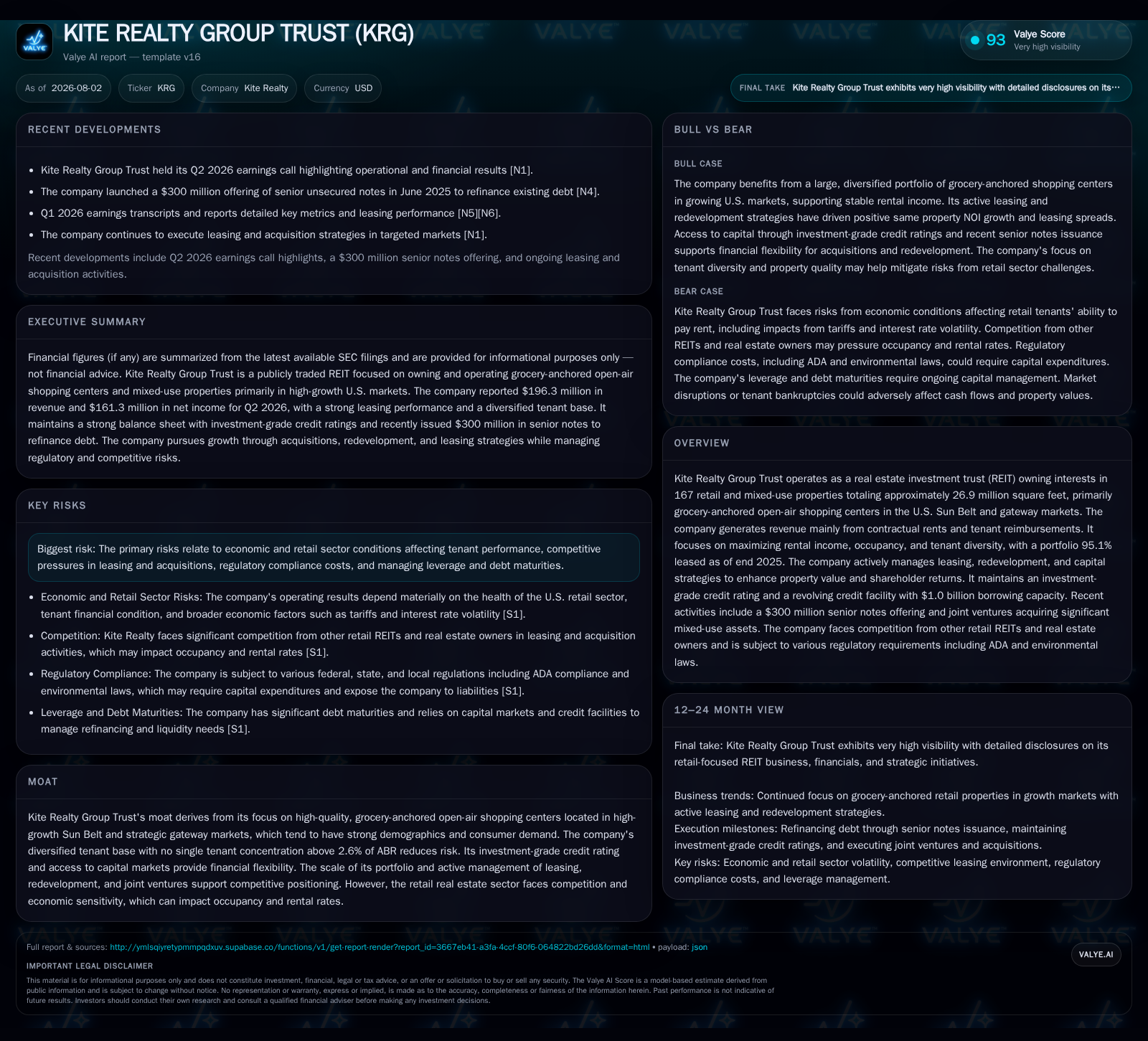
Kite Realty Group Trust's latest quarterly filing confirms its focus on high-quality grocery-anchored shopping centers primarily in the U.S. Sun Belt and gateway markets, maintaining strong portfolio occupancy near 95% with diversified tenant risk. The company actively advances leasing velocity, redevelopment, and joint ventures while managing a $3 billion debt load supported by investment-grade credit ratings and a recent senior notes offering. Operating metrics such as same-property NOI growth and leasing spreads indicate underlying resilience amid economic uncertainties. Its strategic capital recycling and selective acquisitions position it well relative to retail REIT peers navigating evolving consumer behaviors and interest rate volatility.
Recent Operating Update
s.
Financially, Kite fortified its liquidity profile through a $300 million exchangeable senior notes issuance in June 2026 at a fixed coupon of approximately 5.20%, proceeds of which partially refinanced maturing debt instruments and revolver borrowings [S3][S10]. The notes offer optionality by allowing exchanges into common equity or cash, furnishing additional capital structure flexibility. At quarter-end June 30, total consolidated debt stood near $2.85 billion against cash reserves of about $145 million, translating into net debt just over $2.7 billion [F1].
Business Model Overview
Kite operates as a Retail Real Estate Investment Trust (REIT) specialized in owning and managing predominantly grocery-anchored open-air shopping centers complemented by mixed-use developments within select U.S. regions [S1]. Its revenue derives principally from contractual base rents supplemented by tenant reimbursements for property-related operating expenses such as maintenance, taxes, and utilities — typical monetization mechanics for retail REITs where stable cash flow depends heavily on tenant occupancy quality.
The company's focus on grocery anchors boosts defensive tenancy because grocers are essential retailers less vulnerable to e-commerce substitution effects and contribute significantly to foot traffic benefiting co-tenants [S1]. This advantage helps mitigate vacancy risk relative to malls or non-anchored shopping centers facing more pronounced exposure to online retail disruptions.
Kite pursues proactive portfolio management encompassing leasing optimization, redevelopment of underperforming assets (including expansion or densification), strategic capital recycling via dispositions of non-core properties, joint ventures to share risk/capital cost, and targeted acquisitions within demographic growth corridors [S1][S12]. To maintain value enhancement potential, Kite emphasizes local market fundamentals such as accessibility and catchment area demographics alongside tenant mix diversification — keeping no single tenant above approximately 2.6% ABR concentration to reduce landlord dependence on individual credits [S1].
Industry Structure and Competitive Position
Within the broader retail REIT sector characterized by competition from peers like Regency Centers or Federal Realty Investment Trust focusing on similar grocery-anchored portfolios, Kite distinguishes itself through geographic concentration in faster-growing Sun Belt metros such as Dallas-Fort Worth, Miami, Atlanta, and parts of California [S1]. Such markets benefit from stronger population influxes and job creation trends that underpin consumer spending resilience — a critical demand driver for traditional brick-and-mortar retail venues.
While national grocery chains underpin leasing demand stability across the industry, REITs face mounting challenges from rising interest rates pressuring refinancing costs alongside evolving retailer footprints adapting omnichannel strategies [S1][S26]. Kite’s scale—owning interests in nearly three dozen million square feet—and intentional tenant diversification place it favorably compared to smaller regional operators focused narrowly on less diverse portfolios or mature markets lacking demographic tailwinds.
Its expanding joint venture activity further strengthens competitive positioning by leveraging partner capital expertise to acquire premier mixed-use retail assets like Legacy West ($785 million acquisition) while partially de-risking balance sheet exposure [S4]. In addition to organic growth via redevelopments such as The Corner–Indiana project moving into operation last year, these partnerships support portfolio rejuvenation aligned with lifestyle center trends compelling modern consumers.
Growth Drivers
Key drivers supporting Kite’s growth trajectory include persistent population and employment expansion within core Sun Belt regions fueling demand for convenience-oriented shopping options anchored by grocers [S1]. This geographical strategy offers resilience amid macroeconomic fluctuations impacting discretionary categories.
Embedding lease escalations successfully captured a same-property NOI increase nearing 3% in 2025 despite overall sector headwinds—primarily from contractual rents rising on renewals plus re-leasing spreads hitting over 20% for certain comparable new contracts [S1]. Incremental NOI contributions also derive from redeveloping underutilized assets where Kite repurposes anchor spaces or expands mixed uses to capture enhanced rental premiums.
Operational efficiency gains emerge from prudent expense control measures combined with sustainability initiatives targeting utility savings through LED lighting installation and expanded EV charging infrastructure rollout—both elevating asset attractiveness amongst tenants mindful of ESG considerations [S27].
Risks and Watchpoints
Despite stable fundamentals, Kite remains exposed to several sector-specific risks that merit scrutiny going forward:
- Economic fluctuations remain pivotal since downturns could depress discretionary spending adversely affecting tenant sales productivity and thus their ability to meet lease obligations on time [S1]
Monitoring execution against redevelopment timelines and joint venture pipeline progress will be critical for confirming expected asset value uplifts and capturing projected FFO accretion.
What To Watch Next
Key milestones that will inform Kite’s near-term trajectory include the pace of lease renewals expiring over the next few quarters given demonstrated leasing strength so far; rent collection trends reflective of tenant credit quality vis-à-vis macroeconomic shifts; progress on announced redevelopment projects transitioning into stabilized operations; incremental contribution from joint venture acquisitions closing or integrating assets; updates on hedging strategies related to interest rate exposure; announcements concerning capital deployments particularly if further public debt or equity raises occur; evidence of maintenance or improvement in occupancy percentages amidst sector-wide retailer rationalizations; indications from peer retail REIT earnings releases providing comparative context around NOI growth trends; any material changes reported in credit ratings that may affect borrowing costs [N1][N3][N6][S26]
Tracking these external markers alongside internal operational KPIs such as average lease term remaining, lease renewal rates, rental rate per square foot movements, core FFO performance metrics will reveal whether Kite continues navigating headwinds successfully or faces emerging constraints.
Financial Profile Discussion
As of June 30, 2026, Kite maintained total debt of approximately $2.85 billion balanced against cash reserves near $145 million resulting in net debt around $2.7 billion—a leverage level consistent with a large-cap retail REIT operating within an investment-grade rating framework [F1],[S4],[S7]. Earlier issuance of $300 million senior notes helped refinance higher-cost term loan maturities coming due this year.
Effective hedging programs help moderate variable rate exposure though residual risks persist [S5]. Because REIT status mandates dividend distributions approximating taxable income levels annually limiting retained earnings accumulation internally raising dependency on external financing sources aligns with its ongoing capital strategy utilizing equity offerings plus joint ventures prudently.
Overall liquidity appears sufficient at present though continued surveillance warranted given broader economy sensitivity effects on tenant performance translating into rental cash flow cyclicality affecting coverage ratios.[F1],[S25]
This analysis synthesizes publicly filed quarterly (10-Q) and annual (10-K) information together with recent event filings (8-K) without investment research views or price targets. It aims to provide a detailed understanding of Kite Realty Group Trust’s operating posture within the Retail REIT sector grounded strictly in disclosed data affirmed through SEC filings and reputable news sources.
Disclaimer: This is research-only, informational analysis and not investment advice. It may include AI-generated interpretation and general industry context. Always verify important details using primary sources.

Comments