
TriNet Navigates Regulatory Complexity While Expanding SMB HR Outsourcing Services
TriNet Group’s integrated PEO platform leverages co-employment to deliver bundled HR services, supported by robust liquidity and regulatory expertise amid evolving compliance challenges.
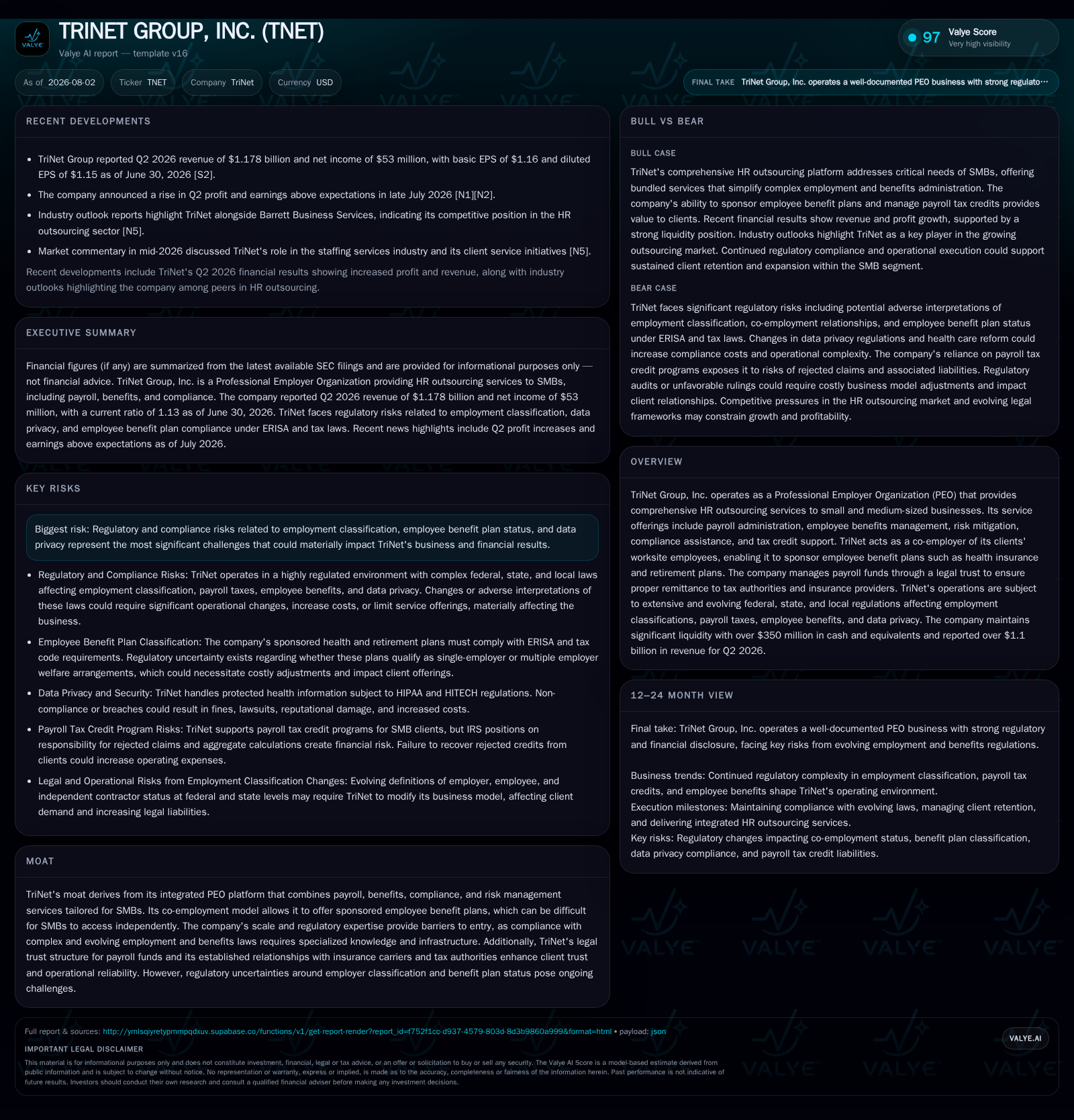
TriNet Group, Inc. reported solid second-quarter 2026 results with sustained growth in worksite employees and enhanced earnings outlook, driven by its comprehensive professional employer organization (PEO) platform serving small and medium-sized businesses (SMBs). The company’s co-employment model allows it to sponsor competitive employee benefits and mitigate complex regulatory risks, creating a defensible moat despite ongoing compliance uncertainties. TriNet maintains a strong liquidity position with over $350 million in cash and manageable debt maturities extending through 2031. Key growth drivers include increasing SMB demand for outsourced HR solutions amid rising employment law complexity, while risks center on regulatory classification and cybersecurity threats.
Recent Operating Update: Q2 2026 Performance Highlights
TriNet Group’s latest quarterly filing dated July 30, 2026, reveals a continuation of underlying business momentum in its PEO segment. The company reported a rise in average worksite employees (WSEs), a critical volume metric reflecting client hiring activity within its managed SMB base [S2]. This increase in WSEs directly boosts payroll volume processed—one of the primary revenue drivers since TriNet’s fees are largely pegged to payroll or headcount under bundled service agreements that include payroll administration, employee benefits management, compliance assistance, and risk mitigation.
Business Model: Integrated PEO Services with Co-Employment Advantage
TriNet operates as a Professional Employer Organization that assumes co-employment responsibilities of its clients’ worksite employees (WSEs). This arrangement allows TriNet to legally sponsor group employee benefits including health insurance and retirement plans that leverage scale economics typically unavailable to smaller firms [S1]. The package is comprehensive — beyond payroll processing — including risk mitigation strategies such as employment practices liability insurance (EPLI) coverage and tax credit support like Employee Retention Tax Credits (ERTC).
Revenue arises principally from fees charged on payroll volume or per-WSE basis under long-term contracts with SMB clients. These contracts combine multiple services into an integrated bundle featuring payroll funds trust custody to ensure remit accuracy for taxes and insurance premiums. The trust structure reinforces operational reliability while also satisfying stringent regulatory demands around fiduciary handling of client funds.
This business model faces operational complexities because TriNet must comply with multifaceted federal, state, and local employment laws governing employer status determinations, employee classifications (full-time vs. contractor), wage/hour regulation, benefits administration under ERISA/HIPAA standards, and myriad reporting/taxation requirements. Successfully navigating this evolving compliance landscape requires specialized expertise that constitutes a substantial barrier to entry for new competitors.
Industry Structure & Competitive Position
The PEO industry serves an essential intermediary role between SMB employers seeking simplified HR outsourcing solutions and the intricate web of regulatory mandates on employment practices. Providers like TriNet compete alongside other integrated PEOs including ADP TotalSource and Insperity as well as HRO vendors offering narrower service portfolios. Unlike pure payroll processors or employee benefits brokers, full-service PEOs gain differentiation from their co-employment legal status enabling benefit plan sponsorship.
TriNet’s competitive moat is fortified by scale—over millions of WSEs served nationally—and deep regulatory know-how embedded in its proprietary platform infrastructure. Its ability to aggregate risk across a broad SMB client base supports negotiating competitive group insurance pricing (better Insurance Cost Ratios) which translates into more attractive offerings for end clients. Meanwhile, its comprehensive compliance assistance reduces client risk exposure—a key intangible asset rarely replicated by smaller vendors or software-only HRIS providers.
However, the complex regulatory environment creates persistent uncertainty that all PEOs contend with—including potential reclassification challenges that could disrupt co-employment models or require costly modifications to benefit plans. Effective cyber risk management is also critical given the sensitive nature of personal health information (PHI) handled under HIPAA rules within its sponsored plans.
Growth Drivers
Several secular trends underpin TriNet’s growth prospects:
- Increasing legal complexity surrounding employment classification incentivizes SMBs to outsource HR functions rather than maintain costly in-house controls.
- Growing demand among SMB clients for comprehensive employee benefits packages amid competitive labor markets drives uptake of sponsored plans through PEOs.
- Expansion of remote/hybrid work arrangements adds complexity that elevates value proposition for integrated compliance and payroll solutions.
- Rising awareness of tax credit opportunities such as the ERTC motivates leveraging PEO-administered tax credit support services.
- Adoption of technology platforms enabling scalable delivery enhances user experience for both clients and their employees accessing HR services digitally.
- Geographic expansion into states with conducive regulatory climates further broadens addressable markets.
Monitoring KPIs including average WSE growth rates, client retention metrics, payroll volume processed, revenue per WSE, insurance cost ratios (ICR), and tax credit utilization offers insight into how these growth drivers translate into financial performance.
Risks & Growth Constraints
Regulatory risks remain the paramount threat. Employment-related legislation can alter co-employment frameworks or introduce new requirements affecting sponsored benefit plans [S1]. Ambiguity or adverse interpretations may lead to litigation or increased compliance costs reducing margin resilience.
Cybersecurity threats targeting sensitive data represent another material operational risk given the extensive PHI handled through health plans. While TriNet has invested heavily in layered cybersecurity programs overseen by dedicated executives and reinforced through third-party vendor controls and employee training regimes [S1], emerging threats require continuous vigilance.
Client churn poses commercial risk especially if competitors offer narrower but cheaper outsourcing alternatives or if perceived service quality degrades. Economic downturns impacting SMB hiring dynamics can also limit new WSE growth temporarily given direct correlation between employment levels and fee-generating payroll volumes.
Dependence on insurance carriers for workers' compensation rates or EPLI coverage exposes TriNet to external pricing volatility pressures which may impair insurance cost ratios affecting profitability.
What To Watch Next
Key upcoming operational milestones include quarterly updates on:
- Average WSE count trajectory—especially seasonally sensitive new client additions early in calendar years—as this directly scales fees.
- Client retention rates signaling stickiness against alternative outsourcing options.
- Development or changes in employment classification legislation or IRS/Department of Labor guidance impacting co-employment status.
- Insurance cost ratio trends reflecting effectiveness of risk mitigation efforts versus market rate shifts.
- Cybersecurity incident disclosures or enhancements indicating resilience against evolving threats.
- Platform user access fee growth as additional users within client organizations adopt TriNet’s digital tools signaling deeper ecosystem embedding.
- Progress on geographic market expansions supporting diversification.
Close monitoring of debt maturities relative to available liquidity supplies insight on capital structure flexibility supporting potential acquisitions or technology investments necessary to sustain competitive advantage [S2]
Financial Profile Discussion
As of June 30, 2026, TriNet holds $358 million in cash and equivalents alongside approximately $2.38 billion in current assets versus $2.11 billion in current liabilities—yielding a current ratio of about 1.13 indicating moderate short-term liquidity cushion [F1]. The company’s total reported debt includes senior unsecured notes consisting of $500 million maturing March 2029 and $400 million due August 2031 supplemented by a revolving credit facility up to $700 million amended as recently as August 2023 providing ample borrowing capacity [S2]. Net debt after subtracting cash approximates a low $37 million at last best estimate date [F1].
This healthy balance sheet supports ongoing investment in platform development, cybersecurity defenses, benefit plan administration capabilities, and sales/marketing initiatives aimed at expanding the SMB client base while maintaining prudent capital allocation policies that avoid excessive leverage typical in more capital-intensive sectors.
Profitability has seen some pressure recently related to stock-based compensation expense scaling with growth investments alongside macroeconomic inflation impacts on insurance premiums reflected somewhat in insurance cost ratios partially offsetting fee uplift from WSE volume gains [S1]. Adjusted EBITDA margin contraction from prior years suggests efficiency improvement remains an execution focus.
Overall, the financial structure positions TriNet well amidst industry complexity enabling endurance through regulatory cycles that might disrupt smaller or less diversified peers.
Disclaimer: This analysis is based on publicly available filings [S1][S2][S3], company facts snapshots [F1], recent news reports [N1], industry context knowledge layers, and does not constitute investment advice.
Disclaimer: This is research-only, informational analysis and not investment advice. It may include AI-generated interpretation and general industry context. Always verify important details using primary sources.

Comments