
IRadimed Strengthens Position with MRidium 3870 Launch Amid MRI-Compatible Device Growth
IRadimed's latest quarterly update highlights firm momentum in specialized MRI-compatible infusion pumps and monitoring devices amid robust industry growth.
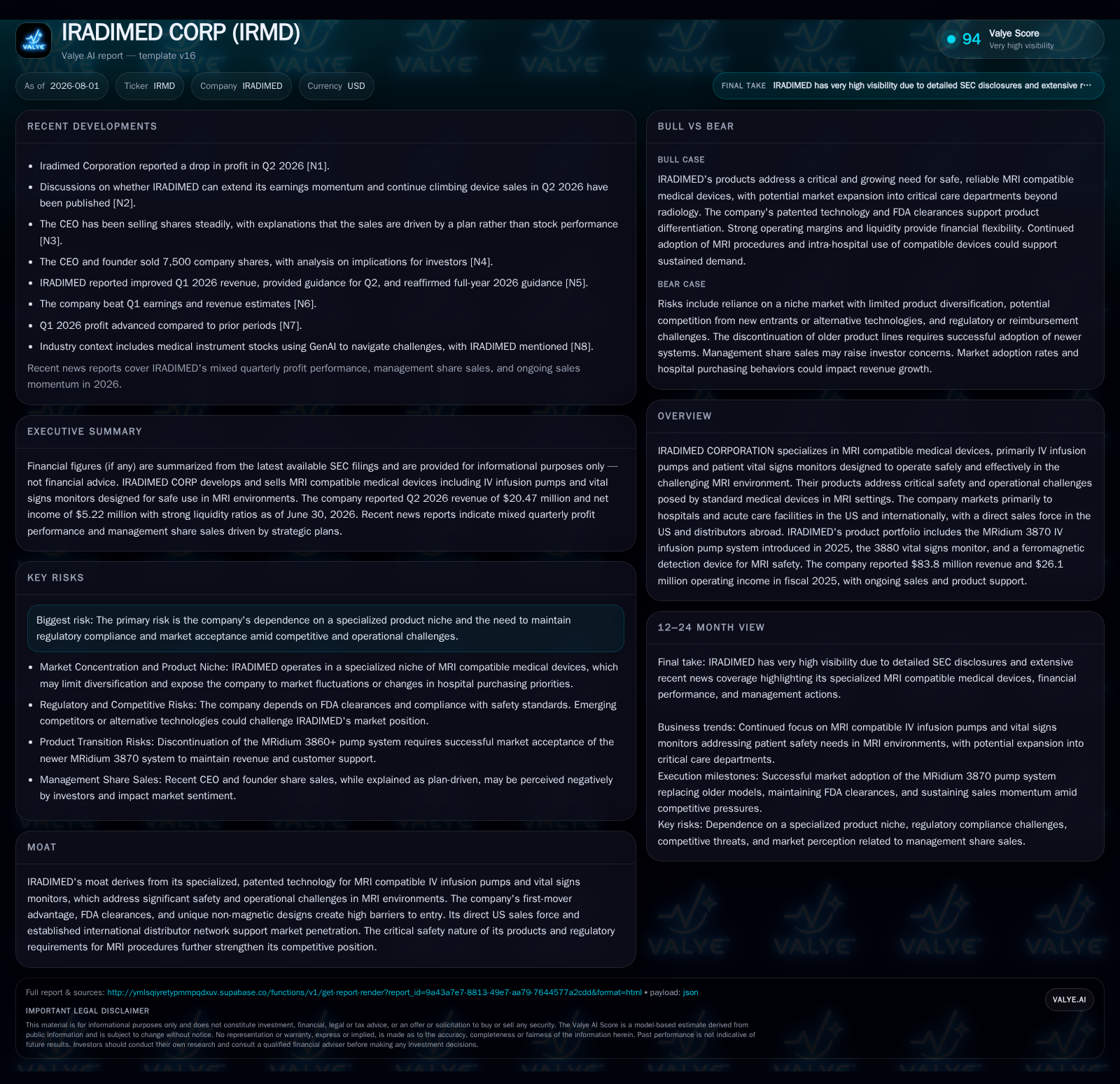
IRadimed Corporation’s July 2026 quarterly filings reveal continued execution in its niche of MRI-compatible medical devices, driven by full-year revenue of $83.8 million and operating income of $26.1 million in 2025. The company’s recently launched MRidium 3870 IV infusion pump system represents a leap in non-magnetic design for safe use inside strong MRI fields, underpinning its competitive moat built on patented ultrasonic motor technology and FDA clearances. IRadimed’s direct US sales and international distributors support steady growth in acute care facilities. Key risks remain regulatory compliance, concentrated market focus, and supply of specialized components. The high current ratio and ample cash provide operational flexibility as the company invests selectively to capitalize on rising MRI procedure volumes and safety demands.
Recent Operating Update
Business Model Overview
IRadimed operates exclusively within the MRI-compatible medical devices subsector, designing and manufacturing equipment that safely functions inside high-strength magnetic fields prevalent in MRI environments. Their flagship products center on intravenous (IV) infusion pump systems — notably the MRidium 3870 introduced in 2025 — featuring patented non-magnetic ultrasonic motors and proprietary non-ferrous components which uniquely address radio frequency interference risks inherent to conventional infusion pumps during MRI scans [S1]
Besides these pumps, IRadimed offers patient vital signs monitors such as the Model 3880 and ferromagnetic detection devices aimed at preventing dangerous magnetic object introductions into MRI rooms. The company monetizes through direct device sales to hospitals and acute care facilities primarily in the US market via a dedicated field sales force supplemented internationally by a network of distribution partners [S1]. Recurring revenue arises from disposable IV tubing sets integral to pump operation alongside warranty and service contracts
The key customer decision factors revolve around safety compliance mandated by regulatory bodies like the FDA, performance reliability under strong magnetic interference, ease of integration into existing clinical workflows (e.g., remote display units enabling controls from outside the MRI chamber), and post-sale technical support. IRadimed’s solution addresses critical clinical needs where patients cannot be disconnected from life-supporting medications during scans — a use case demanding both technological innovation and stringent quality assurance.
Industry Structure and Competitive Position
The MRI-compatible medical device industry is highly specialized due to stringent regulatory pathways requiring exhaustive safety validation and FDA clearances before market entry. This creates significant barriers to entry centered on intellectual property protection (patents on ultrasonic motors/non-ferrous mechanical designs), clinical trial data supporting device safety/effectiveness, and comprehensive manufacturing control systems demonstrating compliance under FDA’s Total Product Life Cycle guidance for infusion pumps [S1,S10]
Within this framework, IRadimed benefits from a first-mover advantage with its MRidium system being one of the only known non-magnetic IV infusion pump platforms cleared for operation within MRI systems up to 15,000 gauss — a magnetic field strength exceeding many competitor offerings partially reliant on metal shielding or restricted use cases.[S1]
Peers such as Baxter International excel broadly at infusion technology but lack an exclusive focus or patented technology targeting MRI compatibility. Similarly, Masimo provides critical care monitoring but their devices generally are not tailored specifically for safety inside MRI rooms. Large diversified medtech firms like Medtronic or GE Healthcare engage tangentially in compatible products but without deep specialization or direct field sales presence focused on this niche. Hence IRadimed’s direct-sales model combined with international distributors enables targeted penetration into hospital acute care units where procedures requiring simultaneous imaging and therapy occur.
Growth Drivers
Multiple secular trends bolster demand for IRadimed’s offerings:
- Rising global MRI scan volumes driven by increasing diagnostic reliance across oncology, neurology, pediatrics, and critical care sectors require compatible devices that maintain continuous medication delivery during imaging.
- Regulatory emphasis on patient safety standards during MRI procedures incentivizes hospital upgrades or replacements of incompatible infusion systems.
- Technological advancements enable more reliable ultrasonic motors with smaller footprints suitable for non-ferromagnetic pump designs.
- Expansion of hospital infrastructure worldwide creates larger addressable markets both domestically and internationally.
- Broader adoption in sensitive populations such as sedated infants necessitates dependable remote-control capable infusion systems minimizing scan disruptions.
These drivers translate into KPIs emphasizing unit sales volume growth of MRidium units and complementary disposables alongside recurring revenue uplift from service contract renewals and regional distributor activation metrics.
Risks and Constraints
IRadimed faces several intrinsic risks stemming mainly from its narrow specialization:
- Regulatory approvals constitute a continuous operational hurdle; delays or denials can materially disrupt product launches or extensions affecting topline momentum [S7].
- Innovation risk looms large with rapid technology evolution potentially rendering existing patents or designs obsolete if competitors develop superior alternatives.
- Supplier dependence on sole-source components critical for non-magnetic motor assembly exposes the firm to supply chain volatility.
- Market concentration risk exists given reliance on US hospital acute care segments while international expansion may encounter reimbursement complexities and distribution channel challenges.
- Pricing pressures may intensify amid global healthcare cost containment initiatives impacting ASPs (average selling prices) achievable.
- Intellectual property litigation against or from competitors remains a latent threat given active patent landscapes surrounding specialized infusion technologies [S19].
- Operational risks around maintaining high-quality manufacturing standards compliant with evolving FDA requirements also warrant ongoing investment.
What to Watch Next
Key milestones that will provide insight into IRadimed’s trajectory include:
- Quarterly updates confirming sustained unit shipment growth for MRidium series devices.
- Progress on new product development cycles especially enhancements reducing deployment cycle times or expanding remote monitoring capabilities.
- Regulatory milestones particularly clearance for any pipeline products or significant modifications extending use cases or markets.
- Geographic expansion indicators reflecting increased traction among non-US distributors or entry into emerging healthcare systems.
- Service contract renewal rates signaling strong post-sale engagement supporting recurring revenue expansion.
- Sales force productivity metrics revealing efficiency improvements balanced against commission cost escalations currently impacting margin dynamics [S4]
Financial Profile Discussion
As of June 30, 2026, IRadimed exhibits strong financial liquidity with cash and equivalents totaling approximately $59 million against current liabilities near $9.16 million, resulting in a very healthy current ratio of about 9.46 that underscores significant short-term financial flexibility [F1]. This capital position supports ongoing research & development spending (~3.5% of revenues) focused on sustaining product innovation while managing operating expense growth driven by higher sales commissions and payroll associated with scaling efforts [S4][S18].
In context, this financial structure aligns well with typical profile of an innovator-focused niche medtech firm balancing product lifecycle investments against sustainable profitability underpinned by stable recurring revenue streams from consumables and technical support contracts.
This analysis synthesizes publicly available SEC filings up to July 31, 2026; it aims to contextualize IRadimed Corporation's strategic positioning within the highly regulated segment of MRI-compatible medical devices without speculative forward guidance or unverified assertions about undisclosed market shares or customer relationships.
Disclaimer: This is research-only, informational analysis and not investment advice. It may include AI-generated interpretation and general industry context. Always verify important details using primary sources.

Comments