
Mid-America Apartment Communities Confronts Same-Store NOI Contraction Amid Market Pressures
MAA’s Q2 2026 report highlights a near flat-to-downward same-store net operating income trajectory, reflecting sector-wide rental market challenges.
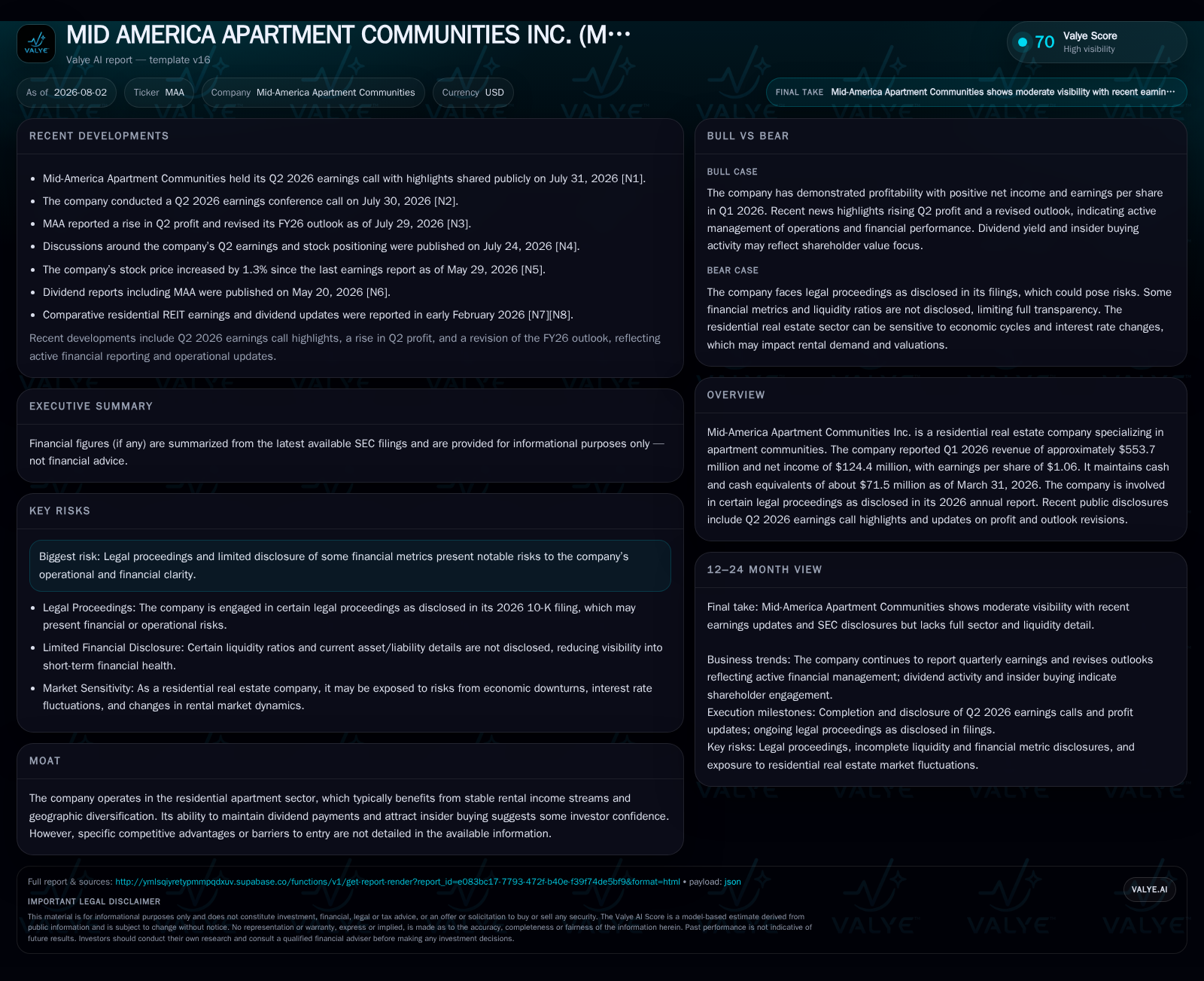
Mid-America Apartment Communities Inc. reported Q2 2026 results showing a slight contraction in same-store net operating income (NOI), with occupancy and rent growth pressures impacting earnings. The company operates as a multifamily residential REIT, generating rental income from a geographically diversified portfolio. While maintaining positive cash flow and steady dividend payouts, MAA faces risks from legal proceedings and a challenging economic environment affecting tenant demand and leasing dynamics. Key growth drivers include demographic trends supporting rental demand and property renovations, but near-term performance exhibits softness relative to historical norms.
Recent Operating Update
occupancy.
Business Model
MAA functions primarily as a multifamily residential real estate investment trust (REIT), generating revenue through rental income collected from tenants residing in its apartment communities. The monetization mechanics revolve around lease agreements that yield rental payments, with revenues closely linked to occupancy rates, average rents per unit, lease renewal spreads, and tenant turnover rates. The company achieves cash flow stability by owning a geographically diversified property portfolio across urban and suburban markets, thus balancing localized economic influences.
Its business strategy includes active asset management—acquiring properties, executing capital expenditures to renovate or reposition assets, enhancing tenant retention through improved amenities or customer service, and selectively disposing of non-core holdings to optimize portfolio quality and cash generation [S1]. These activities deliberately target net operating income growth via increased rental rates and enhanced occupancy while controlling operational expenses. Importantly, MAA distributes earnings predominantly as dividends to shareholders, relying on metrics such as funds from operations (FFO) and adjusted FFO (AFFO) as proxies for dividend sustainability.
Industry Structure and Competitive Position
The residential apartment REIT sector is characterized by recurring revenue streams underpinned by leased multifamily properties to diverse tenant bases typically composed of individuals or families seeking rental housing alternatives. These companies must manage exposure to cyclical demand shifts driven by macroeconomic factors including employment trends, population migration patterns, affordability constraints favoring renting over ownership, and local regulatory regimes affecting rent adjustments.
Within this landscape, MAA occupies the owner-operator role focused on multi-family assets where geographic diversification is an essential mitigation against market-specific volatility. Compared to peers like Equity Residential (EQR) — known for urban high-end portfolios — and AvalonBay Communities noted for balanced geographic exposure with quality assets, MAA competes on property scale, location attractiveness, renovation effectiveness, and lease management efficiency.
The competitive basis hinges on achieving superior occupancy levels close to or above industry averages (~94-96%), maintaining lease renewal rates that support upward rent revisions amid tenant retention challenges, managing expenses effectively to protect NOI margins, and prudent capital deployment for acquisitions or upgrades aimed at generating accretive returns.
Growth Drivers
Several structural tailwinds support mid-to-long-term growth prospects for MAA’s apartment portfolio:
- Demographic shifts: Continued population growth in key markets along with urbanization trends fuel sustained rental housing demand.
- Affordability constraints: Rising home prices keep ownership out of reach for many households, increasing the pool of renters seeking stable apartment communities.
- Limited new supply: Regulatory hurdles constraining new apartment construction in many locales reduce oversupply risks that could depress rents.
- Strategic renovations: Targeted capital investments improve property appeal allowing for higher leasing spreads upon renewal or new leases.
- Geographic expansion: Entering high-growth regions expands addressable tenant demand beyond traditional markets with slower economic growth.
- Improved tenant retention: Enhanced amenities and customer service initiatives reduce turnover rates lowering vacancy duration costs.
- Macroeconomic environment: Employment growth spurs household incomes supporting incremental rent affordability gains.
These drivers collectively aim to bolster same-store NOI expansions—a critical measure reflecting operational health independent of portfolio churn through acquisitions or dispositions.
Risks and Watchpoints
Multiple risks warrant attention as they may constrain MAA’s performance:
Monitoring these factors is essential to understanding future cash flow stability and dividend capacity.
What to Watch Next
Investors should focus on several upcoming markers:
- Same-store NOI updates: Future quarters will reveal if the revised slight contraction is a transient blip or reflects sustained softness.
- Occupancy rate trends: Stabilization or improvement will signal healthier leasing dynamics supportive of revenue resilience.
- Lease renewal spreads: Positive momentum here would indicate pricing power despite competitive pressures.
- Capital deployment activity: Acquisition volumes versus disposition proceeds offer insight into portfolio optimization execution.
- Refinancing milestones: Any debt coming due amid volatile credit markets will test balance sheet robustness.
- Legal case developments: Resolution outcomes might mitigate uncertainty impacting valuation multiples or borrowing terms. -Earnings call commentary provides qualitative color on tenant demand shifts and management’s strategic adjustments [N1][N2]
Financial Profile Discussion
Prudent capital structure management coupled with disciplined operational execution will be critical as MAA navigates evolving market conditions over the remainder of fiscal year 2026.
This analysis provides an informed perspective on Mid-America Apartment Communities’ recent operating performance within the broader residential apartment real estate context without providing investment research views.
Disclaimer: This is research-only, informational analysis and not investment advice. It may include AI-generated interpretation and general industry context. Always verify important details using primary sources.

Comments