
Tyson Foods’ Latest Quarter Reveals Margin Pressures and Strategic Resilience
Q3 2026 results illustrate the impact of volatile commodity costs on margins, balanced by Tyson’s supply chain scale and cybersecurity governance.
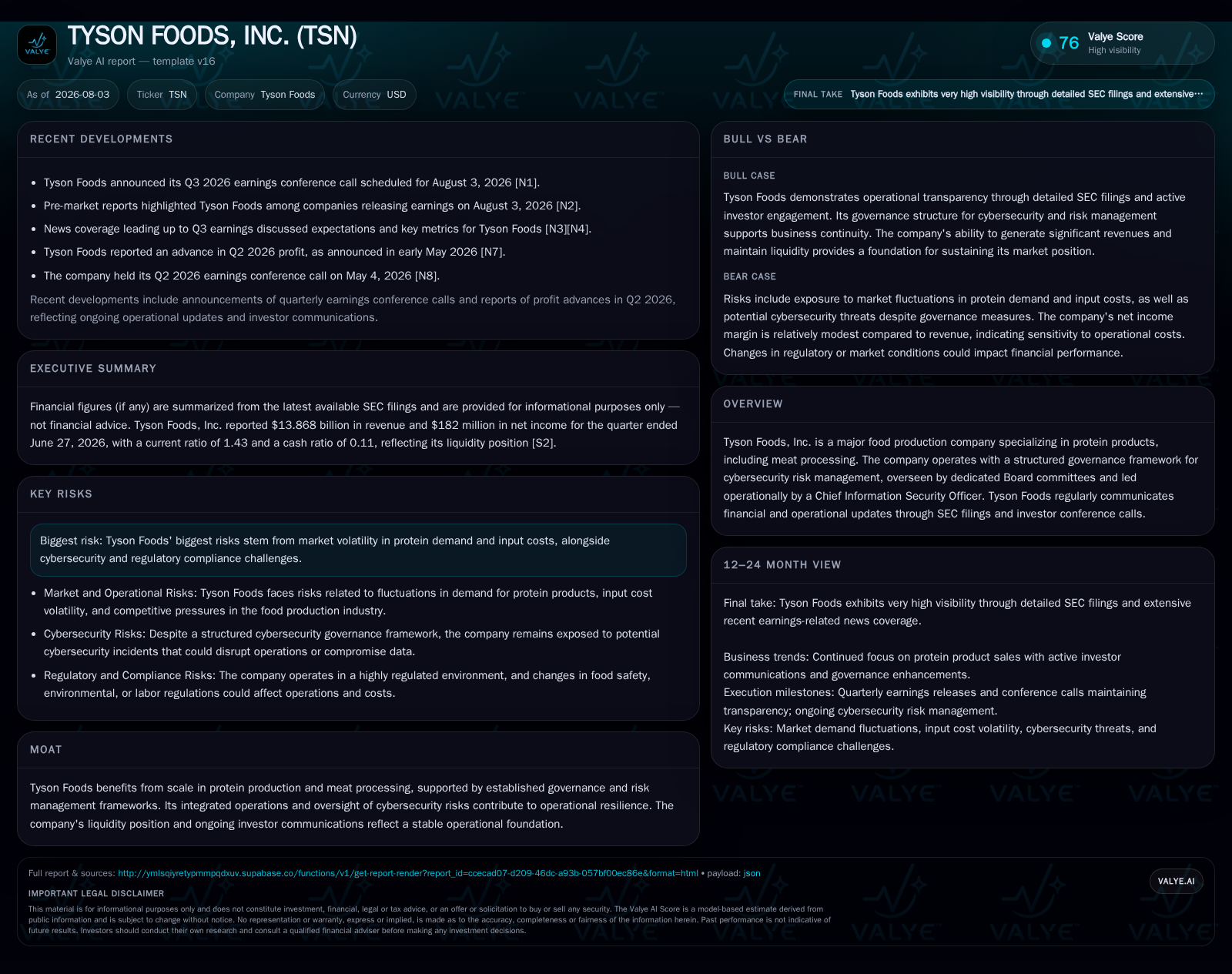
Tyson Foods reported Q3 fiscal 2026 results showing ongoing margin pressures from rising input commodity costs despite stable production volumes, reflecting the sensitivity of protein processing to livestock and feed prices. However, the company’s integrated supply chain operations continue to provide scale economies that buffer some cost volatility. Additionally, Tyson’s comprehensive cybersecurity risk framework underscores its focus on operational resilience amid sector-specific threats. Looking ahead, product mix diversification and efficiency initiatives underpin growth prospects, even as regulatory and labor risks persist.
Q3 2026 Operating Update: Margin Volatility Meets Structural Strength
Tyson Foods’ Q3 fiscal 2026 filing dated August 3 reveals revenue performance slightly lagging expectations amid notable margin pressure driven primarily by surging commodity input costs [S2][N1]. Despite relatively stable production volumes in the core protein processing business—measured by tons processed and yield rates—the operating income suffered compression due to livestock cost inflation and feed price volatility that materially increased costs of goods sold. The company maintained solid food safety compliance metrics during this quarter with no significant incidents reported, an essential factor given regulatory scrutiny in meat processing [S2]. This snapshot underscores Tyson's exposure to cyclical commodity swings inherent in integrated protein production but also highlights operating resilience sustained by scale.
Integrated Supply Chain Depth as a Competitive Shield in Protein Production
Tyson Foods operates within the broader food production and meat processing industry as an integrated processor positioned between livestock producers and end customers such as retailers, foodservice providers, and wholesale channels [S1]. Its vertically integrated supply chain—from livestock sourcing through processing plants to packaging and multi-channel distribution—creates scale economies essential for mitigating the impact of volatile commodity inputs [S1]. Compared with peers like JBS and Hormel Foods, Tyson exhibits comparable breadth in operational scale and integration level, enhancing purchasing leverage for livestock procurement and optimizing logistics costs. This integration not only drives operational efficiency but also supports consistent supply fulfillment rates critical to customer retention across retail grocery chains and large foodservice accounts.
Product Mix Dynamics and Pricing Strategy amid Commodity Cost Swings
The company’s protein portfolio diversified across beef, pork, and poultry segments creates a natural buffer against single-commodity price shocks [S1][S2]. For example, fluctuations in cattle or hog prices can be partially offset by volume or price adjustments in poultry products where feedstock cost dynamics differ. Tyson leverages this product mix diversity alongside strategic pricing initiatives aimed at passing on input cost increases without substantially eroding demand among foodservice or retail customers. The quarterly disclosures suggest continued efforts to balance pricing power with market share preservation amid competitive pressures [S2]. Such flexibility is critical given razor-thin operating margins common in meat processing industries influenced heavily by external commodity cycles.
Cybersecurity Risk Management: An Emerging Operational Priority
Beyond physical processing operations, Tyson Foods emphasizes stringent cybersecurity risk management overseen by dedicated Board committees including the Governance and Nominating Committee as well as a Technology Committee tasked with aligning cyber strategies to business priorities [S1]. The company’s Chief Information Security Officer (CISO), who has led the information security function since 2016 and reports to the Chief Technology Officer appointed in 2025, heads a multifaceted security program covering governance, identity management, cloud infrastructure security, vulnerability management, and incident response [S1]. This comprehensive framework reflects recognition that increasingly digitized operational technology environments in meat processing are vulnerable targets for cyberattacks which could disrupt production or compromise sensitive data. Frequent reporting protocols from CISO to senior management ensure swift escalation of incidents surpassing predefined thresholds.
Growth Outlook: Innovation, Market Demand, and Efficiency Initiatives
The long-term growth drivers for Tyson Foods align closely with rising global protein consumption trends driven by population growth and dietary shifts favoring animal proteins [S1][N10]. Additionally, expansion into value-added prepared foods segments leverages consumer demand for convenience while offering higher-margin opportunities relative to commoditized cuts. The company has signaled investment in operational technology adoption aimed at boosting efficiency through automation or enhanced logistics coordination [S1]. While geographic expansion efforts beyond core U.S. markets are less emphasized in recent filings, the broad product mix innovation pipeline including exploration into alternative proteins complements traditional lines. Recent narrowing of fiscal year sales growth outlook suggests cautious optimism tempered by near-term market volatility [N10].
Risks on the Horizon: Commodity Prices, Regulatory Compliance & Labor Dynamics
Industry-standard risks prominently highlighted include volatility in feed ingredients such as corn and soybean meal impacting livestock feed costs alongside fluctuations in live animal market prices directly influencing cost bases [S1][S2]. Regulatory tightening related to environmental controls on waste emissions from livestock operations as well as evolving labor regulations potentially increasing wage expenses represent material headwinds. The meat processing sector’s capital intensity demands careful capacity utilization management; wage inflation has been cited as a constraint on labor supply availability affecting throughput levels. Food safety recall risks remain ever-present with increased government vigilance further raising compliance costs. These factors combined represent ongoing operating challenges requiring active mitigation.
Key Milestones to Monitor: Upcoming Guidance and Operational Indicators
Future investor attention should focus on subsequent quarterly earnings reports where production volume updates will serve as an indicator of underlying demand stability or fluctuation amidst macroeconomic pressures [N2]. Margin trajectory signals will be closely watched for evidence of cost absorption improvement via pricing adjustments or input cost normalization. Food safety audit results also remain key milestones that affect reputation risk profiles. Updates on regulatory compliance status or labor negotiations could materially influence capacity utilization or cost structures. Any revision of full-year sales guidance will be a critical near-term event reflecting the company's ability to navigate current macroeconomic volatility effectively.
Financial Profile Discussion: Liquidity Stability Amid Capital Intensity
As of quarter-end June 27, 2026, Tyson Foods reported cash and cash equivalents totaling approximately $740 million against total debt near $6.58 billion yielding net debt around $5.84 billion while maintaining a current ratio of roughly 1.43 [F1]. This liquidity position indicates sufficient short-term asset coverage over liabilities supporting working capital needs inherent in procurement of commodities like livestock feed or managing receivables from wholesale channels. Although leverage remains elevated reflecting capital-intensive facilities required for slaughtering, processing lines, packaging plants and distribution networks typical for major meat processors such as Pilgrim's Pride or Hormel Foods; the balance sheet structure appears aligned with sustaining ongoing operational investments given steady cash flow generation documented historically in filings [F1][S2]. Maintaining disciplined debt management will be important considering cyclical profit swings tied closely to commodity market behavior.
This analysis synthesizes Tyson Foods’ recent quarterly disclosures with broader industry context emphasizing how structural advantages such as vertical integration and product diversification mitigate inherent commodity price volatility risks faced by large-scale protein producers. The company’s strong cybersecurity governance further reflects forward-looking resilience planning vital to protecting complex processing operations exposed to increasing digital vulnerabilities. Growth prospects rest on balancing innovation-led product offerings with efficient execution amid persistent regulatory challenges and labor market constraints that shape capacity utilization dynamics.
Disclosure: The information presented herein is based solely on publicly available filings dated up to August 3, 2026 ([S1], [S2], [S3]) supplemented by relevant news coverage ([N1]–[N14]) without any endorsement or research view.
Disclaimer: This is research-only, informational analysis and not investment advice. It may include AI-generated interpretation and general industry context. Always verify important details using primary sources.

Comments